India’s Flavorful M&E Edge
By Pickle April 3, 2025
Share:


At NAB 2025, India’s presence is stronger than ever, showcasing the country’s vast potential, technological advancements, and policy-driven initiatives aimed at fostering growth in the industry.
India’s media and entertainment (M&E) sector is experiencing an unprecedented transformation, emerging as a global powerhouse driven by innovation, government initiatives, and strategic collaborations.
The sector has witnessed a compounded annual growth rate (CAGR) of 10-12% over the past decade, making it one of the fastest-growing industries in the world.
According to a recent EY-FICCI report, the industry is expected to reach $70 billion by 2030, driven by increased digital consumption, expanding broadband penetration, and rising disposable incomes. The OTT market alone is projected to touch $15 billion by 2030, positioning India as one of the largest digital entertainment markets globally.
The sector comprises over 900 television channels, 40+ OTT platforms, and nearly 1,200 FM radio stations. The demand for regional content is also surging, with vernacular OTT platforms seeing 40% year-on-year growth, further contributing to the expansion of the industry.
At NAB 2025, India’s M&E industry stands tall, offering a compelling mix of creativity, technology, and market opportunity.
Prime Minister’s Vision: Creating a Global M&E Powerhouse
Prime Minister Narendra Modi has emerged as a champion of India’s media and entertainment (M&E) sector, reinforcing his vision of ‘Create in India for the World.’ Under his leadership, India has positioned itself as a global powerhouse in content creation, leveraging its rich cultural heritage, skilled talent, and technological prowess.
PM Modi’s strategic push for India’s creative industries has led to transformational initiatives such as WAVES (World Audio-Visual Entertainment Summit), which amplifies India’s role in global AVGC (Animation, Visual Effects, Gaming, and Comics) leadership. His strong advocacy for ‘Create in India for the World’ has accelerated the international success of Indian content, fostering cross-border collaborations, opening new markets, and driving exponential growth in exports of films, digital media, and gaming.
India Cine Hub: The Evolution of Film Facilitation Office (FFO)
Rebranded as India Cine Hub, the former FFO continues to streamline filming processes, attract foreign productions, and position India as a premier destination for international film and content production. Enhanced incentives, simplified regulations, and single-window clearances have further bolstered India’s appeal for global filmmakers.
The Hub, established by the Ministry of Information & Broadcasting, Government of India, is a key initiative to promote and facilitate film shootings in India for both global and Indian filmmakers. Operated under the National Film Development Corporation (NFDC), it serves as a single-window clearance system to streamline the process of obtaining permissions, accessing resources, and exploring India’s diverse filming locations.
The ICH aims to make India an attractive destination for film production by offering support for feature films, TV/web shows, series, and co-productions. It provides services like script evaluation, liaison officer support (with expenses borne by the government if assigned), and assistance with local permissions.
The Indian Institute of Creative Industry: Bridging the Skill Gap
The upcoming Indian Institute of Creative Industry (formerly NCoE) will serve as a premier institution catering to AVGC professionals. With a hub-and-spoke model, it aims to provide cutting-edge training, research, and international collaborations, ensuring India remains a talent hub for the global M&E industry.
The IICT is envisioned as a premier institution akin to the Indian Institutes of Technology (IITs), but focused on creative technology. It will be located in Mumbai’s Film City, Goregaon, with a financial allocation of Rs 400 crore from the central government. The institute aims to drive innovation in fields like film production, digital content, visual effects (VFX), animation, audio-visual storytelling, media innovation, and Web 3.0 technologies.
It’s part of a broader push to position India as a global hub for the creative economy. The IICT will not only be an educational institution but also a center for cutting-edge research and industry collaboration, with regional hubs planned in cities like Hyderabad.
State Policies Driving AVGC Growth
Several Indian states are strategically establishing themselves as hubs for Animation, Visual Effects, Gaming, and Comics (AVGC) by implementing progressive policies, offering tax incentives, and developing dedicated infrastructure.
Karnataka leads with its AVGC Centre of Excellence in Bengaluru, providing state-of-the-art facilities like motion capture and post-production labs, supported by the Karnataka Startup Policy 2022-27, which includes subsidies and a streamlined single-window clearance system.
Maharashtra, home to Mumbai’s Bollywood ecosystem, leverages its 2015 IT policy to promote AVGC, offering tax breaks and hosting over 600 studios, bolstered by institutions like Whistling Woods.
Telangana drives growth through its IMAGE Policy, establishing the IMAGE City in Hyderabad with high-quality infrastructure and incentives like land allocation and power exemptions, attracting both Indian and foreign studios.
Tamil Nadu is crafting its AVGC-XR Policy 2023, planning clusters and a Centre of Excellence, capitalizing on its VFX and post-production strengths in Chennai.
These specialized clusters, backed by financial incentives (e.g., Karnataka’s 15% capital subsidy, Telangana’s up to Rs. 30 crore investment subsidies), robust digital infrastructure, and a skilled talent pool, position India as a cost-effective, high-quality destination for global studios and content creators.
With the national AVGC market eyeing a $26 billion valuation by 2030, these state-led efforts enhance India’s appeal for investment, fostering innovation and job creation in the creative economy.
North East India: The Next AVGC Frontier
North East India, with its rich cultural heritage and breathtaking landscapes, is rapidly emerging as a promising hub for the Animation, Visual Effects, Gaming, and Comics (AVGC) sector.
The region’s diverse traditions, folklore, and natural beauty provide a unique canvas for film production and digital content creation, making it an untapped resource for storytelling and creative innovation as of April 1, 2025.
Government incentives are pivotal in this transformation. Schemes like the North East Special Infrastructure Development Scheme (NESIDS) and the Prime Minister’s Development Initiative for North East (PM-DevINE) fund infrastructure projects in connectivity, power, and digital access, enhancing the region’s appeal for AVGC activities.
States are also offering subsidies and tax breaks, aligning with national efforts like the AVGC Promotion Task Force, which aims to create 20 lakh jobs nationwide by 2030.
Infrastructural development is accelerating this shift. Improved road networks (e.g., 4,000 km under construction), railway expansions, and digital advancements—like 5G labs and broadband expansion in rural areas—are bridging logistical gaps. Guwahati’s 3D printing Centre of Excellence and plans for AVGC-focused clusters further bolster production capabilities.
Skill training initiatives are equally critical. Programs like the North East Entrepreneurship Development Programme (NEEDP) and Tele-education projects in Assam and Sikkim are upskilling youth in animation, VFX, and gaming.
Collaborations with institutions like IIM Calcutta Innovation Park and the upcoming National Centre of Excellence for AVGC in Mumbai aim to harness the region’s talent pool.
With its cost-effective production potential and growing ecosystem, North East India is poised to become a growth engine for AVGC, contributing to India’s ambition of capturing 5% of the $800 billion global market while showcasing its unique identity on the world stage.
India’s Thriving Startup Ecosystem in M&E
India’s dynamic startup ecosystem is fostering innovation across content creation, gaming, AI-driven animation, and immersive storytelling. Platforms like India AVGC-XR Startups and incubation centers are nurturing disruptive ideas, drawing global investors, and accelerating industry growth.
India’s startup ecosystem in the Media & Entertainment (M&E) sector is experiencing a dynamic surge, driven by digital transformation, a massive audience base, and supportive government policies.
India boasts the world’s third-largest startup ecosystem, with over 1.28 lakh startups, including a significant number in M&E. This sector is projected to grow at an 8.3% CAGR, reaching $43.03 billion (Rs. 3,65,000 crore) by FY28, fueled by digital media, OTT platforms, online gaming, and animation/VFX.
Key drivers include India’s 78 crore internet users, 55 crore smartphone users, and the world’s cheapest data costs, enabling a mobile-first consumption trend—82% of entertainment app time is spent on mobiles.
Startups like STAGE, a hyperlocal OTT platform with 4.4 million paying subscribers and Rs. 180 crore in annual recurring revenue, exemplify the rise of regional content.
Others, such as Filmboard Movie Technologies and Quidich Innovation Labs, both National Startup Award winners in 2022, are innovating in film production and broadcast technology. The sector has also birthed seven unicorns, reflecting its high-growth potential.
Government initiatives like Startup India and increased FDI (100% allowed in M&E) bolster this ecosystem, alongside a vibrant funding landscape—$2.8 billion raised by gaming startups alone in the past five years. With digital media overtaking traditional formats (38% of M&E revenue in 2023), India’s youthful population and rising disposable incomes continue to propel this thriving sector forward.
Expanding Market Access and Global Collaborations
Streaming giants like Netflix, Amazon Prime Video, and Disney+ Hotstar are tapping into India’s diverse content ecosystem to bolster their global footprint, leveraging co-production treaties, content localization, and Indian IP-driven storytelling to reshape entertainment trends as of April 1, 2025.
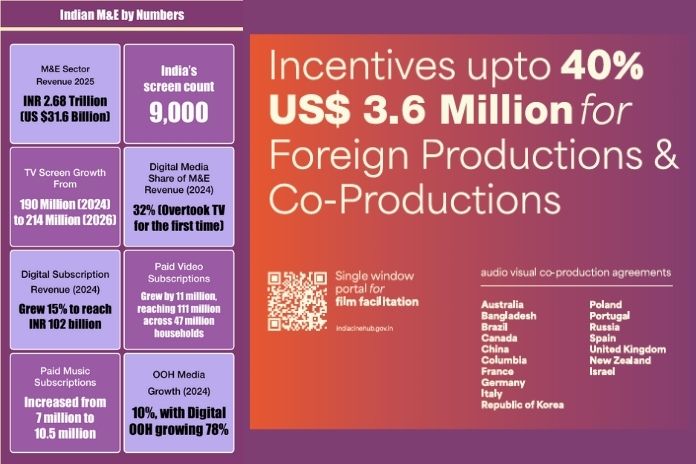
Co-production Treaties: India’s 16+ co-production agreements (e.g., with the UK, Canada, and Italy) enable cost-sharing and talent exchange, reducing production costs by up to 40% via incentives like cash rebates. Netflix’s The Archies (2023) and Amazon’s The Family Man showcase how these treaties blend Indian narratives with global appeal, accessing international tax benefits and markets.
Content Localization: With India’s 1,600+ dialects and 22 official languages, platforms localize content to penetrate its 78 crore internet users. Disney+ Hotstar offers regional dubs (e.g., Tamil, Telugu) for hits like The Mandalorian, while Netflix’s Sacred Games and Amazon’s Made in Heaven mix Hindi and English with local idioms, resonating globally. This approach drives 60-70% of their Indian viewership from Tier-2/3 cities, a model now exported to Southeast Asia and Africa.
Indian IP-Driven Storytelling: Streaming giants are mining India’s rich storytelling heritage—mythology, literature, and regional cinema—for universal appeal. Netflix’s Baahubali: Before the Beginning (pre-production) and Disney+ Hotstar’s Mahabharata adaptations amplify epic narratives, while Amazon’s Panchayat exports small-town charm. Indian IPs contribute 15-20% of their global original content, with 80% of Netflix’s Indian slate targeting international audiences by 2025.
This strategy fuels subscriber growth—Netflix added 6 million Indian users in 2024 alone—and positions India as a content powerhouse, with localized Indian stories like RRR and Kantara influencing global trends in culturally rooted, high-impact entertainment.
Cost-Effective Production Advantage
India continues to offer world-class production facilities at highly competitive costs. With an abundance of skilled professionals, cutting-edge VFX studios, and technology-driven production pipelines, India is a preferred destination for international content development.
India’s cost-effective production advantage in the Media & Entertainment (M&E) sector is a key factor driving its global appeal. This edge stems from a combination of low labor costs, affordable infrastructure, and a skilled yet competitively priced workforce.
Producing a feature film in India costs significantly less than in Western markets—averaging $5-10 million compared to $50-100 million in Hollywood—while delivering high-quality output in areas like VFX, animation, and live-action shoots. For instance, VFX work in India is 30-50% cheaper than in the U.S. or Europe, with top studios like Red Chillies VFX and PhantomFX offering world-class services at a fraction of the cost.
The availability of diverse locations—mountains, deserts, urban hubs—eliminates expensive set construction, often reducing location costs by 40-60%. A vast talent pool, including 2.5 million STEM graduates annually and over 1 million freelancers in M&E (e.g., via platforms like Upwork), keeps wages low yet skilled—editors or animators earn $500-1,000 monthly versus $4,000-6,000 in the West. Government incentives like the Film Facilitation Office and up to 40% cash rebates under co-production treaties further slash expenses.
Coupled with advanced tech adoption (e.g., virtual production) and a weak rupee (enhancing export value), India’s cost advantage makes it a go-to destination for global studios and OTT platforms seeking quality at scale.
Digital Transformation and AI Integration
India’s rapid digitalization, coupled with advancements in AI, ML, and cloud computing, is revolutionizing content production and distribution. AI-powered dubbing, virtual production, and blockchain-enabled rights management are some of the innovations driving India’s M&E sector forward.
WAVES: India’s Global Platform for Creative Exchange
The World Audio Visual & Entertainment Summit (WAVES) 2025 is an inaugural global event hosted by India, scheduled for May 1-4, 2025, at the Jio World Convention Centre in Mumbai. Spearheaded by the Ministry of Information & Broadcasting and aligned with Prime Minister Narendra Modi’s vision, WAVES aims to position India as a leading hub for media, entertainment, and creative innovation.
Inspired by platforms like the World Economic Forum in Davos, it seeks to unite top media CEOs, entertainment icons, creators, policymakers, and innovators from around the world to foster collaboration, trade, and dialogue.
The summit will spotlight India’s strengths in film, digital media, animation, gaming, VFX, and regional content, while promoting technological advancements like AI, virtual production, and immersive experiences. Key features include the Global Media Dialogue (culminating in the WAVES Declaration 2025), over 30 Create in India Challenges to boost the creator economy, WaveXcelerator for M&E startups, and the first-ever e-Bazaar for 24/7 global content trade.
With India’s M&E sector projected to reach $43 billion by FY28, WAVES 2025 is set to amplify the country’s creative prowess, nurture talent, and drive international partnerships, reinforcing its role in the global creative economy.
With favorable government policies, rapid digital adoption, and a thriving content ecosystem, India’s M&E sector is poised for unprecedented growth. NAB 2025 serves as a platform for Indian industry leaders to showcase the nation’s capabilities, foster collaborations, and attract investments that will shape the industry’s future.
As the world tunes into India’s storytelling prowess and technological innovations, the country is well on its way to becoming a global leader in the media and entertainment space.
Highlights

TIFF Reveals Plans for Industry Conference

Films by Shekhar Kapur and Shubham Yogi Selected for Toronto Gala

A Selection to Die for

Le Musk: A Brave New Frontier in Cinema

The Path finder: Jyoti Deshpande

Toonz to Honour Aabid Surti, Biren Ghose at Animation Masters Summit

India is the Country of Honour at Cannes

RAVINDRA VELHAL: DRIVING MEDIA TRANSFORMATION

THE PATH FINDER: JYOTI DESHPANDE

INTO THE WORLD OF RRR

Powerkids Appoints Manoj Mishra as CEO

Toonz Join Tunche Films to Co-Produce Spanish-Peruvian Animation Feature Kayara

National Museum of Indian Cinema Hosts Vintage Vehicles

I&B Secretary promises Govt’s Support to Film industry

Tom Cruise’s ‘Top Gun: Maverick’ to Blaze at Cannes

Illumination’s Minions: The Rise of Gru is the Annecy Festival Opener

Now, Shoot at Sight in India!

Lata Mangeshkar, India’s Singing Goddess

Quantum Image Making Has Arrived

Indian Films To Look Out For In 2022

2022: Centenary of Indian Cinema Legends

Singing Legend Lata Mangeshkar, Nightangale of India, Dies at 92

Bhushan Kumar’s T-Series Ventures Into OTT Content Creation Space

What’s India Looking for at European Film Market