From Mumbai to Berlin: Maharashtra Pushes for Global Cinema Footprint
By Pickle February 14, 2026
Share:


From Mumbai to Berlin: Maharashtra Pushes for Global Cinema Footprint
Maharashtra Culture and IT Minister Ashish Shelar announced new initiatives at Berlinale EFM 2026, committing to showcase Marathi films and support filmmakers in expanding their presence at Berlnale/EFM.
Maharashtra, home to the Bollywood film industry, launched an aggressive campaign at the 76th Berlin International Film Festival and European Film Market to court foreign productions, promising for a “red carpet” welcome.
Ashish Shelar, the state’s Minister for Culture and IT, led the delegation at the European Film Market (EFM), using the Bharat Pavilion as a launchpad to showcase the Film City in Mumbai’s Goregaon, Karjat and Kolhapur. The pitch to global investors and studio executives was clear: India is open for business, and Maharashtra is its primary gateway.
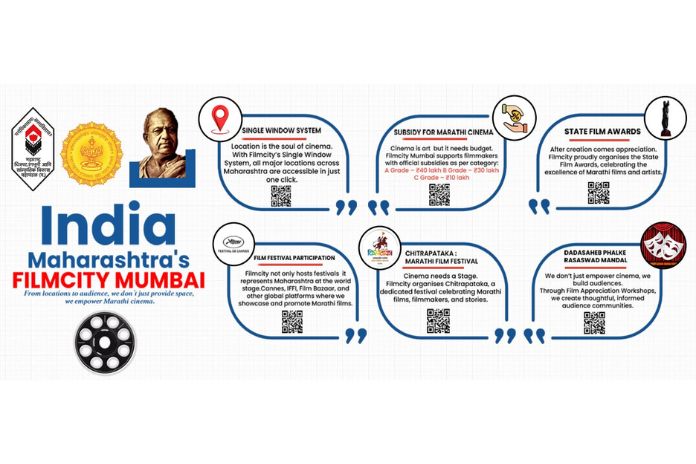
“We are here to give, as uniquely stated, a red carpet, Shelar said. outlining a strategy that pivots on single-window clearances, financial subsidies, and rapid infrastructure growth. The other delegation members include Kiran Kulkarni, Culture Secretary, and Swati Mhase Patil, MD,Film City, Mumbai among others.
Infrastructure push
The minister’s pitch comes as India seeks to position itself as a global content hub, a vision Shelar said aligns with Prime Minister Narendra Modi’s “WAVES ” initiative for the creative economy.
Shelar highlighted Maharashtra’s dual appeal of heritage and high-tech modernization. He cited the state’s expanding metro network and new transport links—developed under the leadership of Chief Minister Devendra Fadnavis—as not just logistical assets but potential filming locations.
“If one has to have different locations in one place, be it a heritage structure, a new development, or a high-rise… Mumbai has it,” Shelar said. He noted that the state’s connectivity, anchored by two international airports and one near Film City, offers unrivaled access to the rest of the country.
Tech and Heritage
The delegation promoted Maharashtra’s diversity of locales, ranging from the UNESCO-recognized Maratha Forts of Chhatrapati Shivaji Maharaj to the planned tech-forward expansion of Film City.
Following meetings at the World Economic Forum in Davos earlier this year where the state courted Hollywood studios, Shelar stated that Mumbai Film City will house the country’s largest campus for the Indian Institute of Creative Technologies (IICT), focusing on AVGC-XR (Animation, Visual Effects, Gaming, Comics, and Extended Reality).
Maharashtra, which topped India’s startup ecosystem in 2025, is now equipped with virtual production studios and AR/VR capabilities to match global standards.
Focus on Marathi Cinema
Beyond attracting foreign productions, the state announced a strategic pivot for its regional cinema. Beginning in 2027, the government plans to subsidize and support delegations of Marathi filmmakers to attend the Berlinale, aiming to replicate the promotional success regional cinema has seen at the Cannes Film Market.
Shelar also extended an unusual offer to international producers: subsidies for foreign creators willing to produce films in the Marathi language, signaling an intent to broaden the cultural reach of the state’s native cinema.
“India, Bharat, is a land of opportunity,” Shelar said. “We have already put forward our steps to invite all the creative industries… please do come to Maharashtra.”
Maharashtra Culture and IT Minister Ashish Shelar announced new initiatives at Berlinale EFM 2026, committing to showcase Marathi films and support filmmakers in expanding their presence at Berlnale/EFM.
Maharashtra, home to the Bollywood film industry, launched an aggressive campaign at the 76th Berlin International Film Festival and European Film Market to court foreign productions, promising for a “red carpet” welcome.
Ashish Shelar, the state’s Minister for Culture and IT, led the delegation at the European Film Market (EFM), using the Bharat Pavilion as a launchpad to showcase the Film City in Mumbai’s Goregaon, Karjat and Kolhapur. The pitch to global investors and studio executives was clear: India is open for business, and Maharashtra is its primary gateway.
“We are here to give, as uniquely stated, a red carpet, Shelar said. outlining a strategy that pivots on single-window clearances, financial subsidies, and rapid infrastructure growth. The other delegation members include Kiran Kulkarni, Culture Secretary, and Swati Mhase Patil, MD,Film City, Mumbai among others.
Infrastructure push
The minister’s pitch comes as India seeks to position itself as a global content hub, a vision Shelar said aligns with Prime Minister Narendra Modi’s “WAVES ” initiative for the creative economy.
Shelar highlighted Maharashtra’s dual appeal of heritage and high-tech modernization. He cited the state’s expanding metro network and new transport links—developed under the leadership of Chief Minister Devendra Fadnavis—as not just logistical assets but potential filming locations.
“If one has to have different locations in one place, be it a heritage structure, a new development, or a high-rise… Mumbai has it,” Shelar said. He noted that the state’s connectivity, anchored by two international airports and one near Film City, offers unrivaled access to the rest of the country.
The delegation promoted Maharashtra’s diversity of locales, ranging from the UNESCO-recognized Maratha For of Chhatrapati Shivaji Maharaj to the planned tech-forward expansion of Film City.
Following meetings at the World Economic Forum in Davos earlier this year where the state courted Hollywood studios, Shelar confirmed that Film City will house the country’s largest campus for the Indian Institute of Creative Technologies (IICT), focusing on AVGC-XR (Animation, Visual Effects, Gaming, Comics, and Extended Reality).
Maharashtra, which topped India’s startup ecosystem in 2025, is now equipped with virtual production studios and AR/VR capabilities to match global standards.
Focus on Marathi Cinema
Beyond attracting foreign productions, the state announced a strategic pivot for its regional cinema. Beginning in 2027, the government plans to subsidize and support delegations of Marathi filmmakers to attend the Berlinale, aiming to replicate the promotional success regional cinema has seen at the Cannes Film Market.
Shelar also extended an unusual offer to international producers: subsidies for foreign creators willing to produce films in the Marathi language, signaling an intent to broaden the cultural reach of the state’s native cinema.
“India, Bharat, is a land of opportunity,” Shelar said. “We have already put forward our steps to invite all the creative industries… please do come to Maharashtra.”
Highlights

TIFF Reveals Plans for Industry Conference

Films by Shekhar Kapur and Shubham Yogi Selected for Toronto Gala

A Selection to Die for

Le Musk: A Brave New Frontier in Cinema

The Path finder: Jyoti Deshpande

Toonz to Honour Aabid Surti, Biren Ghose at Animation Masters Summit

India is the Country of Honour at Cannes

RAVINDRA VELHAL: DRIVING MEDIA TRANSFORMATION

THE PATH FINDER: JYOTI DESHPANDE

INTO THE WORLD OF RRR

Powerkids Appoints Manoj Mishra as CEO

Toonz Join Tunche Films to Co-Produce Spanish-Peruvian Animation Feature Kayara

National Museum of Indian Cinema Hosts Vintage Vehicles

I&B Secretary promises Govt’s Support to Film industry

Tom Cruise’s ‘Top Gun: Maverick’ to Blaze at Cannes

Illumination’s Minions: The Rise of Gru is the Annecy Festival Opener

Now, Shoot at Sight in India!

Lata Mangeshkar, India’s Singing Goddess

Quantum Image Making Has Arrived

Indian Films To Look Out For In 2022

2022: Centenary of Indian Cinema Legends

Singing Legend Lata Mangeshkar, Nightangale of India, Dies at 92

Bhushan Kumar’s T-Series Ventures Into OTT Content Creation Space

What’s India Looking for at European Film Market