Legend Sovan Lal Saha’s Symphony is Now Silent
By Pickle March 9, 2026
Share:


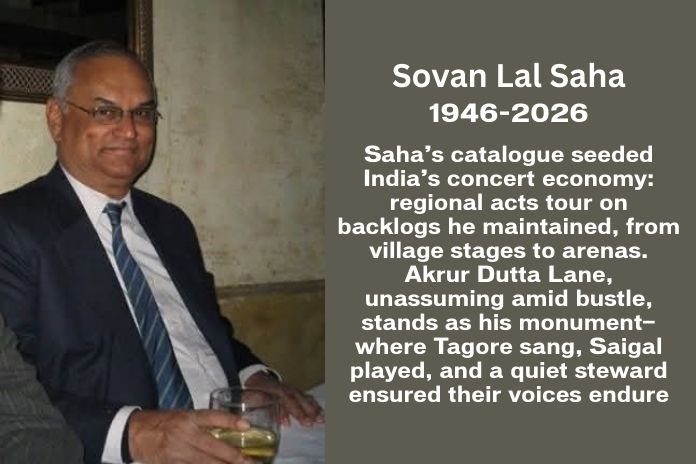
Sovan Lal Saha, the soft-spoken Kolkata patriarch who preserved and expanded one of India’s oldest independent music labels through a century of sonic upheavals, died on March 6, 2026, in Goa on a holiday. He was 80.
Born June 1, 1946, Saha inherited Hindustan Record from his father, Chandi Charan Saha, who founded it in 1932 after importing recording gear from Germany’s Georg Neumann. Rabindranath Tagore cut the label’s first disc, “Tobu mone rekho,” in a cramped Akrur Dutta Lane studio, setting a tone of cultural heft that defined the family enterprise. Saha’s life work was to keep that flame alive, evolving Hindustan into a vast catalogue of Indian sounds while co-founding Inreco to manufacture the records that carried them.
A childhood amid legends
Saha grew up in the studio’s orbit, where 78 rpm shellac discs captured an extraordinary roll call of early Indian talent. His father’s label drew Hindustani classical giants—Ustad Faiyaz Khan, Ustad Bade Ghulam Ali Khan—alongside playback pioneers like K.L. Saigal, whose harmonium still sits in Kolkata, and S.D. Burman. Bengali voices such as Kanan Devi, K.C. Dey, Atul Prasad Sen and Debabrata Biswas filled the cutting rooms, their songs tied to New Theatres films that packed halls across Bengal and beyond.
These weren’t just recordings; they were blueprints for Indian popular music. Hindustan’s shepherd-boy logo graced sleeves carrying Saigal’s “Babul mora,” Burman’s film medleys and classical thumris that introduced ragas to middle-class living rooms. Subinoy Roy’s Rabindra Sangeet interpretations and Purna Das Baul’s mystic folk became neighbourhood staples, their grooves worn smooth by monsoon-evening gramophones.
Taking the reins amid crisis
By the 1970s, as vinyl edged out shellac and multinationals squeezed independents, Saha stepped up. With brother Mohan Lal, he launched Inreco in 1976, building a Taratala pressing plant—the third such facility in India, fully Indian-owned – that made Hindustan self-reliant. This unlocked a creative flood: Bengali modern songs by Hemanta Mukherjee and Manna Dey; Nazrulgeeti; film soundtracks from regional industries.
Inreco’s presses stamped Punjabi private songs, Bhojpuri hits like “Tikulee Ke Laaj,” Malayalam scores by Salil Chowdhury, K.J. Joy and A.T. Ummer, plus Kannada, Tamil and Haryanvi albums overlooked by majors. Classical releases continued—thumris, bhajans, khayals—while devotional tracks and children’s songs rounded out a catalogue mapping India’s linguistic diversity.
Saha nurtured younger Bengali talent too: Somlata Acharyya Chowdhury’s contemporary fusion, Shahana Bajpaie’s acoustic sets, Rupankar Bagchi’s indie folk-rock, Srikanto Acharya’s melodic pop. These joined legacy stars, creating a bridge from acoustic horns to digital playlists.
Labour strife and pivot to content
The 1980s tested Saha’s resolve. Left Front-era unrest shut Taratala for months, trapping masters and driving bankruptcy. He fought to retrieve them, preserving irreplaceable tapes of Saigal, Tagore and Khan. From the 1990s, he shifted to “software”—cassettes, CDs, digitisation—over hardware, reissuing classics with cleaner sound.
Tagore’s early cuts, Biswas’s Rabindra Sangeet and the songs of the Bauls migrated to new formats, landing on global platforms reaching 200 countries. Saha championed immersive tech like Dolby Atmos for regional acts, partnering with Neumann for demo rooms that captured folk and film songs in high fidelity.
The man behind the mic
Reserved yet tenacious, Saha shunned spotlight, crediting artists first. “We’re opening doors to the world of music,” he’d say, from Tagore’s mic to streaming algorithms. Kolkata colleagues recall him at Akrur Dutta Lane, approving test pressings or guiding young singers upstairs. His old-school courtesy—letters, calls—paired oddly with talk of export markets and Atmos.
Kolkata’s enduring echo
Hindustan–Inreco stalls at Kolkata Book Fair draw crowds for Kishore Kumar LPs, Biswas reissues and pen-drive Baul sets. The 2021 Chandi Charan Saha Foundation codified his archival drive, safeguarding masters at the family’s north Kolkata address.
Saha’s catalogue seeded India’s concert economy: regional acts tour on backlogs he maintained, from village stages to arenas. Akrur Dutta Lane, unassuming amid bustle, stands as his monument—where Tagore sang, Saigal played, and a quiet steward ensured their voices endure.
Milestones
1940s–50s: Grows up at Hindustan studio amid Saigal, Burman recordings
1970s: Assumes leadership amid industry crunch
1976: Co-founds Inreco, Taratala plant
1970s–80s: Builds pan-Indian catalogue (Bhojpuri, Malayalam, Punjabi)
1980s–90s: Rescues masters post-bankruptcy
1990s–2000s: Pivots to digital reissues
2010s: Global streaming, Atmos recordings
2021: Chandi Charan Saha Foundation
2020s: Oversees 90-year legacy
Highlights

Ensure Disney’s Next 100 years Are as Successful as Our First: CEO Bob Chapkek

TIFF Reveals Plans for Industry Conference

Films by Shekhar Kapur and Shubham Yogi Selected for Toronto Gala

A Selection to Die for

Le Musk: A Brave New Frontier in Cinema

The Path finder: Jyoti Deshpande

Toonz to Honour Aabid Surti, Biren Ghose at Animation Masters Summit

India is the Country of Honour at Cannes

RAVINDRA VELHAL: DRIVING MEDIA TRANSFORMATION

THE PATH FINDER: JYOTI DESHPANDE

INTO THE WORLD OF RRR

Powerkids Appoints Manoj Mishra as CEO

Toonz Join Tunche Films to Co-Produce Spanish-Peruvian Animation Feature Kayara

National Museum of Indian Cinema Hosts Vintage Vehicles

I&B Secretary promises Govt’s Support to Film industry

Tom Cruise’s ‘Top Gun: Maverick’ to Blaze at Cannes

Illumination’s Minions: The Rise of Gru is the Annecy Festival Opener

Now, Shoot at Sight in India!

Lata Mangeshkar, India’s Singing Goddess

Quantum Image Making Has Arrived

Indian Films To Look Out For In 2022

2022: Centenary of Indian Cinema Legends

Singing Legend Lata Mangeshkar, Nightangale of India, Dies at 92

Bhushan Kumar’s T-Series Ventures Into OTT Content Creation Space