India’s Animators have the stories. What they need is a stage
By Pickle June 21, 2026
Share:


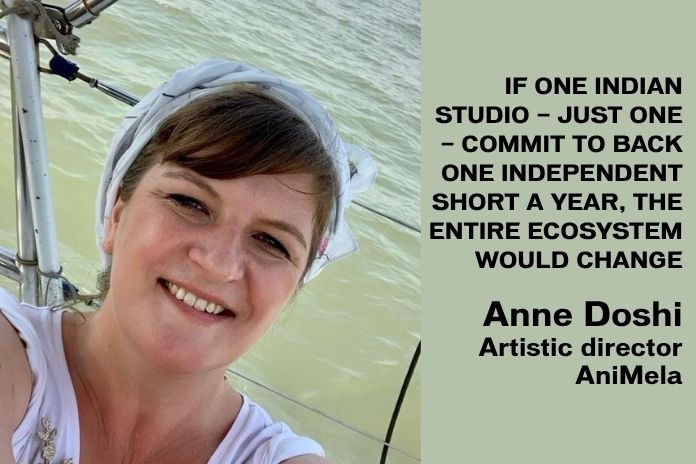
Anne Doshi, artistic director of AniMela, on building Namaste MIFA with Annecy, opening of a global pitch corridor for Indian animation, the third cohort of five projects that will unveil at MIFA 2026, and why Annecy 2027 will look very different from 2024
When Mickaël Marin — now chief executive of CITIA, the body that runs the Annecy International Animation Film Festival and its market, MIFA — first asked Anne Doshi why so little Indian animation surfaced at the world’s most important animation gathering, she had no answer. A decade later, she has built one. AniMela, the South Asia animation festival she co-founded with Kireet Khurana and Arjun of Assemblage (who has been supporting from day one), is now in its third edition. Its flagship industry strand, Namaste MIFA — the Indian chapter of Annecy’s International MIFA Campus (IMC) — has, in two cycles, put 10 projects on the Annecy stage. Six are in production. Two of those six are in European co-production. A third cohort of five is about to walk onto the MIFA floor next week. Anne Doshi, who came to animation laterally from live-action festival curation, is matter-of-fact about why the model is working — and unsparing about what still does not.
You came to animation from the outside — live-action curation, a children’s festival, programming work with French partners. How did a conversation with Mickaël Marin years before he ran CITIA turn into Namaste MIFA?
I knew Mickaël long before he was CEO. We had worked together on a children’s festival, sourcing films from Annecy. He kept asking me the same question — why isn’t Indian animation showing up here? Why aren’t more Indian films selected, why aren’t more Indian creators coming? I had no answer. Then I saw Upamanyu Bhattacharyya’s Wade, and I thought: if a film like that can be made in India, the talent must exist. There were extraordinary animators — Krishna Chandran A. Nair, the circle around Suresh Eriyat, students winning at Annecy. But no platform. With Kireet Khurana and Arjun of Assemblage, we decided the missing piece was a festival of international standard. There were AVGC events, there were industry meets, but nothing global. I called Mickaël and asked if Annecy would back us. He said yes, immediately. He said: we have tried this many times in India, it has never worked, but we trust you. That trust is the only reason this exists.
Annecy and CITIA work with very few country partners at this depth. How does the Namaste MIFA pipeline run from open call to the Annecy’s MIFA Pitch, and what does each side bring to the table?
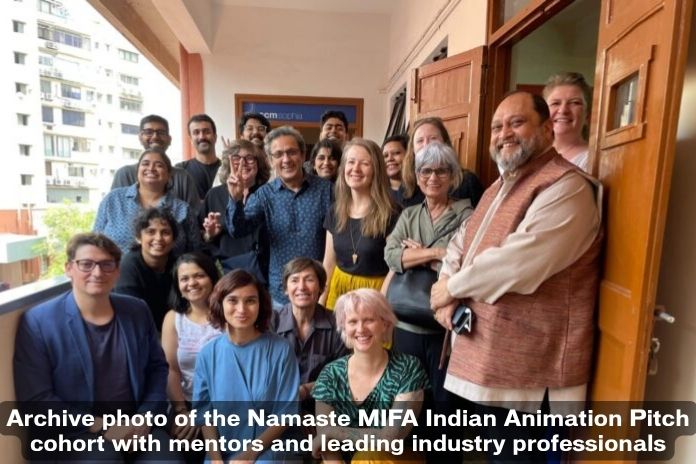
Annecy runs the IMC — the International MIFA Campus — in a handful of countries every year. They send a team to mentor selected talents and make them pitch-ready. India had never been one of those countries. We agreed it was the right place to begin the partnership. AniMela sends out a call for projects in any animation format — short, feature, series, mixed media, with a 50–60 per cent animation floor. In year one, without pushing hard, we received more than 80 pitches. We shortlist 15 and send them to Annecy. Three external mentors plus the MIFA team choose five. Those five arrive in Mumbai the Monday before AniMela. For four days they are mentored intensively, until they are pitch-ready. On the Friday — the opening day of AniMela — they pitch live in front of an audience and a jury. The same five then travel to Annecy in June to pitch on the MIFA floor. Annecy lends the global validation and the room. We do the discovery, the curation and the Indian context. The French Institute supports most of the cost.
Two editions in, what does the scoreboard actually look like — how many projects have gone through the pipeline, how many are now in production, and what does the Gowariker–Penumbra story tell us about how this is rewiring the Indian industry?
Ten projects across two editions. Six are in production. Within those six, two are in European co-production. Two short films are also in co-production. The first jury, Rakesh Omprakash Mehra and Ashutosh Gowariker, was meant to pick the best pitch, not the best project. But Gowariker’s son, who studied VFX and animation, has since started a company with his father dedicated to animation. They are backing one of last year’s projects — Penumbra, an adult animated series by two very young creators. We were blown away when we first saw it. That is the crossover we wanted: an established mainstream filmmaker, his next-generation son, and an independent adult series finding each other through a pitch room.
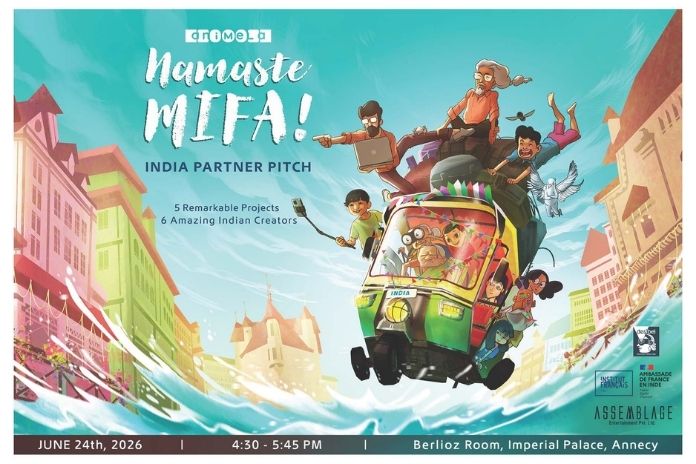
The spread this year leans towards original IP — personal stories, small-town worlds, two projects where the directors genuinely let go and use animation the way it should be used, rather than telling square stories safely. The full 2024–25 slate plus the 2026 shortlist of 15 is in the dossier we are circulating; the five who go to Annecy will be public at MIFA.
Where is the talent actually coming from — which schools, which cities — and what does the institutional map tell us about who is funding the next generation of Indian animators?
NID, SRFTI, IDC at IIT Bombay, Srishti Manipal — those are the four. Three of the four are publicly funded. We do not curate by institution; that is simply where the strongest work is. We receive far more student films than professional ones, because a graduate cannot finance an independent short on their own. A decent independent short in animation costs around ₹50 lakh. No one is writing that cheque. So the students keep making, and the professionals quietly disappear into service work or VFX for live action.
India already has three established animation tracks — broadcast television, domestic features, and offshore service work. Where does Namaste MIFA sit in that landscape?
Namaste MIFA is the fourth track — the one no one is looking at. Independent animation. Original IP. The films we receive and programme have almost nothing to do with mythology. They are stories from small towns, about grandparents, about childhood. As a French viewer I do not know Indian mythology. But a story of grandparents making pickles for a granddaughter going to university — that is the same as my grandparents making jam from the fruits in their garden. Same story. That is what resonates everywhere.
What is the missing piece for this to scale beyond what you can personally hold up?
A dedicated fund. If one Indian studio — just one — committed to backing one independent short a year, the entire ecosystem would change. The Japanese have done with anime what the Americans did with Disney. India has the audience. If young Indians are watching anime in Japanese, they will watch animation in Indian languages.
Animation feature Mahavatar Narsimha is a great case study. Return of the Jungle is out. The space exists. Someone has to take the lead on adult, original, and the rest will follow.
Craft-wise, what are international distributors telling you is missing, and what are you telling young Indian animators they need to stop doing?
Story and visual quality are largely there. Sound design and voice work are consistently the weakest link when international distributors evaluate the work. And too many young filmmakers still play it safe. Animation is the one form where you can go anywhere. A lot of Indian work is still telling square stories. The ones who let go are extraordinary.
Project forward for us. By 2027 — once this third cohort has cycled through MIFA, once Penumbra and the in-production features land, once the European co-productions deliver — what does the Indian animation slate actually look like to the world?
By 2027 you will see a genuine slate from India. Independent shorts on the global festival circuit. At least one adult Indian animated series breaking out internationally. Two or three features in international co-production, with European partners and European broadcasters attached. A recognisable cohort of Indian directors that Annecy, Berlin and the European platforms know by name. The corridor is open. The work is in production. The question is no longer whether India can make it. It is whether India will fund it.
Highlights

Mehrunisa Aims more Destinations

TIFF Reveals Plans for Industry Conference

Films by Shekhar Kapur and Shubham Yogi Selected for Toronto Gala

A Selection to Die for

Le Musk: A Brave New Frontier in Cinema

The Path finder: Jyoti Deshpande

Toonz to Honour Aabid Surti, Biren Ghose at Animation Masters Summit

India is the Country of Honour at Cannes

RAVINDRA VELHAL: DRIVING MEDIA TRANSFORMATION

THE PATH FINDER: JYOTI DESHPANDE

INTO THE WORLD OF RRR

Powerkids Appoints Manoj Mishra as CEO

Toonz Join Tunche Films to Co-Produce Spanish-Peruvian Animation Feature Kayara

National Museum of Indian Cinema Hosts Vintage Vehicles

I&B Secretary promises Govt’s Support to Film industry

Tom Cruise’s ‘Top Gun: Maverick’ to Blaze at Cannes

Illumination’s Minions: The Rise of Gru is the Annecy Festival Opener

Now, Shoot at Sight in India!

Lata Mangeshkar, India’s Singing Goddess

Quantum Image Making Has Arrived

Indian Films To Look Out For In 2022

2022: Centenary of Indian Cinema Legends

Singing Legend Lata Mangeshkar, Nightangale of India, Dies at 92

Bhushan Kumar’s T-Series Ventures Into OTT Content Creation Space