Janta Cinema’s Wild Ride with Return of the Jungle
By Pickle June 21, 2026
Share:


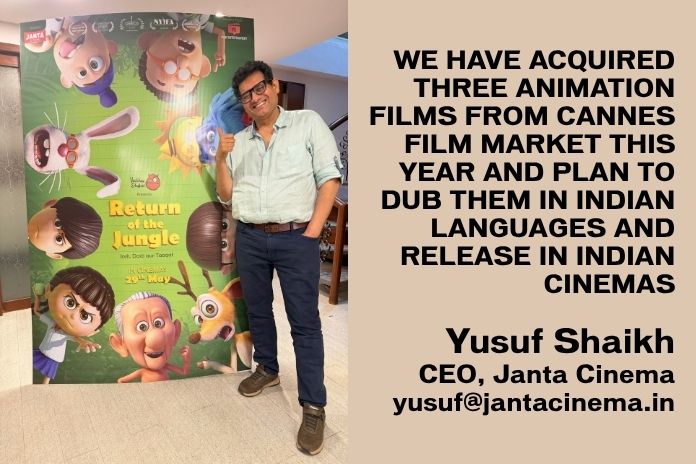
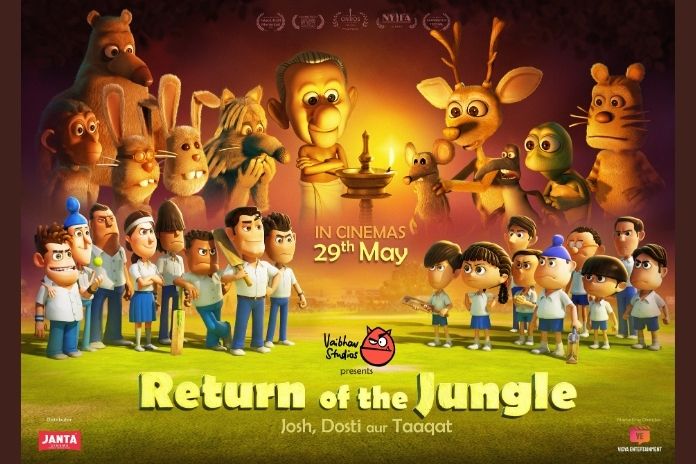
From makeshift halls to family-packed auditoriums, Janta Cinema’s mission is clear: no village should be left behind. CEO Yusuf Shaikh reveals how ‘Return of the Jungle’, directed by Vaibhav Kumaresh, became a blockbuster
Janta Cinema’s model focuses on bringing films to the underserved, interior, screen-dark regions of India. What made Return of the Jungle the right film to carry that mission forward?
At Janta Cinema, we are creating a market and catering to an underserved audience of approx. 90 crore (900 million) Indians in the interiors who have no access to cinema halls. In India, where the density of cinema screens is low, people in rural areas must travel many miles to watch a film in a theater, or they resort to watching pirated copies.
Janta Cinema converts village centers/community halls or town halls/local school/college auditoriums into pop-up cinema hall screens and e-education centers in these small towns and villages.
Return of the Jungle is one such film that local students and kids in India really loved. The theme stems from the folk tales of Panchatantra and revolves around a jungle that has friendly ‘talking animals’ and has some ’life lessons’ for children.
In simple terms, what is Janta Cinema, and what problem is it solving for the Indian film industry?
Janta Cinema converts any public utility halls into cinema halls. It caters to underserved areas in the interior of India where there are no cinema halls. The Janta Cinema model ties up with the government to convert halls owned by local bodies into edutainment hubs where we teach students in the mornings and show ‘first day first show’ movies in the 2nd half of the day through our proprietary ‘Janta Cinema technology.’
Problem 1 – Screen deficit
Janta Cinema is trying to sort out the issue of screen deficit in India. India has only 7 screens per million people compared to China, which has 70 screens per million.
China has 95,000 screens, and India has only 9,500 screens. India and China have similar populations.
India makes 2,400 films annually in more than 20 state languages. But the screens are not enough to accommodate all these films.
Ticket prices are too high for the masses to enjoy a film due to the lack of screens.
Problem 2: Piracy leads to significant revenue loss for producers.
Because of the scarcity of screens, the box-office collections of all films suffer a great deal due to piracy. According to EY reports for 2024, the loss due to piracy in India was approximately 3 billion USD (Rs 24,000 crore). India, on the other hand, made about 1.5 billion USD (Rs 11,330 crore) at the box office. By reaching out to the interiors of India, Janta Cinema plans to cater to that very audience, which has no access to cinemas and are avid watchers of films.
Why animation? Is it a genre you believe in, or was this specifically about backing Vaibhav Kumaresh’s vision?
I distributed and marketed Hanuman when I was heading Percept and Sahara. Hanuman was the first big animation success in India at that time. Thereafter, I also had the opportunity to distribute other animation films such as Dashavatar, Cheenti Bang Bang, and Hanuman 2 / Hanuman 3 (Hanuman Da Damdaar) while at Percept.
Animation gives me a wonderful joy because it caters to children mainly, and the joy it brings for children and families is unmatched compared to the live-action dramas.
We can create our own heroes in animation, whereas in live action, we have to hero-worship a character or a star. When we marketed Hanuman, we came up with this tagline.
You have seen Spider-Man and Superman, but now you see your own superhero, Hanu-Man.
Those days in the Indian box office, Sunny Deol and Ajay Devgan were the biggest stars, but when I saw Hanuman, I felt Hanuman had equal heroism and star pull due to various factors. Along with that came the ‘faith’ factor of Indian mythology.
In Vaibhav’s Return to the Jungle, I saw that it’s a subject that caters to Indian kids, and it has a very good positioning for Indian families, especially in the summer vacations. And that USP has worked wonders for ‘Return of the Jungle.’ Now that the film has earned a great ‘word of mouth,’ we are getting many schools to take shows for all their students, converting them into lots of ‘housefull shows’ for children.
How many screens did Return of the Jungle release on, and how hard was it to get exhibitors to say yes to an independent animated film?
The film had a very decent marketing spread, which allowed us to get more than 550 screens in the 1st week itself. The exhibitors also had lots of hope for the film due to its smart marketing and the summer vacation period. Additionally, my background with successful animation films instilled confidence in the exhibitors regarding the film’s marketing and reception.
What was the toughest part of distributing a film that had no studio, no OTT pre-buy, and no traditional marketing machinery behind it?
Honestly, once you nail the positioning of a film, then everyone starts identifying with it and opens up to support. In this case, the positioning was ‘international-quality animation with an Indian story for the entire family during this summer vacation.’
The film screened at Cannes and IFFI before its theatrical release. Did that festival’s credibility open doors—or does that prestige still not move the needle at the Indian box office?
The film had appreciation and earned credibility from all quarters, including Cannes and IFFI, but it needed specific positioning for the release, especially in the Indian markets. The multiplexes were hungry for ‘different content,’ and the families were waiting for a ‘child-friendly’ film during the vacations.
Over a dozen Indian animated films are now in the pipeline. What is the one thing you wish animation filmmakers understood about theatrical distribution before they go into production?
It’s a wonderful time for the Indian animation films after Narsimha Avtar/Krishnaavtaram and now Return of the Jungle. The advantage they have is that they can cater to audiences with great new stories instead of the typical formula of live-action dramas and action films, which audiences have gotten bored of. Plus, animation always caters to the entire family, and that becomes a big USP in India, as families like to go together to watch films.
What needs to change—in distribution, exhibition, or policy—for Indian animation to become a commercially viable genre, and what role does Janta Cinema want to play in that?
Honestly, the only problem everyone has is the ticket rates in multiplexes and their habit of giving preference to star-cast-driven formula films instead of promoting animation films and new stories that the audience wants to see.
As far as the policy is concerned, the Government of India could help with subsidies for animation films and also encourage schools to show these films on their premises. That would get easy access to the students and encourage them to see animation as a career too. The Janta model is to go where the audience is. We will go and pop up the cinemas in school auditoriums and college amphitheaters.
Beyond India—will Janta Cinema open to distributing animated films from Europe, BRICS nations, or North America to Indian audiences? And if so, what kind of content would you be looking for?
We have acquired 3 animation films from Cannes this year and plan to dub them in Indian languages and release them here in Indian cinemas. We are open to supporting films from all over the world and would be happy to give them a theater release as well as other formats.
Janta Cinema Solution is not only catering to animation films but also all Indian films. Imagine an Indian family living in California wants to watch Return of the Jungle there, or a Bengali family wants to watch a Bengali film with their community in the US or in the Middle East; we can easily send them the film through the Janta Cinema tech, and they can easily have a ticketed show there. So, the Janta Cinema model is all-pervasive to audiences all over the world.
Highlights

Shaunak Sen’s Doc Wins Big At Sundance

TIFF Reveals Plans for Industry Conference

Films by Shekhar Kapur and Shubham Yogi Selected for Toronto Gala

A Selection to Die for

Le Musk: A Brave New Frontier in Cinema

The Path finder: Jyoti Deshpande

Toonz to Honour Aabid Surti, Biren Ghose at Animation Masters Summit

India is the Country of Honour at Cannes

RAVINDRA VELHAL: DRIVING MEDIA TRANSFORMATION

THE PATH FINDER: JYOTI DESHPANDE

INTO THE WORLD OF RRR

Powerkids Appoints Manoj Mishra as CEO

Toonz Join Tunche Films to Co-Produce Spanish-Peruvian Animation Feature Kayara

National Museum of Indian Cinema Hosts Vintage Vehicles

I&B Secretary promises Govt’s Support to Film industry

Tom Cruise’s ‘Top Gun: Maverick’ to Blaze at Cannes

Illumination’s Minions: The Rise of Gru is the Annecy Festival Opener

Now, Shoot at Sight in India!

Lata Mangeshkar, India’s Singing Goddess

Quantum Image Making Has Arrived

Indian Films To Look Out For In 2022

2022: Centenary of Indian Cinema Legends

Singing Legend Lata Mangeshkar, Nightangale of India, Dies at 92

Bhushan Kumar’s T-Series Ventures Into OTT Content Creation Space