TIFF Winners Rewrite Awards Season
By Pickle September 28, 2026
Share:


Toronto’s winners bring distinctive voices into awards contention, turning audience acclaim and festival recognition into opportunities for wider global reach
Toronto’s audiences have handed the awards season a striking proposition: a Spanish queer epic can outpoll Hollywood crowdpleasers, while a debut from Nagaland can secure its own Oscar pathway. Across TIFF’s 2026 winners, the connecting thread is not scale but the reclamation of lives, communities and histories that mainstream storytelling often leaves behind.
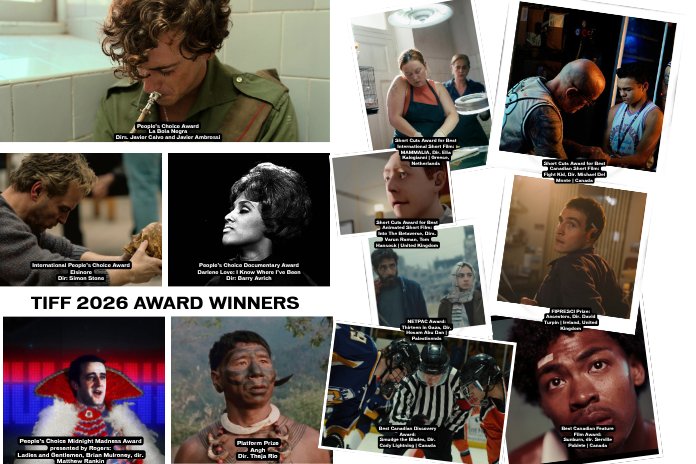
Javier Calvo and Javier Ambrossi’s La Bola Negra won the People’s Choice Award, becoming its first non-English-language recipient since Where Do We Go Now? in 2011. Inspired by Federico García Lorca’s unfinished work, it connects three gay men across 1932, 1937 and 2017, turning desire, repression and memory into an expansive historical drama. The Guardian’s Peter Bradshaw called it “handsomely produced, lovingly detailed and confidently constructed”.
Its campaign is already more than speculation: Reports say Netflix U.S. and Suma Content are leading the effort, with the directors preparing for months of travel and further festival appearances. Spain’s International Feature submission opened domestically on September 25; its U.S. theatrical launch is October 16, followed by Netflix on December 2. Toronto adds audience endorsement to its Cannes directing prize, strengthening a campaign with ambitions beyond the international category.
Simon Stone’s International People’s Choice winner Elsinore finds a different register: Andrew Scott plays Ian Charleson attempting Hamlet while living with AIDS. Rather than a conventional cradle-to-grave biography, it concentrates on artistic purpose near death, balancing grief with humour; Critics hailed Scott’s “performance for the ages”. That reception suggests an actor-led awards pitch, although detailed campaign plans remain unconfirmed. Its U.S. release is November 20, followed by Britain on January 29, 2027.
For India, Theja Rio’s Platform winner Angh offers the festival’s most consequential breakthrough. Set in 1960s Nagaland, its Konyak-language portrait of a chief confronting religious conversion and cultural erosion uses local first-time actors and textured 16mm photography. The film is praised for its elegiac power while finding the treatment occasionally too cautious.
The Academy’s new festival-award route allows a qualifying non-English-language Platform winner to enter International Feature consideration without national selection; this is eligibility, not a nomination. Jungle Book Studios handles Angh’s distribution, but a commercial release date and detailed campaign have not been confirmed in the reporting reviewed. Its next challenge is converting recognition into sustained visibility.
Barry Avrich’s documentary audience winner Darlene Love: I Know Where I’ve Been restores ownership to a singer whose voice became famous before her name did. Present-day testimony, archives and fresh performances make recognition, rather than celebrity nostalgia alone, its organising idea. TheWrap reported it seeking distribution at TIFF; a documentary campaign would require a confirmed release and eligibility strategy, not simply the audience trophy.
Matthew Rankin’s Midnight Madness winner Ladies and Gentlemen, Brian Mulroney pushes nonfiction towards political hallucination. Its archival collage, fabricated television packaging and animation interrogate how politics becomes entertainment; IndieWire praised its singularity but noted the density confronting outsiders. Its review reported U.S. distribution still being sought, leaving the release timetable unresolved.
The audience runners-up, Peter Farrelly’s I Play Rocky and Siân Heder’s Being Heumann, keep accessible Hollywood storytelling in contention: one revisits the making of Rocky, the other disability-rights activism. Their presence alongside La Bola Negra suggests that Toronto rewarded emotional engagement rather than a single language, budget or production model. For smaller winners, the likely priorities are selective festival bookings, distributor conversations and screenings that explain what makes each film distinctive, rather than imitating an expensive studio campaign.
Elsewhere, Serville Poblete’s Sunburn won Best Canadian Feature and Cody Lightning’s Smudge the Blades took Canadian Discovery; David Turpin’s Ancestors received FIPRESCI and Hosam Abu Dan’s Thirteen in Gaza won NETPAC. Short Cuts honoured Elia Kalogianni’s MAMMALIA, Michael Del Monte’s Fight Kid and Varun Raman and Tom Hancock’s animated Into The Betaverse.
For these winners, the next contest is turning festival enthusiasm into distribution, voter attention and an audience beyond Toronto.
Highlights

51 International Film Festival of India, Goa ( 20 -28 November, 2020)

Ketan Mehta, Nina Sabnani To be honoured at Animation Masters Summit 2021

TIFF Reveals Plans for Industry Conference

Films by Shekhar Kapur and Shubham Yogi Selected for Toronto Gala

A Selection to Die for

Le Musk: A Brave New Frontier in Cinema

The Path finder: Jyoti Deshpande

Toonz to Honour Aabid Surti, Biren Ghose at Animation Masters Summit

India is the Country of Honour at Cannes

RAVINDRA VELHAL: DRIVING MEDIA TRANSFORMATION

THE PATH FINDER: JYOTI DESHPANDE

INTO THE WORLD OF RRR

Powerkids Appoints Manoj Mishra as CEO

Toonz Join Tunche Films to Co-Produce Spanish-Peruvian Animation Feature Kayara

National Museum of Indian Cinema Hosts Vintage Vehicles

I&B Secretary promises Govt’s Support to Film industry

Tom Cruise’s ‘Top Gun: Maverick’ to Blaze at Cannes

Illumination’s Minions: The Rise of Gru is the Annecy Festival Opener

Now, Shoot at Sight in India!

Lata Mangeshkar, India’s Singing Goddess

Quantum Image Making Has Arrived

Indian Films To Look Out For In 2022

2022: Centenary of Indian Cinema Legends

Singing Legend Lata Mangeshkar, Nightangale of India, Dies at 92