MIPCOM 2026: Where Media CEOs Will Look for Growth
By Pickle October 10, 2026
Share:



Media chiefs heading to Cannes will examine how AI, creator partnerships and new funding models can deliver lasting business growth
New sources of finance, closer ties with creators and the commercial promise of artificial intelligence will compete with programme sales for attention when global media executives gather at MIPCOM 2026. For chief executives, Cannes will offer a view of where the industry’s next opportunities are taking shape.
Running from October 12 to 15, the market is broadening its focus beyond buying and selling television programmes. Its expanding agenda brings studios, streamers and broadcasters together with creators, advertisers and technology companies, reflecting a search for new ways to fund content, reach audiences and generate revenue.
That search comes as traditional funding becomes scarcer and acquisition budgets tighten, a challenge highlighted by MIPCOM director Lucy Smith. The question for media leaders is how these emerging partnerships can support growth while preserving ownership of intellectual property and the audience relationships on which future earnings depend.
Global buyers and the value of scale
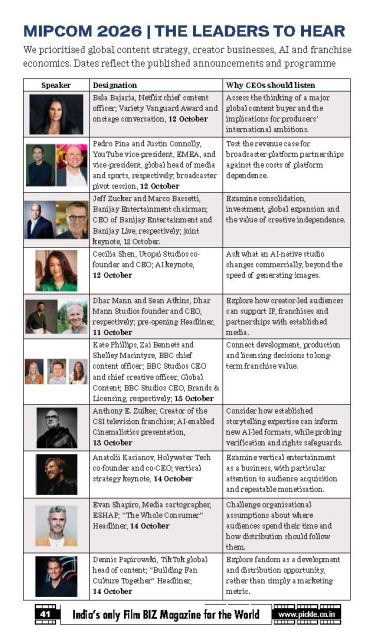
Netflix chief content officer Bela Bajaria will receive the Variety Vanguard Award and participate in an onstage interview on October 12. Her appearance will be closely watched by producers and studio chiefs seeking insight into the priorities of a global buyer whose decisions influence content businesses across markets.
Banijay Entertainment chairman Jeff Zucker and chief executive Marco Bassetti will discuss the newly combined group’s direction, investment and independence. Their conversation brings consolidation into focus, offering executives a chance to examine how greater scale can support creative investment, international expansion and the development of valuable franchises.
The longer view will come from BBC content chief Kate Phillips and BBC Studios leaders Zai Bennett and Shelley Macintyre. Drawing on brands including Bluey, Doctor Who and Dancing with the Stars, their session will explore how entertainment properties are developed and expanded for audiences around the world.
Creators move into the mainstream
YouTube’s Pedro Pina and Justin Connolly will address broadcasters’ pursuit of digital reach and new revenue streams. For media groups, the discussion goes beyond establishing a presence on another platform to the economics of distribution, advertising income and building audiences outside their own channels and services.
The balance between reach and control will be important. Wider distribution can introduce content to new viewers, but it also raises questions about dependence on platforms, access to audience data and the ability to turn viewing into a lasting commercial relationship.
Dhar Mann and Dhar Mann Studios chief executive Sean Atkins will give the creator economy an early platform, appearing before the market formally opens. Their session will examine how a business built around engaged audiences develops intellectual property and partnerships with the wider entertainment industry.
For established companies, this puts creators in a different light: as potential production and distribution partners rather than simply promotional talent. The opportunity lies in combining their audience connections with the financing, production expertise and international networks of traditional media businesses.
MIP BrandWorks, developed with branded-content pioneer Doug Scott, will add matchmaking and pitching opportunities connecting brands, producers and creators. Dentsu is its first headline partner, with Meta participating across elements of the programme. These discussions will open another avenue for financing, alongside questions about ownership, creative control and commercial objectives.
AI moves from trials to business
The inaugural MIP AI Entertainment Forum will bring production workflows, storytelling and licensing into the same conversation. Smith describes an industry moving “from experimentation to execution”, with localisation, production efficiency and rights intelligence among the areas attracting attention.
Utopai Studios co-founder and chief executive Cecilia Shen will explore AI-native studios and original IP in an opening-day keynote. Her appearance will give media leaders an opportunity to assess how businesses built around AI differ from established companies introducing the technology into existing operations.
For CEOs, the commercial questions extend beyond faster production to measurable savings, output quality, permissions and accountability. Training-data deals are also on the forum’s agenda, placing catalogue owners in the conversation as potential licensors and raising questions about how their content is valued and reused.
Microdrama provides another meeting point for technology, audiences and new business models. Holywater Tech co-founder and co-chief executive Anatolii Kasianov will examine vertical entertainment through original IP, audience insights, monetisation and AI-enabled production. The discussion will be relevant to executives weighing its potential against acquisition costs and audience retention.
Across these conversations, the opportunity for media CEOs is to connect emerging ideas with partners capable of delivering them. Cannes will offer more than a reading of industry trends: it will provide a setting to explore financing, distribution and technology partnerships that can strengthen the businesses behind the stories. The strongest prospects will be those that connect creative ambition with clear ownership and reliable commercial returns.
Highlights

South Korea will be MIPCOM 2020 country of honor

TIFF Reveals Plans for Industry Conference

Films by Shekhar Kapur and Shubham Yogi Selected for Toronto Gala

A Selection to Die for

Le Musk: A Brave New Frontier in Cinema

The Path finder: Jyoti Deshpande

Toonz to Honour Aabid Surti, Biren Ghose at Animation Masters Summit

India is the Country of Honour at Cannes

RAVINDRA VELHAL: DRIVING MEDIA TRANSFORMATION

THE PATH FINDER: JYOTI DESHPANDE

INTO THE WORLD OF RRR

Powerkids Appoints Manoj Mishra as CEO

Toonz Join Tunche Films to Co-Produce Spanish-Peruvian Animation Feature Kayara

National Museum of Indian Cinema Hosts Vintage Vehicles

I&B Secretary promises Govt’s Support to Film industry

Tom Cruise’s ‘Top Gun: Maverick’ to Blaze at Cannes

Illumination’s Minions: The Rise of Gru is the Annecy Festival Opener

Now, Shoot at Sight in India!

Lata Mangeshkar, India’s Singing Goddess

Quantum Image Making Has Arrived

Indian Films To Look Out For In 2022

2022: Centenary of Indian Cinema Legends

Singing Legend Lata Mangeshkar, Nightangale of India, Dies at 92

Bhushan Kumar’s T-Series Ventures Into OTT Content Creation Space