Ramayana brings an Indian epic to the global stage
By Pickle October 10, 2026
Share:


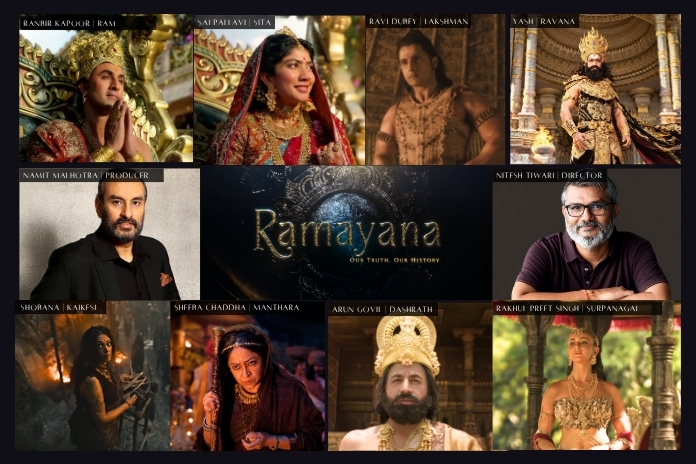
Namit Malhotra’s “Ramayana” arrives this Deepavali with ambitions that no Indian blockbuster has ever had. Backed by leading Indian stars, international filmmakers and Sony Pictures’ overseas distribution network, the epic is shaping up as one of 2026’s biggest cinematic bets: taking a deeply rooted Indian story to audiences worldwide
For MIPCOM delegates, its significance extends beyond the box office. “Ramayana” brings together storytelling, visual effects, language technology and global distribution in a test of India’s ability to build entertainment franchises for audiences beyond its diaspora.
Directed by Nitesh Tiwari, the production comes from Prime Focus Studios and DNEG, in association with Yash’s Monster Mind Creations. Part One is scheduled for November’s Deepavali season, with Part Two following in 2027. Sony Pictures will distribute outside India, while Dharma Productions handles North India’s Hindi-speaking markets.
The financial commitment matches that ambition. Namit Malhotra has estimated about $500 million for the two films. Actor and co-producer Yash has clarified that the widely reported Rs 4,000 crore includes both installments, their release and promotion, rather than the production cost of Part One alone.
Ranbir Kapoor plays Rama, Sai Pallavi portrays Sita and Yash takes on the role of Ravana. Sunny Deol appears as Hanuman, Ravie Dubey as Lakshman and Arun Govil as King Dashrath. Their characters inhabit an epic of love, duty and sacrifice, centered on Rama’s struggle to rescue Sita after Ravana abducts her.
The filmmakers’ behind-the-scenes video, “This is our Rama,” places the human challenge ahead of the spectacle. “This isn’t a role, or merely an exciting role in a movie. This is a responsibility,” Ranbir Kapoor says.
Sai Pallavi recalls seeing the Rama of her childhood imagination in Ranbir Kapoor’s appearance. Nitesh Tiwari and Namit Malhotra discuss the difficulty of casting a figure whose bearing and values matter as much as his heroism. Forgiveness, simplicity and emotional restraint emerge as foundations of the performance.
Ranbir Kapoor trained in movement and body language with Terry Notary, whose credits include the “Avengers” and “Planet of the Apes” films. Working with action specialist Guy Norris on two set pieces, Ranbir Kapoor found an emphasis on Rama’s emotions alongside the physical demands of combat.
That combination of performance and technical precision runs through the production. DNEG and ReDefine are providing visual effects for a film designed for IMAX presentation. DNEG’s teams have earned eight visual-effects Academy Awards, with winning credits including “Inception,” “Interstellar,” “Blade Runner 2049,” “Dune” and “Dune: Part Two.”
The digital work began before filming. Cinematographer Pankaj Kumar has described using motion capture to previsualize scenes, animating them in virtual environments. Working with Nitesh Tiwari and the animation team, Pankaj Kumar planned camera movements before shooting, combining physical sections of sets with blue-screen backgrounds for digitally constructed surroundings.
This gave the filmmakers a way to assess composition and movement before committing to a live shoot. Digital planning connected the director’s vision with the practical work of camera crews, performers and artists.
The approach makes visual effects an integral part of the film’s design, not simply a finishing layer. Namit Malhotra has promised landscapes, creatures and battles reimagined for the scale of international cinema. The challenge is making that world convincing without allowing its grandeur to overwhelm the characters.
Reports put the overall workforce at more than 10,000 across visual effects, production design, costumes, action and other departments. That is a total crew figure, not a count of VFX artists. Production designers Ravi Bansal and Ramsey Avery help shape the environments, while Hans Zimmer and A.R. Rahman collaborate on the score.
Technology also underpins the international release. Namit Malhotra has described combining human voice performances, artist-led lip movements and AI-assisted finishing to make translated dialogue appear naturally spoken onscreen. The aim is to preserve emotion while reducing the distraction of mismatched dubbing.
For distributors and broadcasters, that language strategy could be as significant as the spectacle. Namit Malhotra has also discussed television spinoffs and merchandise, pointing to ambitions beyond the two films although a licensed slate has not been announced.
The first test, however, remains theatrical. Nitesh Tiwari has stressed that audiences must connect with the characters, however magnificent their surroundings. This Deepavali, “Ramayana” will test whether global filmmaking resources can bring an ancient Indian epic closer to viewers discovering it for the first time.
Highlights

India Offers Fascinating Landscapes

National Education Policy: Game Changer

TIFF Reveals Plans for Industry Conference

Films by Shekhar Kapur and Shubham Yogi Selected for Toronto Gala

A Selection to Die for

Le Musk: A Brave New Frontier in Cinema

The Path finder: Jyoti Deshpande

Toonz to Honour Aabid Surti, Biren Ghose at Animation Masters Summit

India is the Country of Honour at Cannes

RAVINDRA VELHAL: DRIVING MEDIA TRANSFORMATION

THE PATH FINDER: JYOTI DESHPANDE

INTO THE WORLD OF RRR

Powerkids Appoints Manoj Mishra as CEO

Toonz Join Tunche Films to Co-Produce Spanish-Peruvian Animation Feature Kayara

National Museum of Indian Cinema Hosts Vintage Vehicles

I&B Secretary promises Govt’s Support to Film industry

Tom Cruise’s ‘Top Gun: Maverick’ to Blaze at Cannes

Illumination’s Minions: The Rise of Gru is the Annecy Festival Opener

Now, Shoot at Sight in India!

Lata Mangeshkar, India’s Singing Goddess

Quantum Image Making Has Arrived

Indian Films To Look Out For In 2022

2022: Centenary of Indian Cinema Legends

Singing Legend Lata Mangeshkar, Nightangale of India, Dies at 92