Namit Malhotra: India’s Global Image Maker
By Pickle November 8, 2026
Share:


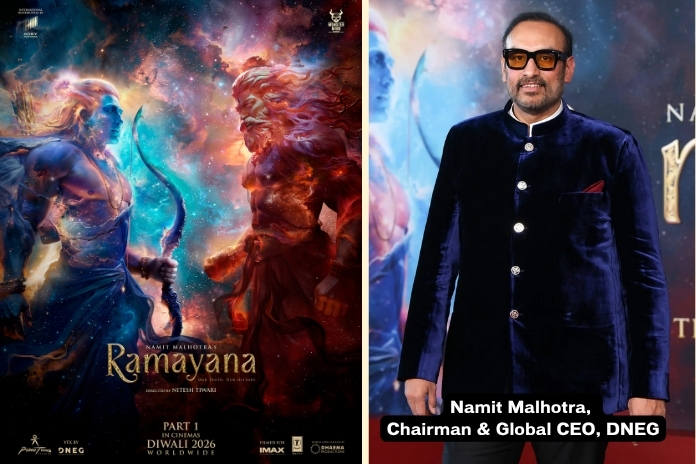
From a Mumbai garage to Hollywood, the DNEG chief has built a career making the improbable visible. His Ramayana is drawing an enthusiastic response from audiences worldwide. With an international workforce and an expanding technology ecosystem, his ambition is larger: to change what the world sees in India
At the Los Angeles premiere of Ramayana, Namit Malhotra had an admission that cut through the customary confidence of a producer promoting his biggest project: he could scarcely believe the occasion belonged to him. “I still feel like I’ve just come for somebody else’s event,” he told MUSE TV on the red carpet.
Inside, he sounded certain. “This is my Oscar moment,” he told the audience, recalling the teenager who had started in a Mumbai garage with an Apple computer and three of his teachers. The contrast is the story: an entrepreneur accustomed to delivering other people’s impossibilities, suddenly confronting the scale of his own.
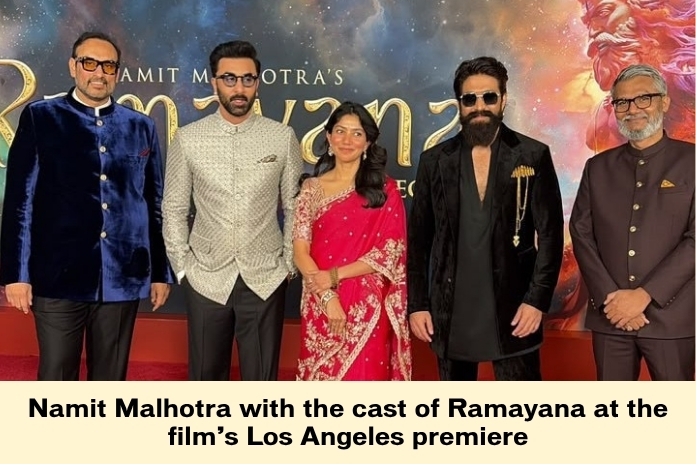
Ramayana brings together director Nitesh Tiwari, Ranbir Kapoor as Rama, Sai Pallavi as Sita and Yash as Ravana, with Hans Zimmer and A.R. Rahman composing the score. For Namit Malhotra, however, its most consequential transformation may be less visible than anything on screen: the move from helping Hollywood imagine its worlds to asking global audiences to enter an Indian one.
The apprenticeship
The garage was real; the absence of a cinematic inheritance was not. His father, Naresh Malhotra, produced Shahenshah, while his grandfather, M.N. Malhotra, was a cinematographer; Namit Malhotra initially wanted to direct. What makes his beginning interesting is not a mythology of starting with nothing, but his decision to approach the family business through a different door.
Jurassic Park supplied the revelation: technology could enlarge what storytelling made possible, he recalled. In 1995, he established Video Workshop with an Apple Mac and three people who had taught him computer graphics, working on television programmes, advertisements and music videos. Before the imagined kingdoms came Boogie Woogie and Colgate Top 10.
By his account, within two years the operation had grown from one editing studio to seven, with 15 television shows airing weekly; Prime Focus followed in 1997. The method was incremental rather than prophetic: set an attainable leadership target, reach it, then choose a bigger one. Ambition, in this telling, was something exercised, not announced.
Hollywood tested that discipline. Namit Malhotra arrived in Los Angeles in 2007 and, he told the Ramayana premiere audience, lost 90 per cent of his wealth in the following year’s financial crisis. The migration towards opportunity had become an education in exposure.
The deeper obstacle was trust: filmmakers wanted collaborators who understood their intentions, not merely a cheaper production address, he explained. That distinction remains essential to understanding him. The ambition was not simply to make India useful to Hollywood, but to make Indian leadership credible within it.
In 2014, Prime Focus World merged with London’s Double Negative, bringing together two histories rather than conjuring a global studio from scratch. Double Negative had already won the visual-effects Oscar for Inception; seven further wins followed, culminating in Dune: Part Two in 2025. These are collective triumphs, built on the contributions of extraordinary creative teams.
Across Interstellar, Ex Machina, Blade Runner 2049, First Man, Tenet and the two Dune films, DNEG’s award-winning work spans cosmic spectacle, artificial life and the machinery of human aspiration. For its leader, the accumulated achievement offers something more useful than decoration: a persuasive answer when someone asks whether an Indian epic can command comparable craft.
The people behind the pictures
The image maker’s achievement is inseparable from the talents of others. DNEG’s workforce comprises thousands of artists, producers, technicians and support staff, with Indian centres including Mumbai, Chennai, Bengaluru and Mohali connected to an international studio network. The significance for India lies not simply in the jobs, but in the proximity to demanding creative work: the opportunity to develop judgement alongside technical skill.
There is an apprenticeship behind the spectacle, too. DNEG’s Greenlight India programme has offered paid training, classroom instruction and expert mentorship, with successful participants considered for junior artist roles. Such pathways matter because a creative industry cannot live indefinitely on the discovery of exceptional individuals. It needs ways to help talent become accomplished, employable and capable of teaching the next generation.
This is the less photogenic part of Namit Malhotra’s success story: the construction of an ecosystem in which ambition can become a profession. The garage is an appealing origin; the deeper achievement is making the route beyond it less solitary for others. For India, excellence in making images must become a repeatable capability, not an occasional miracle.
The ecosystem extends from the artist’s workstation to the software underneath it. Prime Focus Technologies, founded by Ramki Sankaranarayanan and acquired by DNEG Group in 2024, contributes CLEAR and CLEAR AI, tools for managing media, collaborating on video and automating production and distribution workflows. These are not interchangeable with visual effects; they address the less visible challenge of organising content and moving it through a business.
Brahma AI takes the technology ambition further. Led by founder and chief executive Prabhu Narasimhan, it draws on capabilities developed across DNEG, Metaphysic and Prime Focus Technologies; its Core platform addresses content intelligence and management, while Studio encompasses visual AI, digital humans, voice and multilingual performance. The larger possibility is that experience acquired making films can also produce tools used far beyond them. India need not choose between supplying creative talent and developing creative technology.
There is physical infrastructure alongside the software. Prime Focus Group says its Mumbai production complex already includes eight soundstages, with post-production facilities nearby; its announcement with Maharashtra outlined plans for a further entertainment destination. The direction is clear: connect people, production facilities and proprietary tools so that more of a filmmaker’s ambition can be realised within India.
Bringing the world home
On LinkedIn, Namit Malhotra introduced Ramayana with “Ten years of Aspiration” and “Relentless Conviction”, stressing both international collaboration and reverence for the story. The capital letters belong to a promoter; the pairing of reverence and ambition defines the assignment. Familiarity must not become complacency, nor spectacle a substitute for feeling.
At San Diego Comic-Con, he offered a revealing distinction between “fans and the believers”. A producer addressing both has a delicate task: the newcomer needs an inviting story, while the devotee brings an intimate relationship with its characters. Neither audience should feel that the other has been purchased at its expense.
His account of recruiting the composers is more disarming. An A.R. Rahman admirer who had become deeply attached to Hans Zimmer’s music, Namit Malhotra has said that he approached Hans Zimmer about bringing the two together and was surprised by his enthusiasm. The global dealmaker is still recognisably a film enthusiast assembling his dream collaboration.
At CinemaCon, Namit Malhotra reached for a Hollywood shorthand, describing the film as “Avatar meets Gladiator”. It is a salesman’s bridge between the known and the unknown, but also a measure of the change he is attempting. The reference points may be American; the imaginative centre is not. He is borrowing the language of the blockbuster without surrendering the provenance of the story.
There is strategy beneath the enthusiasm. Sony Pictures is handling distribution outside India, while Dharma Productions leads distribution in North India’s Hindi-speaking markets. This is a potentially pathbreaking arrangement for this particular ambition: international reach built into the release, rather than left as an aspiration attached to a domestic success. Distribution cannot manufacture affection, but it can give unfamiliar audiences a chance to develop it.
By the Los Angeles premiere, he was measuring progress in the city itself. He pointed to Ramayana hoardings across the American metropolis and distinguished a mainstream Western audience from a screening organised principally for Indians abroad. An image maker could hardly choose a more revealing yardstick: not just the pictures inside the cinema, but whose stories occupy the streets outside it.
Namit Malhotra has also described two master versions, including an English version whose script was rewritten rather than simply translated, designed for people encountering Ramayana for the first time. That is an important distinction. Cultural confidence need not mean expecting the visitor to arrive already fluent.
Brahma AI makes that argument tangible. According to Nitesh Tiwari and Namit Malhotra, human artists performed the dubbed voices, while AI-assisted technology adapted the actors’ lip movements for the international version. Their account places technology in service of performance, not in its place. The test is whether audiences feel closer to the characters rather than conscious of the machinery.
Yet his most expansive pitch is also perhaps his simplest of all. On the premiere red carpet, he described the epic as a story of “love, sacrifice, family”, values he believed could resonate anywhere. That conviction is the human counterweight to the machinery. Technology can make a world convincing; only the people inside it can make an audience care enough to return.
The commercial logic extends beyond one film. Namit Malhotra has linked the move into producing content to the vulnerability exposed by the pandemic and Hollywood strikes: creating projects of his own could help protect the business he had built. Owning more of the opportunity also means carrying more of the risk. A supplier’s celebrated craftsmanship does not guarantee a producer’s successful wager.
A door, not a destination
This is where the possibility of an Indian “K-pop moment” becomes compelling, provided it is treated as an ambition rather than a prediction. A breakthrough for Ramayana could make international partners more receptive to other Indian projects, encouraging investment not only in spectacular epics but in unfamiliar voices, genres and imaginative traditions.
The real prize would be curiosity that survives the closing credits. An audience drawn towards another Indian film, another musical idiom or another story would represent something more durable than a single opening weekend. For that to happen, a hit would need successors, distribution relationships, patient marketing and room for creative difference. The workforce and tools matter precisely because they could help turn a breakthrough into a continuing supply of accomplished work.
It would also require resisting the temptation to make one sacred epic stand for an entire country. India’s next global story need not resemble Ramayana in scale, setting or belief. The most valuable door this film could open is one through which very different storytellers can walk.
For now, the wager remains unresolved, with the first instalment released on November 5, 2026. The achievement already visible is the assembly of the opportunity, not proof of the outcome. Namit Malhotra’s success story is more interesting for being unfinished.
Asked whether he still wanted to direct, he offered a different destination: “I think now I could be the best producer in the world.”
Highlights

ads2OTT set to Launch in Oct 2020

Virtual Nab Show Express will Take Place May 13-14, 2020

TIFF Reveals Plans for Industry Conference

Films by Shekhar Kapur and Shubham Yogi Selected for Toronto Gala

A Selection to Die for

Le Musk: A Brave New Frontier in Cinema

The Path finder: Jyoti Deshpande

Toonz to Honour Aabid Surti, Biren Ghose at Animation Masters Summit

India is the Country of Honour at Cannes

RAVINDRA VELHAL: DRIVING MEDIA TRANSFORMATION

THE PATH FINDER: JYOTI DESHPANDE

INTO THE WORLD OF RRR

Powerkids Appoints Manoj Mishra as CEO

Toonz Join Tunche Films to Co-Produce Spanish-Peruvian Animation Feature Kayara

National Museum of Indian Cinema Hosts Vintage Vehicles

I&B Secretary promises Govt’s Support to Film industry

Tom Cruise’s ‘Top Gun: Maverick’ to Blaze at Cannes

Illumination’s Minions: The Rise of Gru is the Annecy Festival Opener

Now, Shoot at Sight in India!

Lata Mangeshkar, India’s Singing Goddess

Quantum Image Making Has Arrived

Indian Films To Look Out For In 2022

2022: Centenary of Indian Cinema Legends

Singing Legend Lata Mangeshkar, Nightangale of India, Dies at 92