WAVES Film Bazaar Connects Stories to Their Next Stage
By Pickle November 13, 2026
Share:


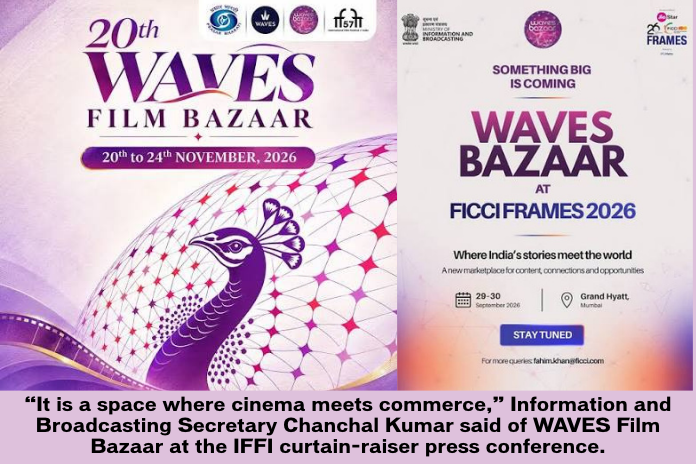
The 20th edition will bring film professionals to Goa for project development, co-production and distribution conversations. Delegates can explore a programme spanning scripts, rough cuts, completed films, production destinations and filmmaking technology.
“It is a space where cinema meets commerce,” Information and Broadcasting Secretary Chanchal Kumar said of WAVES Film Bazaar at the IFFI curtain-raiser press conference. “Over two decades, it has developed into an important meeting ground for filmmakers, producers, writers, and industry professionals to discover and explore partnerships.”
The market is a core industry pillar of IFFI, with NFDC Managing Director Dheeraj Singh placing it alongside screenings among the festival’s central components. For delegates, its programme offers different routes to potential partners, professional feedback and audiences, depending on whether they are developing a script, completing a film or seeking distribution.
The 20th edition of WAVES Film Bazaar will run from November 20 to 24 at Taj Cidade de Horizonte, Goa, alongside IFFI. Organisers have announced 150 invited guests, including buyers and production houses, with the Screenwriters’ Lab, Co-production Market, Viewing Room and Work-in-Progress Lab among the principal programmes.
Delegates do not need to arrive with a project to participate in the market: NFDC’s guidance also identifies opportunities for producers, buyers and investors looking for new films and collaborators. Access to particular programmes, however, depends on selection or professional accreditation rather than being automatically included for every attendee.
For projects in development, the Co-production Market connects selected filmmakers with Indian and international producers, financiers, distributors and sales agents who may provide financial or artistic support. Its feature and documentary sections give delegates distinct groups of projects to explore, depending on their interests and production plans.
The Screenwriters’ Lab has selected eight projects from 213 entries, according to the curtain-raiser presentation. The programme combines screenplay development with mentoring by script and industry experts, and prepares participants to present their projects to producers and investors. For potential collaborators, the focus is on stories being developed for the next stage of production rather than completed films available for acquisition.
Filmmakers with work already in post-production have a different route through the Work-in-Progress Lab. Selected participants present rough cuts to international experts and work with feedback and editing mentors towards a final version, while retaining the freedom to decide whether to adopt the advice. The lab is a focused development process, not an open screening programme for all delegates.
The Viewing Room serves another purpose: helping eligible industry professionals discover completed films and works in post-production seeking festival opportunities, distribution, world sales or finishing funds. Access is restricted and granted according to professional profiles, including buyers, investors, festival programmers, sales representatives and distributors; submitting a film does not itself give a filmmaker Viewing Room access.
Market Screenings provide a separate opportunity for filmmakers to present their work to industry professionals in specially arranged digital theatres. Together, these formats allow the market to address both the creative needs of films nearing completion and the commercial needs of works seeking circulation.
Delegates exploring where and how to produce can also turn to the country and state pavilions, which are intended to facilitate discussions about film policies, incentives and production partnerships. The published country-pavilion line-up includes Spain’s Embassy and ICAA, HKTDC Filmart from Hong Kong, ROSKINO from Russia and Kyrgyzstan, alongside Indian state and industry representation.
The Knowledge Series adds discussions on content, distribution platforms, co-production, international collaboration and navigating festivals and markets. Netflix has been announced as Knowledge Series partner, with participation covering creative capacity-building, VFX skills and pitching, alongside the gala premiere of Pushpak Viman and an international screening of Ray Gunn.
Technology will also feature through the VFX and Tech Pavilion, whose stated scope includes animation, visual effects, virtual reality and CGI. Chanchal Kumar said the industry’s adoption of new tools should remain anchored in creative expression: “Our efforts must be to ensure that technology strengthens the storyteller’s imagination and that creators have the skills, platforms, and opportunities to participate in this changing landscape.”
The Bazaar remains a business-to-business market, distinct from IFFI’s audience-facing film festival; participation in the market does not automatically mean a film has been selected for an IFFI screening. NFDC also makes clear that it does not guarantee business opportunities and that collaboration terms must be negotiated by the parties themselves.
Highlights

India Offers Fascinating Landscapes

TIFF Reveals Plans for Industry Conference

Films by Shekhar Kapur and Shubham Yogi Selected for Toronto Gala

A Selection to Die for

Le Musk: A Brave New Frontier in Cinema

The Path finder: Jyoti Deshpande

Toonz to Honour Aabid Surti, Biren Ghose at Animation Masters Summit

India is the Country of Honour at Cannes

RAVINDRA VELHAL: DRIVING MEDIA TRANSFORMATION

THE PATH FINDER: JYOTI DESHPANDE

INTO THE WORLD OF RRR

Powerkids Appoints Manoj Mishra as CEO

Toonz Join Tunche Films to Co-Produce Spanish-Peruvian Animation Feature Kayara

National Museum of Indian Cinema Hosts Vintage Vehicles

I&B Secretary promises Govt’s Support to Film industry

Tom Cruise’s ‘Top Gun: Maverick’ to Blaze at Cannes

Illumination’s Minions: The Rise of Gru is the Annecy Festival Opener

Now, Shoot at Sight in India!

Lata Mangeshkar, India’s Singing Goddess

Quantum Image Making Has Arrived

Indian Films To Look Out For In 2022

2022: Centenary of Indian Cinema Legends

Singing Legend Lata Mangeshkar, Nightangale of India, Dies at 92

Bhushan Kumar’s T-Series Ventures Into OTT Content Creation Space