IFFI Makes Room for the Next Filmmakers
By Pickle November 13, 2026
Share:


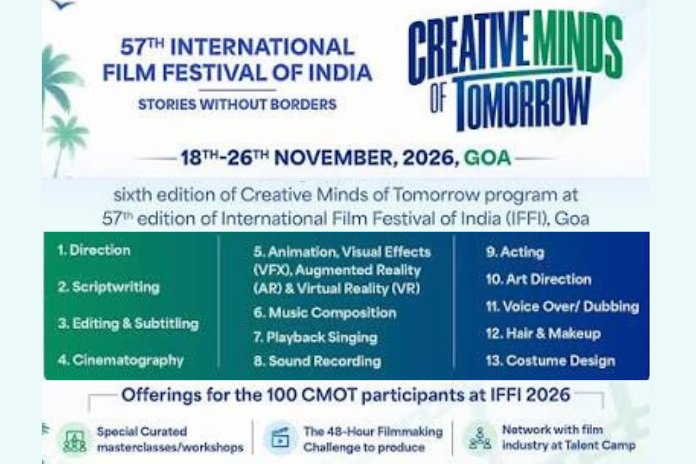
IFFI’s talent story is not confined to a single prize. Its 2026 programme combines an international debut-film competition with a separate Indian debut-director award and the sixth edition of Creative Minds of Tomorrow, which will bring together 100 selected participants across 13 filmmaking crafts. These initiatives address different points in a creative career, from recognising a completed first feature to giving emerging practitioners a setting in which to learn and work.
Seven films will compete in the international Best Debut Feature Films section: Fading Man from Germany, The Sledge from India, Paris from Belgium, The Black Sea from Egypt, L’Âge d’Or (The Golden Age) from France and Italy, Birds on Ice from India, and Atlantic from China.
The selection gives first features a shared international context without requiring them to come from the same production culture.
The award carries a Silver Peacock, certificate and ₹15 lakh cash prize under IFFI’s international-cinema regulations. IFFI international-cinema regulations
) Recognition at this stage can provide a useful point of attention for a filmmaker. It should not, however, be confused with a guarantee of distribution or financing for a second film.
Indian Panorama’s Best Debut Director of an Indian Feature Film Award is a separate recognition. Indian Panorama regulations. Its five nominees are Chennai Love Story by Ravi Varma Namburi, Pratyabartan by Samarpan Sengupta, Tighi by Jeejivisha Kale, Sledge by Raja Shabir Mohd Khan and Hanuman Ansh by Dr. Vishal Chaturvedi. Keeping the two awards distinct allows readers to understand exactly what kind of selection or recognition a filmmaker has received.
Creative Minds of Tomorrow approaches the talent question through practice. Its announced programme includes workshops, masterclasses, conversations, a 48-hour filmmaking challenge and the CMOT Talent Camp, with opportunities to engage with industry professionals and pitch ideas. The emphasis on 13 crafts also makes room for a broader understanding of film careers than a focus on direction alone.
A short filmmaking challenge can make collaboration immediate. Participants have to decide what can be achieved, divide responsibilities and complete a piece of work within a limited period. The useful lesson is not simply speed. It is the relationship between a creative ambition and the practical choices that allow a team to realise it.
The Talent Camp offers a different kind of encounter: a chance to present abilities and ideas in a professional setting. For participants, a productive outcome might be clearer feedback, a new collaborator or an informed next step. None should be reported in advance as a job placement or a commissioned project.
Ashutosh Gowariker framed access to storytelling as another border: the gap between people who have already had the opportunity to tell their stories and those who are beginning. That is a useful lens for this part of the festival. Emerging talent needs more than a declaration that new voices are welcome; it needs occasions to show work, receive a response and meet people who understand the craft.
Highlights

Film Making Centres of India

TIFF Reveals Plans for Industry Conference

Films by Shekhar Kapur and Shubham Yogi Selected for Toronto Gala

A Selection to Die for

Le Musk: A Brave New Frontier in Cinema

The Path finder: Jyoti Deshpande

Toonz to Honour Aabid Surti, Biren Ghose at Animation Masters Summit

India is the Country of Honour at Cannes

RAVINDRA VELHAL: DRIVING MEDIA TRANSFORMATION

THE PATH FINDER: JYOTI DESHPANDE

INTO THE WORLD OF RRR

Powerkids Appoints Manoj Mishra as CEO

Toonz Join Tunche Films to Co-Produce Spanish-Peruvian Animation Feature Kayara

National Museum of Indian Cinema Hosts Vintage Vehicles

I&B Secretary promises Govt’s Support to Film industry

Tom Cruise’s ‘Top Gun: Maverick’ to Blaze at Cannes

Illumination’s Minions: The Rise of Gru is the Annecy Festival Opener

Now, Shoot at Sight in India!

Lata Mangeshkar, India’s Singing Goddess

Quantum Image Making Has Arrived

Indian Films To Look Out For In 2022

2022: Centenary of Indian Cinema Legends

Singing Legend Lata Mangeshkar, Nightangale of India, Dies at 92

Bhushan Kumar’s T-Series Ventures Into OTT Content Creation Space