Ramoji Film City: Where Scripts Become Finished Films
By Pickle November 18, 2026
Share:


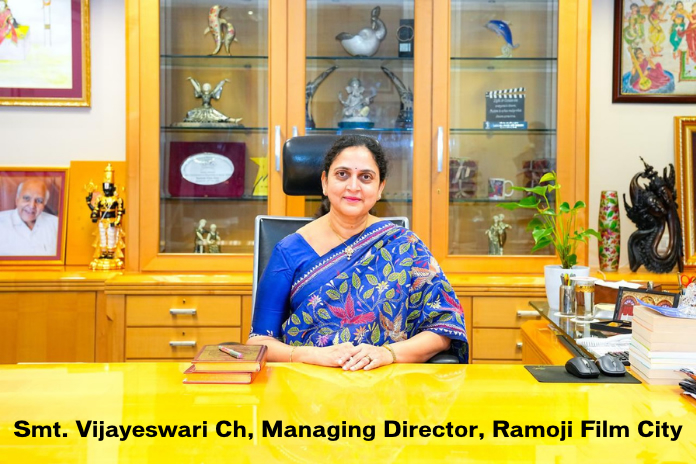
From Baahubali to Varanasi, Ramoji Film City has built many worlds. Managing Director Vijayaeswari Ch. explains how one campus helps global and Indian producers shoot faster, smarter and leaner
What makes Ramoji the right choice for a global production and domestic production, and how does Hyderabad’s wider filmmaking ecosystem strengthen your offering?
Ramoji Film City is conceived to support productions from the ground up – locations, sets, studios, production services, accommodation, catering and logistics. And Hyderabad has a very strong well established film Industry and filmmaking ecosystem for decades, with experienced crew, technicians, artists, equipment suppliers and production talent. The biggest advantage is that a producer can find scale, infrastructure and filmmaking expertise.
For an international producer, that combination offers familiarity, flexibility and cost savings. For an Indian production, it means being able to scale up or move between very different production requirements without having to rebuild.
How does your promise, “Come with a script and go with a film,” work in practice, from script breakdown and budgeting to delivery of the finished film?
Vision of our founder Shri.Ramoji Rao was to provide comprehensive film making infrastructure under one roof. The advantage of having every facility within one complex offers film makers flexibility to take decisions faster and production becomes simpler with focus on creativity.
Which production best demonstrates Ramoji’s ability to deliver at scale, and what was the toughest creative or logistical challenge your team solved?
We have supported productions across languages, genres and scales.
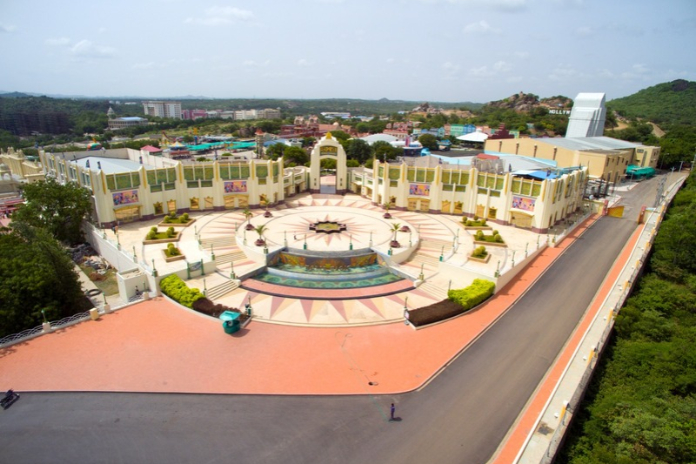
Some of the mega supported by Ramoji film city include BAHUBALI, PUSHPA-2, RRR, KALKI , KGF, SAALAR, SORYAVAMSHI, SINGHAM and VARANASI to name a few.
What consistently demonstrates our capability is the ability to accommodate productions that require multiple worlds within the same project – large sets, period/social environments, urban settings, outdoor locations and controlled studio environments.

The real challenge at that scale is coordination. A filmmaker sees one finished scene; behind it are art teams, construction crews, lighting, technical teams, production logistics and location management all working to the same deadline.
Our professional teams are adept at handling diverse projects from mega budget to small and medium sized films, Game shows, OTT, Television serials and commercials.
What is your current capacity across locations, backlots and sound stages, and how can producers combine them to shoot different countries, periods and worlds without leaving the campus?
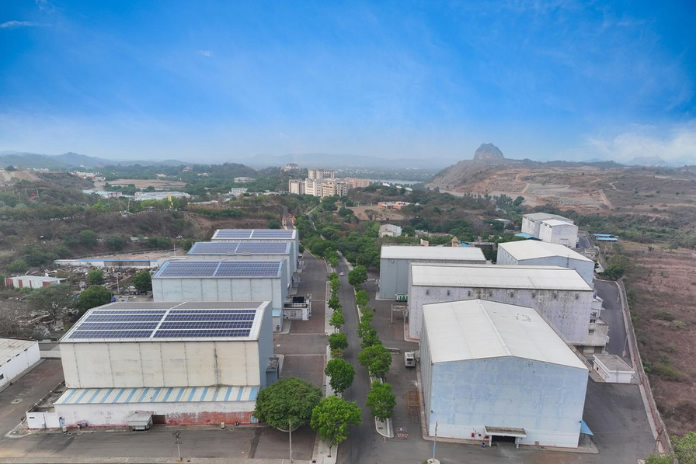
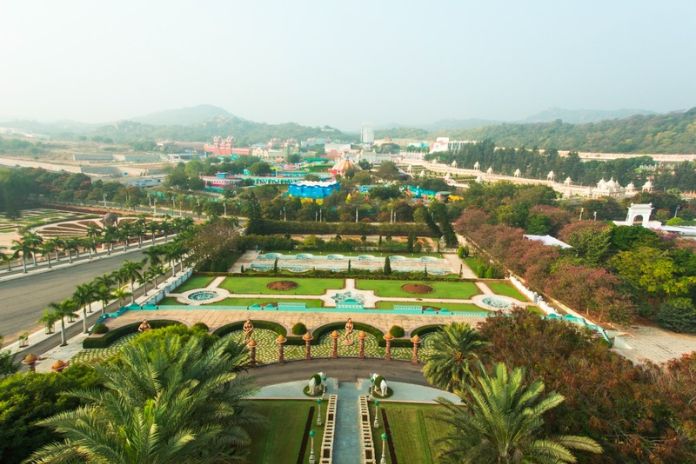
The strength of Ramoji is the variety within a single campus.
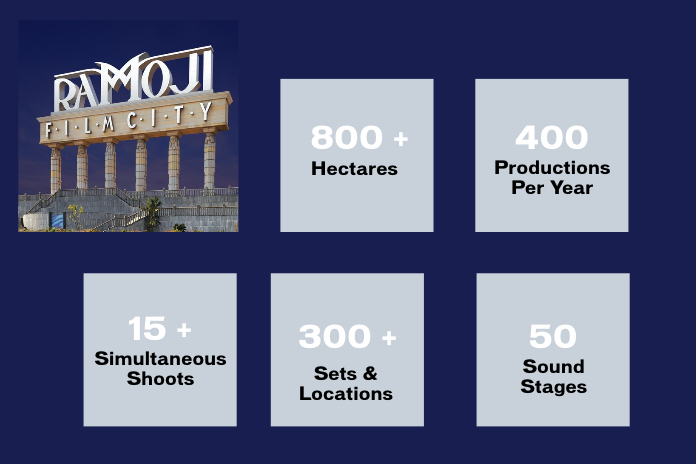
More than 300 ready to shoot locations, varied sizes of shooting floors, exclusive set design and making facilities and others production services can support up to 15 shoots a day.
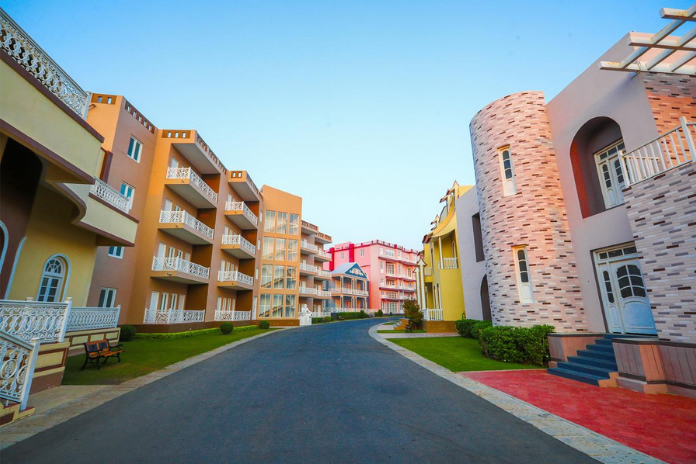
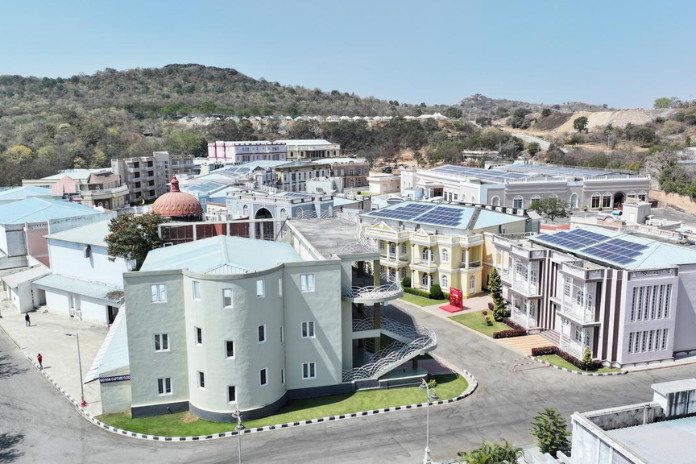
The purpose-built studio spaces, outdoor locations, thematic avenues, sets and other locations can be easily adapted for different storytelling requirements.
At Ramoji Film City, the savings start on day one. Producers get world-class stages, sets, crews and post-production under one roof, at a base cost lower than most destinations offer after rebates. No paperwork. No waiting. No fine print
A production can therefore move from an indoor controlled environment to an outdoor period setting or a completely different architectural world without the logistical overhead of moving across multiple cities.
When a filmmaker imagines something that does not yet exist, how do your set-construction teams, craftspeople, prop house and costume services bring it to life within budget?
A filmmaker may come to us with a reference, a sketch or simply an idea. Our teams can work backwards from that creative brief – understanding the scale, period, materials, other production requirements and budget – and translate it into something physically buildable.
The process involves production designers, art directors, sculptors, carpenters, painters, moulders and other skilled craftspeople.
The important part is that the creative ambition and production reality have to meet somewhere in the middle. The objective isn’t simply to build something impressive; it is to build what the camera needs, within the time and budget available.
What can producers access on-site in sound stages, cameras, lenses, lighting, cranes and specialist rigs, and how do you meet a production’s specific technical requirements?
We start with the technical requirements of the production and then determine what can be provided within the Ramoji ecosystem and what needs to be sourced additionally.
That flexibility is important, particularly for international productions, because technical specifications can vary significantly between productions.
How do you assemble crews for international productions and meet their requirements for working practices, safety, insurance and confidentiality?
The starting point is understanding the production’s requirements well before shooting begins.
Apart from Ramoji film city ,Hyderabad has a deep pool of experienced filmmaking professionals, and we can work with producers to identify the appropriate local talent and production specialists.
For international productions, working practices, safety protocols, insurance requirements, confidentiality and production-specific compliance are discussed much before the commencement of the project by our professional teams to ensure hassle free production.
For us, the objective is to make the local production environment work seamlessly with the standards and expectations of the visiting production.
What virtual-production and motion-capture capabilities are operational today, and how do you help filmmakers choose between physical sets, digital environments and a combination of both?
Virtual production is particularly useful when a filmmaker wants to create a location that is either difficult to access or expensive and complicated to shoot in. At Ramoji, we can combine physical elements – like props, foreground sets and actors with a completely digital environment in the background.
Our virtual production setup is Chroma-based and supported by Mo-Sys camera tracking So, for example, the background could be a real location recreated digitally, or it could be an entirely imaginary world.
We don’t see it as a choice between physical and digital. In many cases, the best solution is a combination of both. The actors have real elements to interact with, while the larger world can be created digitally. That gives filmmakers much greater creative freedom and can also solve significant location and logistics challenges.
Our professional teams are adept at handling diverse projects from mega budget to small and medium sized films, Game shows, OTT, Television serials and commercials
We also have a dedicated motion-capture facility with 24 OptiTrack cameras capable of capturing 5–6 characters in real time. Those performances can then be retargeted onto 3D characters. So our approach is quite simple: start with what the filmmaker wants to create, and then decide what should be built physically, what should be created digitally, and where the two can work together most effectively.
This is one of the very important advantages for a producer.
A long production schedule is not only about the cost of cameras and sets. Every movement of people and equipment adds time and money. Having accommodation, catering, transport and production facilities within the same larger campus can significantly simplify daily logistics.
How do your hotels, crew accommodation, catering and internal transport support a long production schedule while reducing travel time and daily costs?
For a crew working long hours, the difference between a short internal transfer and a daily city commute can become substantial over the course of a production.
Our ambition over 30 years has not been only to simply function as a location where filmmakers come to shoot, but as a production partner they can rely on from the first conversation through execution
So when we talk about production efficiency, we look at the entire production day – not just the shoot itself.
What support can an overseas producer expect from the first enquiry through location scouting, visas, filming permissions, equipment customs clearance and incentive applications?
We aim to be the production partner that helps navigate the local ecosystem.
That starts with understanding the script and production requirement, followed by location options, budgeting and production planning.
Vision of our founder Shri.Ramoji Rao was to provide comprehensive film making infrastructure under one roof
For international productions, there are also practical considerations around visas, permissions, equipment movement, customs and government processes. We help coordinate the relevant stakeholders and guide producers through the requirements.
We can also help producers understand the relevant state and national frameworks and connect them with the appropriate authorities.
How do you provide a single point of accountability and transparent pricing, so producers know what is included, what costs extra and how changes will affect the budget?
Transparency starts before the cameras roll.
We work to understand the production requirement in detail and build the scope accordingly – locations, sets, infrastructure, accommodation, equipment, manpower and other services.
The producer should be able to distinguish between what is included, what is an additional requirement and what changes if the creative brief changes.
A filmmaker may come to us with a reference, a sketch or simply an idea. Our teams can work backwards from that creative brief – understanding the scale, period, materials, other production requirements and budget – and translate it into something physically buildable
Production inevitably involves changes. The important thing is to surface the impact early rather than allowing costs to appear at the end.
That is where a single accountable production interface becomes valuable.
How does your production-cost-saving model work for Indian and overseas producers, and where do the biggest savings come from without compromising quality?
They come from reducing friction across the production. Imagine crew walking to a film set for the shoot. Time is money in filmmaking. If you can save a production day, reduce travel or avoid rebuilding infrastructure elsewhere, the saving can be significant.
Think about the cumulative effect of fewer location moves, shorter crew transfers, readily available infrastructure, integrated accommodation and catering, local production expertise and the ability to build multiple environments in one place.
Our proposition is therefore about production efficiency, not simply being the cheapest option.
Can you share a like-for-like budget comparison showing how Ramoji’s total production cost compares with an incentive-led destination, separating operational savings from rebates? Can a producer benefit from Ramoji even if they don’t qualify for incentives?
At Ramoji Film City, the savings come at the start. Producer gets world class stages, sets, crews and post under one roof at a base cost that already beats what most places charge after their rebate. No paperwork, no waiting, no fine print. Just a better number on day one.”
And yes, a producer can benefit from the Ramoji proposition because the underlying value is the production ecosystem itself: infrastructure, locations, talent, logistics and the ability to bring multiple requirements together.
What kinds of global and domestic productions would you most like to bring to Ramoji?
We wish to invite productions that can genuinely benefit from what the ecosystem offers – large-scale films, international productions, OTT series, period dramas, action projects, fantasy worlds and productions requiring multiple locations or substantial set construction.
Our ambition over 30 years has not been only to simply function as a location where filmmakers come to shoot, but as a production partner they can rely on from the first conversation through execution.
Highlights

TIFF Reveals Plans for Industry Conference

Films by Shekhar Kapur and Shubham Yogi Selected for Toronto Gala

A Selection to Die for

Le Musk: A Brave New Frontier in Cinema

The Path finder: Jyoti Deshpande

Toonz to Honour Aabid Surti, Biren Ghose at Animation Masters Summit

India is the Country of Honour at Cannes

RAVINDRA VELHAL: DRIVING MEDIA TRANSFORMATION

THE PATH FINDER: JYOTI DESHPANDE

INTO THE WORLD OF RRR

Powerkids Appoints Manoj Mishra as CEO

Toonz Join Tunche Films to Co-Produce Spanish-Peruvian Animation Feature Kayara

National Museum of Indian Cinema Hosts Vintage Vehicles

I&B Secretary promises Govt’s Support to Film industry

Tom Cruise’s ‘Top Gun: Maverick’ to Blaze at Cannes

Illumination’s Minions: The Rise of Gru is the Annecy Festival Opener

Now, Shoot at Sight in India!

Lata Mangeshkar, India’s Singing Goddess

Quantum Image Making Has Arrived

Indian Films To Look Out For In 2022

2022: Centenary of Indian Cinema Legends

Singing Legend Lata Mangeshkar, Nightangale of India, Dies at 92

Bhushan Kumar’s T-Series Ventures Into OTT Content Creation Space

What’s India Looking for at European Film Market