Dhurandhar Opens IFFI Indian Panorama
By Pickle November 21, 2026
Share:


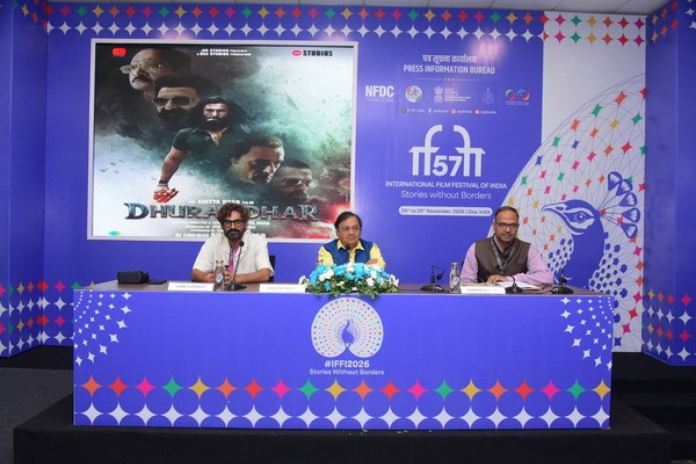
Aditya Dhar’s Dhurandhar opened Indian Panorama’s Mainstream Cinema category at the 57th IFFI Goa, putting craft and character centre stage.
Aditya Dhar’s Hindi feature Dhurandhar, which opened the Mainstream Cinema Feature Film category of the Indian Panorama, was the top focus at the 57th International Film Festival of India (IFFI) in Goa.
Veteran actor Rakesh Bedi and production designer Saini S. Johray discussed the film’s creative journey, characterisation and visual world-building at an interactive session. Mahesh Kumar, Additional Director General, Ministry of Information and Broadcasting, moderated.
Rakesh Bedi, who plays Jamil Jamali, stressed the importance of layered character writing in contemporary cinema. Calling theatre the enduring foundation of his craft, he described the meticulous research behind the role. A character’s actions, he said, must be driven by the demands of the scene, making the performance a complete portrayal rather than mimicry.
Looking back on a five-decade career, Rakesh Bedi recalled the popularity of Ek Duuje Ke Liye, Tirangaa and Chashme Buddoor. Cinema had tremendous public appeal then, he said, but its reach was limited by the absence of digital connectivity. Social media now takes an actor’s work to audiences worldwide with a single click.
Asked about his comic and dramatic timing, Rakesh Bedi said such nuances are never accidental. Every gesture and expression is planned as part of the script and character arc.
He also advised actors against rehearsing in front of a mirror. Watching oneself can stunt an actor’s growth, he said, because a performance is difficult to assess objectively while delivering it. Once an actor understands a character’s psyche, speech, reactions and emotional transitions flow naturally.
Saini S. Johray said the team built more than 40 practical sets. Without physical access to locations in Pakistan, the production designer relied on exhaustive research to reconstruct the film’s environment from scratch. That research covered news archives, local gang-war reports, urban textures and Google Maps.
The interaction underlined IFFI’s role as a platform for conversations on the craft, research and collaboration behind filmmaking.
Highlights

TIFF Reveals Plans for Industry Conference

Films by Shekhar Kapur and Shubham Yogi Selected for Toronto Gala

A Selection to Die for

Le Musk: A Brave New Frontier in Cinema

The Path finder: Jyoti Deshpande

Toonz to Honour Aabid Surti, Biren Ghose at Animation Masters Summit

India is the Country of Honour at Cannes

RAVINDRA VELHAL: DRIVING MEDIA TRANSFORMATION

THE PATH FINDER: JYOTI DESHPANDE

INTO THE WORLD OF RRR

Powerkids Appoints Manoj Mishra as CEO

Toonz Join Tunche Films to Co-Produce Spanish-Peruvian Animation Feature Kayara

National Museum of Indian Cinema Hosts Vintage Vehicles

I&B Secretary promises Govt’s Support to Film industry

Tom Cruise’s ‘Top Gun: Maverick’ to Blaze at Cannes

Illumination’s Minions: The Rise of Gru is the Annecy Festival Opener

Now, Shoot at Sight in India!

Lata Mangeshkar, India’s Singing Goddess

Quantum Image Making Has Arrived

Indian Films To Look Out For In 2022

2022: Centenary of Indian Cinema Legends

Singing Legend Lata Mangeshkar, Nightangale of India, Dies at 92

Bhushan Kumar’s T-Series Ventures Into OTT Content Creation Space

What’s India Looking for at European Film Market