IFFI Goa: Art Is Discovered, Craft Is Taught
By Pickle November 22, 2026
Share:


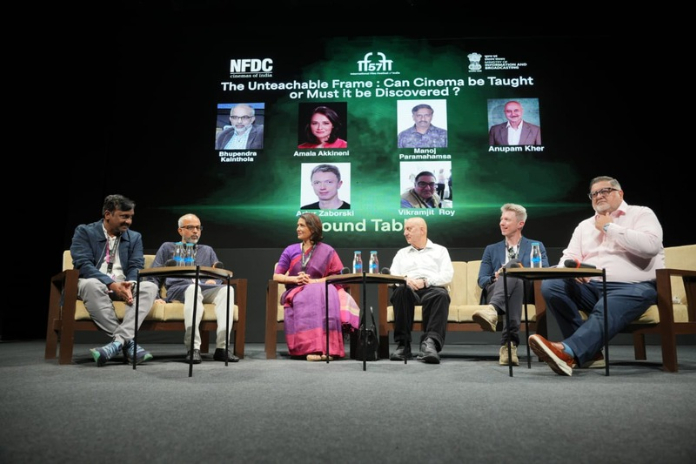
Film schools remain essential for teaching craft, collaboration and business skills, even as AI reshapes filmmaking, IFFI Goa panellists said.
“Art can be discovered, but craft has to be taught,” said Bhupendra Kainthola, former director of the Film and Television Institute of India (FTII), at the 57th International Film Festival of India (IFFI) in Goa, where a panel of educators and practitioners made the case for formal film training.
The session, titled ‘The Unteachable Frame: Can Cinema Be Taught or Must It Be Discovered?’, was moderated by Vikramjit Roy, who has held leadership positions at Sony Pictures India and the National Film Development Corporation (NFDC).
Bhupendra Kainthola said success in filmmaking requires creativity to be backed by discipline, structured learning and professional processes. Many FTII students choose film education despite conventional career expectations within their families, he noted, and public-funded institutions have a responsibility to provide an environment in which their ambitions can be nurtured.
Actor Anupam Kher, founder of Actor Prepares, credited his own training for his career. “I would not have been sitting here had I not gone to National School of Drama,” he said. Anupam Kher said his training equipped him to play a 65-year-old man at the age of 28 in his debut film Saaransh.
He identified observation, imagination and emotional memory as the three essential qualities of an actor, and described acting as an engagement with the Navarasas, the nine emotions. “Every experience teaches you something. What you learn as a human being will help you in your acting,” he said. Anupam Kher also warned young actors against complacency, observing that competence can become an obstacle to brilliance.
Amala Akkineni, actor and director of Annapurna College of Film and Media, said film schools teach students to work together and understand how filmmaking disciplines depend on one another. She called on educators to challenge stereotypes and encourage more women to pursue professional training, and urged aspiring filmmakers to go the extra mile.
Artur Daborski, vice-rector for international cooperation at Warsaw Film School, said students there make films in a supportive environment where they can experiment and learn from mistakes, which carry significant financial and practical consequences on professional sets. He stressed the need to prepare students for the business of filmmaking, including pitching to producers and securing funding, and described festival exposure as integral to that preparation.
On what European festivals look for, Artur Daborski encouraged young filmmakers to explore subjects that trouble them, saying festivals value films that engage with important social and human concerns.
Cinematographer Manoj Paramahamsa, founder of Cinema Factory Academy, said professional sets leave beginners little scope for trial and error. Film schools provide that foundation, he said, while also teaching students to manage people, coordinate teams and collaborate.
On Artificial Intelligence, Manoj Paramahamsa said the technology is simplifying repetitive tasks, generating preliminary storyboards and improving production workflows. Filmmakers can now modify backgrounds and create sophisticated visual environments after filming, he added.
Anupam Kher acknowledged the need to adapt, but said AI-generated avatars cannot replicate the heart and soul that human beings bring to acting.
Highlights

Stage set for Cannes from July 6. Spike Lee, Cannes Jury Head

TIFF Reveals Plans for Industry Conference

Films by Shekhar Kapur and Shubham Yogi Selected for Toronto Gala

A Selection to Die for

Le Musk: A Brave New Frontier in Cinema

The Path finder: Jyoti Deshpande

Toonz to Honour Aabid Surti, Biren Ghose at Animation Masters Summit

India is the Country of Honour at Cannes

RAVINDRA VELHAL: DRIVING MEDIA TRANSFORMATION

THE PATH FINDER: JYOTI DESHPANDE

INTO THE WORLD OF RRR

Powerkids Appoints Manoj Mishra as CEO

Toonz Join Tunche Films to Co-Produce Spanish-Peruvian Animation Feature Kayara

National Museum of Indian Cinema Hosts Vintage Vehicles

I&B Secretary promises Govt’s Support to Film industry

Tom Cruise’s ‘Top Gun: Maverick’ to Blaze at Cannes

Illumination’s Minions: The Rise of Gru is the Annecy Festival Opener

Now, Shoot at Sight in India!

Lata Mangeshkar, India’s Singing Goddess

Quantum Image Making Has Arrived

Indian Films To Look Out For In 2022

2022: Centenary of Indian Cinema Legends

Singing Legend Lata Mangeshkar, Nightangale of India, Dies at 92

Bhushan Kumar’s T-Series Ventures Into OTT Content Creation Space