It’s Time for India to Stream, Dream, and Scheme with AI: Uday Shankar
By Pickle February 22, 2026
Share:


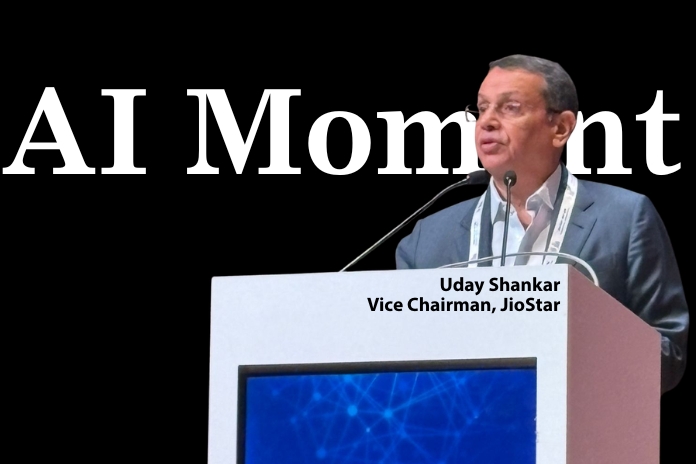
For a nation defined by its stories, the next chapter could be written by AI—and by a new self-belief that it’s India’s turn to lead, says Uday Shankar, JioStar Vice Chairman at the India AI Impact Summit.
As artificial intelligence takes centre stage globally, India is poised at a crossroads—and few articulated its promise and pitfalls more sharply than Uday Shankar at the India AI Impact Summit, capturing a nation’s restless ambition and its anxieties—and then pointing to artificial intelligence as India’s next great leap.
In a keynote that blended optimism with realism, the JioStar Vice Chairman highlighted how India’s storytelling tradition, when fused with cutting-edge AI, could finally propel the nation’s media industry to global prominence. But, he cautioned, ambition alone won’t suffice; the time to act is now.
The setting itself was loaded with symbolism: Bharat Mandapam, hosting the first global AI summit in the Global South, a space where delegates from around the world mingled with India’s tech and media elite. But it was Uday Shankar’s keynote that electrified the room, not just for its optimism, but for its candor about India’s creative paradox.
The Indian Dream
Uday Shankar did something unusual for a tech summit: he started not with jargon, but with stories—about how technology, from the first personal computer in newsrooms to the birth of digital news, had changed Indian media. As a veteran of the industry, Uday Shankar has had, as he put it, a “ringside view” of this transformation. His anecdotes felt less like nostalgia and more like a prelude—reminding the audience that innovation is as much about culture and courage as it is about code.
It’s hard to overstate how far India’s media industry has come. In a generation, it has become the world’s fifth-largest, reaching more than 800 million video consumers, and producing content in dozens of languages. Uday Shankar pointed to the social and economic impact: media shaping not just what people watch, but what they dare to dream.
Yet, for all its scale and vibrancy, Indian content rarely breaks through globally. While South Korea rides the “K-wave” with hits like Squid Game and Parasite, while Latin pop and reggaeton dominate Spotify, Indian exports—save for rare exceptions like RRR and Dangal—remain largely for domestic or diaspora audiences. For Uday Shankar, this gap is both a puzzle and a provocation.
The Structural Bind
The problem isn’t a lack of talent. “The breathtaking VFX of Life of Pi was largely created in Mumbai and Hyderabad,” Uday Shankar reminded the crowd. Indian artists have worked on Avatar, The Dark Knight, and Game of Thrones. But back home, budgets are a tenth of Hollywood’s—making it impossible for Indian producers to consistently match global quality or retain their best talent.
The result, he argued, is an industry boxed in by its own economic realities. “Limited capital and a primarily domestic audience constrain our global competitiveness. That lack of competitiveness, in turn, hinders our ability to attract the capital that would close the gap.” It’s a chicken-and-egg dilemma, familiar to any Indian entrepreneur who’s ever wondered why the country’s stories don’t travel farther.
AI: India’s Creative Breakout Moment?
Where does AI fit in this narrative? For Uday Shankar, it’s nothing less than a generational opportunity—“the ultimate leveller.” AI, he said, isn’t just about automating tasks or boosting efficiency; it’s about erasing the old barriers of cost and access, allowing imagination and creativity to finally take center stage.
He cited JioStar’s own experiment: Mahabharat: Ek Dharmayudh, a sprawling 100-episode epic, produced at a fraction of the usual cost and time thanks to AI-driven production pipelines. The implication is clear: if technology can democratize high-quality storytelling, then India’s deep reservoir of narratives and creative talent could finally find a global audience.
But Uday Shankar’s vision goes further. AI, he suggested, will upend not just production, but the very relationship between creators and consumers. Imagine, he mused, a world where viewers can influence storylines, discover content through conversation, or enjoy regional adaptations that capture the true flavor of India’s diversity—not just dubbed voices, but authentic local stories at scale.
And then there’s money. For a century, Indian media has relied on subscriptions and advertising—blunt instruments for a country with wildly different economic realities. AI, Uday Shankar believes, will finally make it possible to segment, price, and package content in ways that reflect what people really want and can afford—unlocking billions in new value.
The Real Challenge: Will India Move Fast Enough?
If Uday Shankar’s keynote had a thesis, it’s this: India has the scale, the stories, and now the technology. But will it have the nerve and the unity of purpose? He issued three calls to action:
Disrupt yourself, or be disrupted. Uday Shankar warned against the conservatism of incumbents—a lesson he’s seen play out before, as digital newsrooms and OTT platforms met resistance. With AI, India has an agility advantage over the West, where legal and protectionist instincts are stalling progress.
Build hybrid talent. The future, he argued, belongs not to pure technologists or traditional artists, but to those who blend both—people who can dream up world-class stories and also wield AI tools with mastery.
Make policy an accelerator, not a brake. This, perhaps, is the most pointed message. India must shape its own regulatory frameworks—not simply import Western models. Early decisions will have multiplier effects as the industry scales, and policymakers should clear obstacles, not create them.
A New Cultural Self-Confidence
Uday Shankar’s address wasn’t just a technocratic pitch—it was a call for cultural confidence. The energy in the room suggested that India isn’t content to be a fast follower anymore. For too long, the tools, platforms, and rules of media have been written elsewhere. But as AI collapses old hierarchies, Uday Shankar believes the advantage will shift to nations with the deepest wells of stories and most dynamic audiences.
He left his audience with a challenge: “The question before us today is not whether India can become the global media powerhouse of the AI age. It is whether we will move fast enough to claim that position.” The stories, he said, “have always been here.” Now, the world may finally be ready.
Here are 10 nuggets from Uday Shankar’s India AI Impact Summit keynote:
- Once‑in‑a‑generation opening: AI gives India a unique chance to move from “back office” to creative capital of the world and become the standard‑setter for global content.
- Three-pillar reset: AI is rewiring the core of media and entertainment across content, consumers and commerce, not just adding another tool to the stack.
- Content at global scale: AI-powered production can deliver the visual and emotional scale of global shows three to five times faster, as with JioStar’s 100‑episode “Mahabharat: Ek Dharmayudh.”
- Imagination becomes the constraint: With infrastructure barriers collapsing, the real limit is now imagination and creativity—where India’s cultural depth and storytelling DNA give it a natural edge.
- From monologue to dialogue with audiences: AI turns a one-way “we produce, they receive” model into conversational discovery, interactive storytelling and deep regionalisation that captures India’s local textures.
- Beyond ads and subs: AI enables genuine consumer segmentation, dynamic pricing and new monetisation categories, moving beyond the two blunt levers of subscriptions and advertising.
- Exploding India’s global share: In a nearly $3 trillion media market headed to $3.5 trillion by 2029, shifting India’s share from under 2% to even 5% could unlock tens of billions of dollars in new value.
- Three calls to action: Disrupt ourselves or be disrupted; make India the global hotbed of AI‑native creative talent; and ensure policy acts as an accelerator, not a brake.
- Hybrid creator as the new MVP: The most valuable talent will be hybrids who can conceive world‑class stories and command AI tools to bring them to life, blending creative and engineering strengths.
- From follower to rule‑maker: As AI collapses barriers across the value chain, advantage shifts from those with the deepest pockets to those with culture, audiences and scale—positioning India to write the new rules of the global media game.
Highlights

Singing Legend Lata Mangeshkar, Nightangale of India, Dies at 92

Berlinale Co-Prod Market: 35 Films from 25 Countries

TIFF Reveals Plans for Industry Conference

Films by Shekhar Kapur and Shubham Yogi Selected for Toronto Gala

A Selection to Die for

Le Musk: A Brave New Frontier in Cinema

The Path finder: Jyoti Deshpande

Toonz to Honour Aabid Surti, Biren Ghose at Animation Masters Summit

India is the Country of Honour at Cannes

RAVINDRA VELHAL: DRIVING MEDIA TRANSFORMATION

THE PATH FINDER: JYOTI DESHPANDE

INTO THE WORLD OF RRR

Powerkids Appoints Manoj Mishra as CEO

Toonz Join Tunche Films to Co-Produce Spanish-Peruvian Animation Feature Kayara

National Museum of Indian Cinema Hosts Vintage Vehicles

I&B Secretary promises Govt’s Support to Film industry

Tom Cruise’s ‘Top Gun: Maverick’ to Blaze at Cannes

Illumination’s Minions: The Rise of Gru is the Annecy Festival Opener

Now, Shoot at Sight in India!

Lata Mangeshkar, India’s Singing Goddess

Quantum Image Making Has Arrived

Indian Films To Look Out For In 2022

2022: Centenary of Indian Cinema Legends

Bhushan Kumar’s T-Series Ventures Into OTT Content Creation Space


