Uttam Kumar Centenary
By Pickle February 11, 2026
Share:


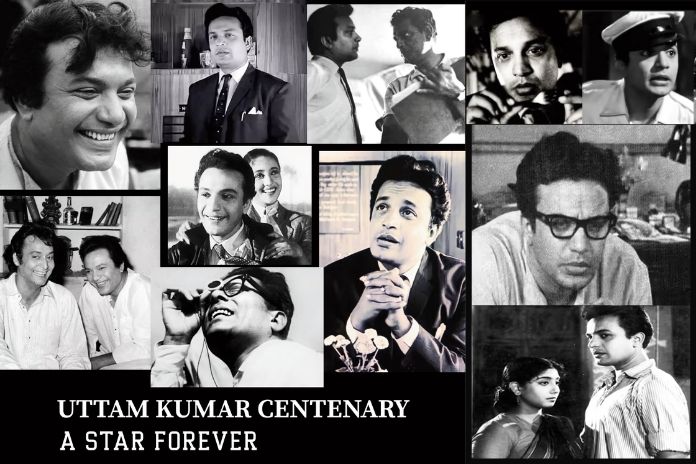
A Star Forever
Uttam Kumar’s timeless charm and unparalleled versatility continue to inspire Bengali cinema, his legacy shining brightly decades after his final curtain call, reminding us that true stardom never fades.
By Saibal Chatterjee
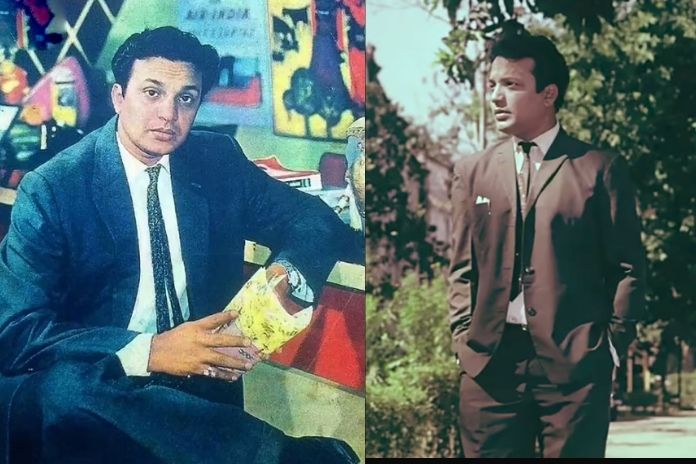
Imagine a movie star who combines shades of Cary Grant, Spencer Tracy and Errol Flynn – and then some: chances are that the visage that will float into your mind’s eye is that of Uttam Kumar. No matter who you choose to compare him to, the iconic superstar who defined Bengali cinema for an entire generation had an acting style entirely his own.
The inimitable leading man was the sturdy fulcrum around which Bengali cinema’s equivalent of Hollywood’s Golden Age unfolded in the 1950s and 1960s. He brought class, natural flair and exceptional depth to bear upon his craft – and upon the movies that he propelled with his magnetic presence.
“Mahanayak” (Great Hero), as he was called by his fans, would have turned 100 on September 23, 2026. As his centenary rolls in, this is as good a time as any to assess Uttam Kumar’s abiding legacy in Bengal and the city of his birth, Kolkata (formerly Calcutta).
Uttam Kumar did not rise like a meteor. He debuted in his early 20s in a supporting role in Dhristidaan (1948). He was a clerk at Calcutta Port Trust, a job he held until Agni Pariksha (Trial by Fire, 1954) rescued him from flop actor status and set him on the path to superstardom.
He had already appeared in two films, Basu Paribar (1952) and Sharey Chuattor (Seventy-Four and a Half), that had earned him some recognition, with the latter casting him opposite Suchitra Sen, with whom he was to form a legendary screen pairing that yielded countless classics like Harano Sur (Lost Melody, 1957), Indrani (1958), Saptapadi (Seven Steps, 1961) and Agni Pariksha.
Uttam Kumar did not enjoy the kind of global fame that his great contemporary and Satyajit Ray’s alter ego, Soumitra Chatterjee, did. Chatterjee and Ray made 14 films together, and almost all of them travelled to and earned accolades at major international festivals. But at home, at the box office, Uttam Kumar was second to none.
Uttam Kumar collaborated with Ray on two films – Nayak (The Hero, 1966) and Chiriyakhana (The Menagerie, 1967). Over a decade earlier, the actor also appeared in Raat Bhore (Dawn), the debut film of Mrinal Sen, who was to go on and win a Special Jury Prize in Berlin for Aakaler Sandhane (In Search of Famine) in 1981.
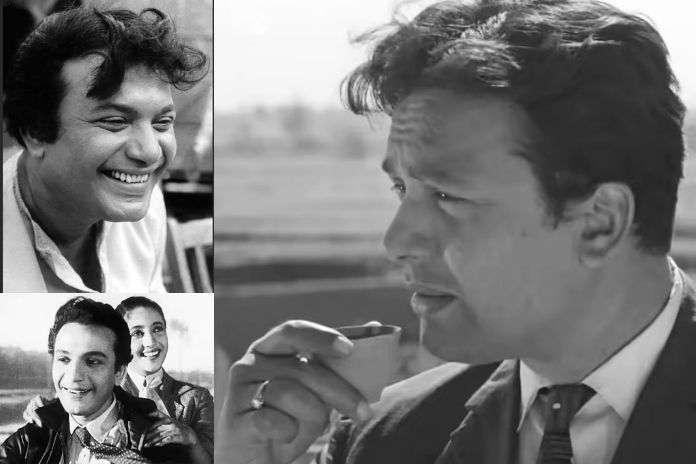
Uttam Kumar played stellar roles in more than 200 films in a career that lasted three decades and a bit. His high-wattage smile could charm a bird off its perch, but there was much more to Uttam Kumar than the gentle, enigmatic demeanour of a romantic hero.
In addition to being the mainstay of many a blockbuster, he was a producer who also directed three films – Sudhu Ekti Bochor (Just One Year, 1966), Bon Palashir Padabali (The Ballads of Bon Palashi, which he co-wrote, 1973) and Kalankini Kankabati (Tainted Kankabati, released posthumously).
During his long reign as the most admired Bengali screen actor, Uttam Kumar delivered dozens of megahits (including several co-starring Satyajit Ray heroines Madhabi Mukherjee and Sharmila Tagore) that remain unmatched in the impact that they had on the collective consciousness of the region.
Uttam Kumar, as a romantic hero of popular cinema, personified the urbane Bengali man to perfection, although he never lost an opportunity to play characters that went against the grain of his established screen persona and demonstrated his phenomenal versatility.
For two roles that he essayed in 1967 – in Anthony Firingee, a biopic of the 19th-century Portuguese-Bengali folk poet Hensman Anthony, and Chiriyakhana, a whodunnit directed by Satyajit Ray – he won India’s National Award for the Best Actor. It was the year that the acting category was introduced at the National Awards.
Apart from a suave, genteel lover in a string of films co-starring Suchitra Sen and intense and conflicted men in social dramas, he notably played the self-effacing retainer of a wealthy family in Khokababur Pratyabartan (The Return of the Little Master, 1960), a swashbuckling action star in the Ruritanian adventure Jhinder Bondi (The Prisoner of Jhind, 1961), inspired by The Prisoner of Zenda, and an antihero in Kuhak (1960), the closest Bengali cinema came to film noir in that era.
Towards the end of his career, he even played a wheelchair-using serial killer in a Hindi film, Plot No. 5, which hit the screen after his demise. At the other end of the spectrum, he portrayed a police investigator in the psychological thriller Thana Theke Aschi (1960).
He was equally successful at comedy, with films like Bhranti Bilas (1963), an adaptation of Comedy of Errors produced by Uttam Kumar himself, and Chaddobeshi (Disguised, 1971), which was remade in Hindi (Hrishikesh Mukherjee’s Chupke Chupke) four years later, standing the test of time.
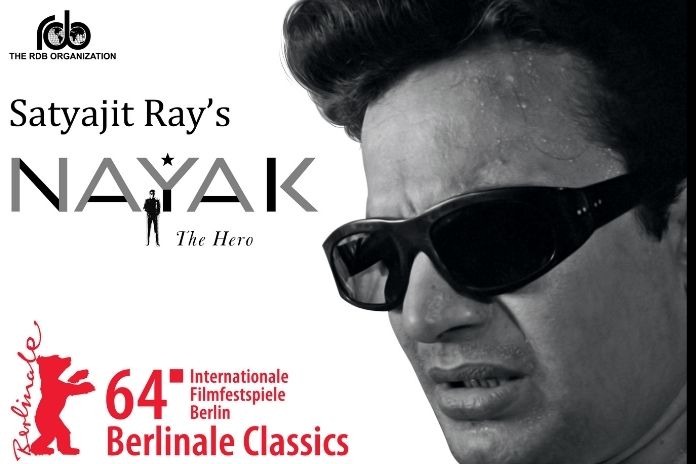
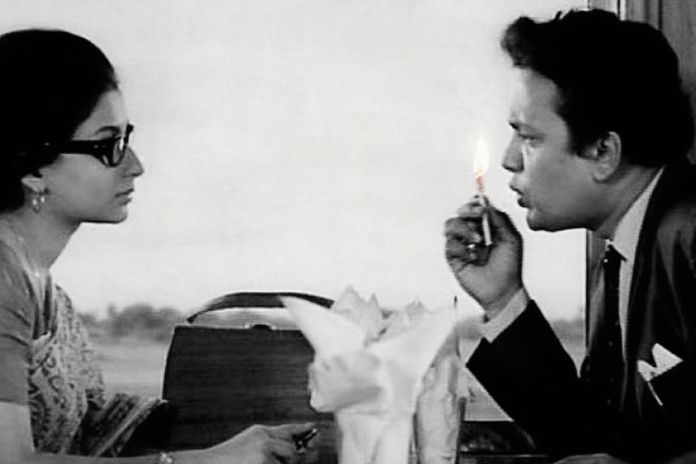
Satyajit Ray’s Nayak (The Hero, 1966), starring Uttam Kumar, premiered at the Berlinale. The film, about a matinee idol who travels by train to Delhi to receive an award and, during the journey, shares his story with a journalist, was written with the star in mind. In 1967, Uttam Kumar was a guest of the Berlin Film Festival.
Ray, Berlin Golden Bear winner (for Ashani Sanket, 1973) and Silver Bear recipient for Best Director (Mahanagar, 1963 and Charulata, 1964), cast Uttam Kumar in 1967 in Chiriyakhana, a Byomkesh Bakshi detective story. At the time of its release, the film was regarded as Ray’s weakest but has, over the years, gained cult status.
Uttam Kumar left the world with greasepaint on 46 years ago. He was rushed to Kolkata’s Belle Vue Clinic from the set of his last film (Ogo Bodhu Sundari, a Bengali adaptation of George Bernard Shaw’s Pygmalion) after a heart attack on July 23, 1980. He was five weeks shy of 54.
The path that he paved still guides every actor and every professional who ventures into Bengali film. Shilpi Sansad, the organisation Uttam Kumar founded in 1968 to support needy workers of the film industry, still functions and hosts a festival of films featuring the actor in lead roles.
The building that houses Shilpi Sansad is crumbling and is in need of urgent renovation, but the aura of Uttam Kumar remains as bright as ever.
Highlights

TIFF Reveals Plans for Industry Conference

Films by Shekhar Kapur and Shubham Yogi Selected for Toronto Gala

A Selection to Die for

Le Musk: A Brave New Frontier in Cinema

The Path finder: Jyoti Deshpande

Toonz to Honour Aabid Surti, Biren Ghose at Animation Masters Summit

India is the Country of Honour at Cannes

RAVINDRA VELHAL: DRIVING MEDIA TRANSFORMATION

THE PATH FINDER: JYOTI DESHPANDE

INTO THE WORLD OF RRR

Powerkids Appoints Manoj Mishra as CEO

Toonz Join Tunche Films to Co-Produce Spanish-Peruvian Animation Feature Kayara

National Museum of Indian Cinema Hosts Vintage Vehicles

I&B Secretary promises Govt’s Support to Film industry

Tom Cruise’s ‘Top Gun: Maverick’ to Blaze at Cannes

Illumination’s Minions: The Rise of Gru is the Annecy Festival Opener

Now, Shoot at Sight in India!

Lata Mangeshkar, India’s Singing Goddess

Quantum Image Making Has Arrived

Indian Films To Look Out For In 2022

2022: Centenary of Indian Cinema Legends

Singing Legend Lata Mangeshkar, Nightangale of India, Dies at 92

Bhushan Kumar’s T-Series Ventures Into OTT Content Creation Space

What’s India Looking for at European Film Market


