Gaming for Good is about impact beyond play: Rajan Navani
By Pickle August 10, 2025
Share:


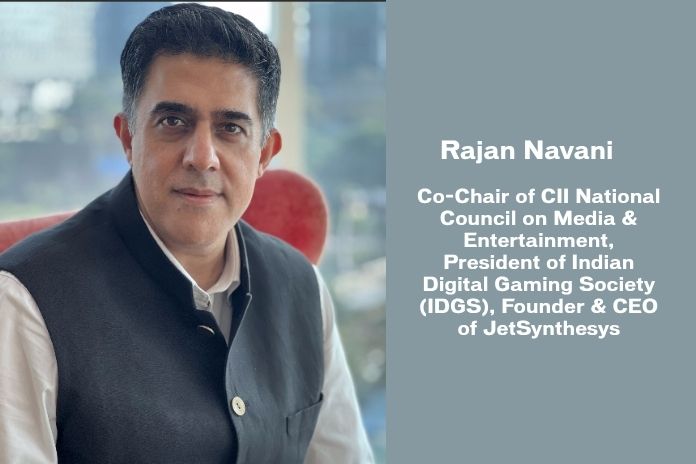
Rajan Navani, Co-Chair of CII National Council on Media & Entertainment, President of Indian Digital Gaming Society (IDGS), Founder & CEO of JetSynthesys, shares how India’s 591 million gamers, cultural confidence, and tech-driven talent are shaping a mobile-first, globally ambitious gaming powerhouse
How would you describe the current landscape of India’s video gaming industry, and what sets it apart from other global markets? Under your leadership, “Gaming for Good” is getting traction…
India has evolved into a truly mass-market, mobile-first video gaming nation. With around 591 million video gamers, we boast one of the largest user bases globally, coupled with some of the highest data consumption rates—driven by affordable smartphones and fast, accessible networks. This scale and accessibility set India apart. The rapid growth of the sector is also translating into significant employment opportunities across game development, design, engineering, content creation, and esports management—making video gaming not just a cultural force but a viable and expanding economic contributor.
“Gaming for Good” reflects the idea that video games can do more than entertain—they can educate, include, and inspire. Encouragingly, the government’s AVGC-XR (Animation, Visual Effects, Video Gaming, Comics & Extended Reality) Task Force has highlighted the importance of education, skills, and public-interest gaming applications. The ecosystem is increasingly aligning with this vision.
What are the top growth drivers and challenges you foresee for video gaming in India over the next five years?
I would say there are three standout drivers: (1) Connectivity: 5G and FWA (Fixed Wireless Access) are spreading quality internet to more towns; (2) Demographics: a young, creator-led audience discovering new genres every month; and (3) Momentum: most outlooks expect steady growth through the decade, with India’s games market projected to keep expanding on the back of in-app purchases and advertising.
As for challenges, we need deeper monetization models, better discoverability of Indian video gaming IP, and a stronger pool of tech-art and engineering talent.
We’re already addressing the talent gap with initiatives like the Indian Institute of Creative Technologies (IICT), which will offer 17 AVGC-XR courses this year, aimed at creating job-ready professionals.
There has been a spurt of localized content and culturally resonant games shaping player engagement and industry innovation in India? (Example: real cricket.)
Real Cricket is a perfect example. We tapped into India’s biggest passion, treated it authentically with official team and player tie-ups, and built a community that plays, watches, and now even competes on broadcast. This league model illustrates how an Indian idea can scale while staying rooted in culture. This is the model I believe in: start local, get the craft right, and empower the ecosystem—players, creators, and leagues—to carry it forward.
With esports gaining popularity, how do you envision the future of organized competitive gaming, and what unique opportunities does it offer for India’s youth?
The formal recognition of esports in India marked a significant milestone. It provided legitimacy, gave aspiring players a clear path, and reassured parents. We now anticipate structured calendars, city-based franchises, and academy-style training. With e-cricket through the Global e-Cricket Premier League (GEPL), we’re demonstrating how strong fandom, robust broadcasting, and professional formats can unlock opportunities—not just for players, but also for coaches, analysts, production crews, and event managers. It’s the convergence of sport and technology.
What role do skill development and specialized education play in building a sustainable talent pipeline for India’s game developers, designers, and artists?
It’s foundational. The Media & Entertainment Skills Council (MESC) has defined clear Qualification Packs (QPs) and National Occupational Standards. There are currently 108 Qualification Packs (QPs) designed to certify individuals for specific job roles within the media and entertainment industry. Each QP includes a National Vocational Educational Qualification Framework (NVEQF) level ranging from 1 to 10, which theoretically enables the development of competency-based training for every entry-level position in this sector.
The Qualification Packs (QPs) establish a project-based learning and assessment model for higher education in AVGC-XR, akin to the formats used by NID and NIFT, by obtaining exemptions from UGC norms. This model is also adopted for AVGC-XR education outside of India. The IICT plans to implement a curriculum based on the NIFT/NID framework, ensuring that colleges equip students with the necessary skills and that learners grasp industry expectations. The objective is to bridge the gap between academia and the industry. This hands-on, standards-based approach is essential for developing a job-ready talent pool.
How is the industry addressing the current shortage of game engineers, backend developers, and other specialized roles, and what steps are being taken to bridge the skill gap?
We’re addressing the skill gap in India’s video gaming industry through a focused three-pronged approach. First, we’re aligning academic curricula with MESC standards, enabling students to gain practical knowledge in engines, tools, tech art, and live-ops. Second, dedicated institutions like the Indian Institute of Creative Technologies (IICT) are introducing multi-track programs tailored specifically to video gaming disciplines. Third, we’re strengthening the studio–campus connection through internships, game jams, and capstone projects—ensuring that students don’t just build portfolios but graduate with actual shipped builds. It’s a practical, industry-aligned solution that’s already in motion.
As the sector expands into tier-2 and tier-3 cities, what impact do you see on job creation, regional growth, and inclusivity within the Indian gaming ecosystem?
This is India’s superpower.
A majority of our gamers now come from beyond the metros, and women gamers are a fast-growing cohort. As connectivity improves, including 5G and Fixed Wireless Access, you’ll see more creator collectives, testing hubs, shout-casting studios, and events outside the big cities.
That spreads opportunity and brings new stories and languages into mainstream gaming.
How are emerging technologies like AI, AR/VR, and cloud gaming changing the way games are designed, produced, and experienced by Indian gamers?
AI is quietly transforming the video gaming landscape—streamlining everything from asset creation and quality assurance to intelligent live-ops management. Cloud gaming is removing hardware barriers, enabling instant access to games without downloads, and expanding reach across diverse user segments. As locally developed content grows, AR and VR technologies are poised to gain greater relevance, especially in delivering immersive, culturally rooted storytelling. Backed by the IndiaAI Mission, which aims to strengthen the country’s AI infrastructure and research ecosystem, Indian developers now have the tools to build richer, more accessible, and globally competitive video gaming experiences.
What policy or regulatory reforms would most effectively accelerate the growth of India’s video gaming and mobile gaming industry, and how can industry-government partnerships advance this goal?
Two simple priorities. First, operationalize the National AVGC-XR Mission with a clear toolkit: incentives for original game IP, export support, and scaled skilling. Second, keep industry and government at one table—through platforms like CII and IDGS—so curricula, research grants, and incubation move quickly and stay market-relevant. We need execution.
Looking ahead, what would be your vision for Indian-developed video games and esports on the global stage, and how can India establish itself as a true gaming hub for the world?
Our edge is cultural confidence plus engineering discipline. I see Indian IP—like our cricket ecosystem—travelling globally because it feels authentic and plays world-class. Esports will follow the same path: formats designed in India, broadcast at scale, and exportable to any cricket-loving market. The mantra stays the same—create in India, for India, for the world, and back it with talent, partnerships, and patient capital.
Highlights

TIFF Reveals Plans for Industry Conference

Films by Shekhar Kapur and Shubham Yogi Selected for Toronto Gala

A Selection to Die for

Le Musk: A Brave New Frontier in Cinema

The Path finder: Jyoti Deshpande

Toonz to Honour Aabid Surti, Biren Ghose at Animation Masters Summit

India is the Country of Honour at Cannes

RAVINDRA VELHAL: DRIVING MEDIA TRANSFORMATION

THE PATH FINDER: JYOTI DESHPANDE

INTO THE WORLD OF RRR

Powerkids Appoints Manoj Mishra as CEO

Toonz Join Tunche Films to Co-Produce Spanish-Peruvian Animation Feature Kayara

National Museum of Indian Cinema Hosts Vintage Vehicles

I&B Secretary promises Govt’s Support to Film industry

Tom Cruise’s ‘Top Gun: Maverick’ to Blaze at Cannes

Illumination’s Minions: The Rise of Gru is the Annecy Festival Opener

Now, Shoot at Sight in India!

Lata Mangeshkar, India’s Singing Goddess

Quantum Image Making Has Arrived

Indian Films To Look Out For In 2022

2022: Centenary of Indian Cinema Legends

Singing Legend Lata Mangeshkar, Nightangale of India, Dies at 92

Bhushan Kumar’s T-Series Ventures Into OTT Content Creation Space

What’s India Looking for at European Film Market


