India’s M&E engine is ready: All systems go
By Pickle February 11, 2026
Share:


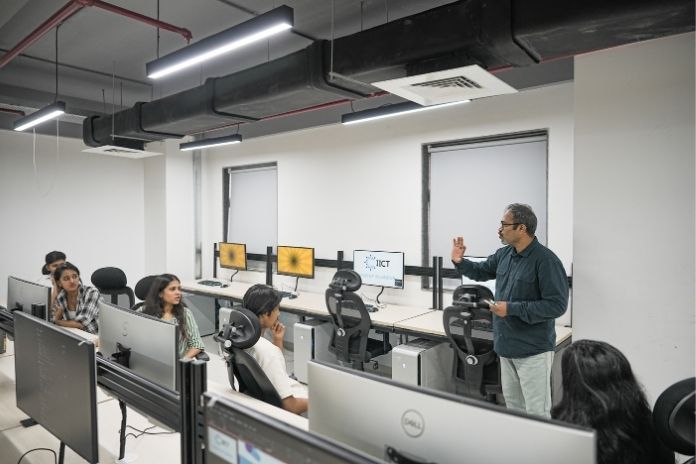
From WAVES to IICT, India has quietly built the full creative stack. Talent, tech, creators and scale now form an M&E engine designed to serve global entertainment demand.
Media and entertainment (M&E) in India has moved from growth to global advantage. What was once a huge consumer market is now a global production engine with scale, talent, technology, policy clarity, and cultural depth. India is becoming a strategic hub for content creation, post-production, AVGC-XR, and AI-led storytelling as global studios, streamers, creators, and tech platforms seek cost-effective, innovation-ready creative ecosystems.
Over the past decade, India’s M&E sector has grown at a CAGR of 10–12%, making it among the fastest-growing creative economies globally. The industry is projected to reach $70 billion by 2030, powered by digital consumption, rising incomes, affordable data, and regional content growth. But numbers alone do not explain India’s rising strategic importance. The deeper story is how India is building a full-stack creative ecosystem — from policy frameworks and education pipelines to creator monetisation, AI innovation, and global market access.
Clear Government Policy Signals: Building the Creative Economy at Scale
India’s policy direction is a M&E strength. The government’s “Create in India for the World” vision is being implemented through institutional reform, financing, education, and international collaboration. The Film Facilitation Office became the India Cine Hub, simplifying permissions, clearances, and incentives for international shoots and co-productions. Location filming and positioning India as a plug-and-play production destination for global studios depend on this.
Equally important is the policy focus on AVGC-XR (Animation, Visual Effects, Gaming, Comics and Extended Reality). Multiple states — Maharashtra, Karnataka, Telangana, and Tamil Nadu — are building creative clusters with tax incentives, infrastructure, and Centres of Excellence. These are not isolated policy experiments; they reflect a coordinated push to ensure India competes in high-value creative services, not only in content consumption.
IICT and the Talent Pipeline: From Skill Gaps to Global Standards
A defining upgrade in India’s M&E ecosystem is the creation of institutional capacity for creative technology. The Indian Institute of Creative Technology (IICT) in Mumbai is being positioned as a national centre of excellence for AVGC-XR, akin to what IITs represent for engineering. Its mandate spans education, research, incubation, and policy support — addressing one of India’s historic weaknesses: fragmented skill development in creative technologies.
The 2026–27 Union Budget’s allocation of Rs 250 crore to establish creative labs in schools and colleges further strengthens this pipeline. IICT’s role in aligning curricula, training faculty, and building continuity from secondary education to advanced creative tech programs marks a structural shift. This is not just about producing animators or VFX technicians; it is about building a workforce fluent in AI tools, real-time engines, immersive storytelling, and global production workflows.
For global studios and platforms, this talent infrastructure reduces long-term risk. It signals that India’s creative workforce will not only be large and affordable, but future-ready — capable of handling complex pipelines in virtual production, AI-assisted animation, real-time rendering, and global IP development.
WAVES: Repositioning India as a Creative Nation
WAVES has played a powerful role in reshaping how India presents itself to the world. Beyond being an industry summit, WAVES has functioned as a brand platform — repositioning India not merely as a content exporter, but as a creative partner for the global M&E ecosystem. The emphasis on cross-border collaboration, creator challenges, startup acceleration, and IP marketplaces has aligned India’s M&E ambitions with global industry priorities.
This rebranding matters. For decades, India’s creative strength was often seen through the lens of Bollywood or domestic entertainment. WAVES reframed that narrative, showcasing India’s depth in gaming, VFX, post-production, regional storytelling, immersive tech, and creator entrepreneurship. In global markets increasingly shaped by IP franchises, platform partnerships, and transnational storytelling, perception is strategic capital — and India is now actively shaping it.
The Creator Economy: From Influencers to IP Entrepreneurs
India’s creator economy goes beyond influencers and brand integrations. It is becoming an IP economy where creators build franchises, communities, and monetisable universes across platforms. With over 78 crore internet users and the cheapest data, India gives creators scale and experimentation room. Entertainment is expanding with short-form video, regional-language content, podcasts, gaming streams, and virtual creators.
Policy support, startup incubation, and platform partnerships are turning creators into small studios. The rise of hyperlocal OTT platforms and regional content networks shows how India’s linguistic and cultural diversity is becoming a competitive advantage, not a fragmentation challenge. For global platforms, this creator ecosystem offers a living lab for audience engagement models that can be exported to other emerging markets.
India’s AI Advantage in Creative Production
India’s AI advantage in M&E is emerging at the intersection of scale and engineering talent. AI-powered dubbing, subtitling, localisation, asset generation, and workflow automation are being rapidly adopted across production pipelines. With one of the world’s largest pools of STEM graduates and a fast-growing AI startup ecosystem, India is well-positioned to build creative AI tools at scale.
Future content production requires faster, smarter pipelines, not just cheaper labor. Virtual production, real-time environments, AI-assisted editing, and procedural animation are changing content creation. India’s cost advantage and tech advantage are allowing global studios to shorten production cycles without sacrificing quality.
Talent Density and Workforce Depth
India’s M&E workforce is both vast and increasingly specialised. From editors and sound designers to game artists, motion capture specialists, and virtual production technicians, the talent base has deepened across disciplines. The sheer density of creative professionals creates network effects: studios scale faster, freelance markets mature, and production ecosystems become resilient.
Technical education and rapid upskilling in India boost this workforce advantage. IICT and state-level initiatives to integrate creative technology into formal education ensure that India’s talent pipeline grows and adapts to industry needs. Predictable capacity helps global partners plan long-term production.
Market Opportunity and the Domestic Growth Engine
India’s domestic market remains a strategic anchor for global M&E players. With OTT consumption rising sharply, regional content booming, and gaming and immersive entertainment expanding, India offers scale few markets can match. This internal demand fuels experimentation — allowing studios, platforms, and creators to test formats, technologies, and monetisation models before exporting them globally.
The domestic market also supports IP development. Franchises born in India increasingly find international audiences, while co-productions blend local narratives with global sensibilities. This two-way flow of content and capital strengthens India’s position as both a consumer and creator economy.
Post-Production and AVGC Strength: The Quiet Powerhouse
India’s post-production advantage is often underplayed — but it is one of the country’s most export-ready M&E strengths. VFX, animation, sound design, editing, and colour grading services are already integrated into global pipelines for films, series, and games. The cost-quality equation remains compelling, but what sets India apart now is scale. With hundreds of studios and thousands of skilled professionals, India can absorb large volumes of global work without bottlenecks.
AVGC capabilities extend beyond service work into original IP creation, gaming studios, and immersive experiences. As global demand for digital content outpaces traditional production capacities, India’s post-production and AVGC ecosystem positions it as a global capacity provider for the creative economy.
Regional Hubs and the Geography of Creative Scale
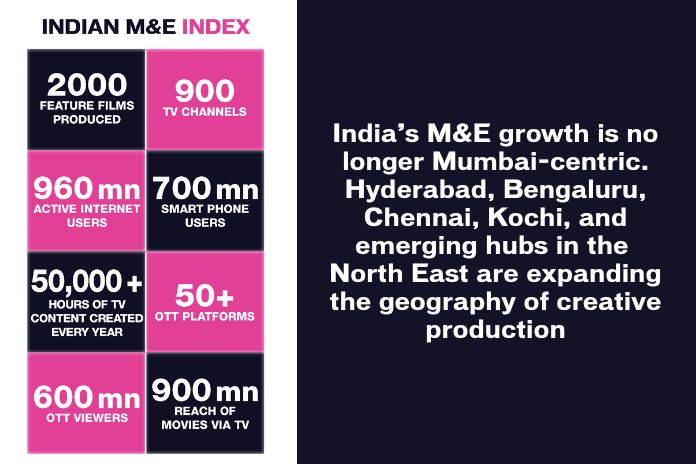
India’s M&E growth is no longer Mumbai-centric. Hyderabad, Bengaluru, Chennai, Kochi, and emerging hubs in the North East are expanding the geography of creative production. State policies, infrastructure investments, and local talent pools are creating distributed creative clusters. This regionalisation reduces cost pressure, diversifies creative voices, and builds resilience into the national ecosystem.
For global studios, this means access to multiple production centres with different cost structures, creative styles, and logistical advantages — all within a single national framework.
Shooting, Soft Power, and the Global Mindset
India continues to attract international shoots, supported by streamlined facilitation and diverse locations. While not positioned as a headline advantage, on-ground production remains a strategic soft-power lever. More importantly, India’s creative sector is adopting a global mindset — thinking in terms of exportable IP, cross-border partnerships, and international audiences from the outset.
This mindset shift is perhaps India’s most important M&E upgrade. The industry is no longer content with being a domestic success story. It is actively positioning itself as a participant in global value chains — from ideation and production to post-production, technology development, and IP monetisation.
The Expanding Global Footprint
The opportunity ahead lies in expanding India’s global footprint — not just as a market, but as a creative partner. Co-production treaties, platform partnerships, and international festivals are creating pathways for Indian studios, creators, and tech firms to embed themselves into global workflows. As content globalises and audiences seek diverse narratives, India’s cultural depth, technical capacity, and cost efficiency form a powerful combination.
India’s M&E advantage today is not a single factor; it is an ecosystem advantage.
Highlights

TIFF Reveals Plans for Industry Conference

Films by Shekhar Kapur and Shubham Yogi Selected for Toronto Gala

A Selection to Die for

Le Musk: A Brave New Frontier in Cinema

The Path finder: Jyoti Deshpande

Toonz to Honour Aabid Surti, Biren Ghose at Animation Masters Summit

India is the Country of Honour at Cannes

RAVINDRA VELHAL: DRIVING MEDIA TRANSFORMATION

THE PATH FINDER: JYOTI DESHPANDE

INTO THE WORLD OF RRR

Powerkids Appoints Manoj Mishra as CEO

Toonz Join Tunche Films to Co-Produce Spanish-Peruvian Animation Feature Kayara

National Museum of Indian Cinema Hosts Vintage Vehicles

I&B Secretary promises Govt’s Support to Film industry

Tom Cruise’s ‘Top Gun: Maverick’ to Blaze at Cannes

Illumination’s Minions: The Rise of Gru is the Annecy Festival Opener

Now, Shoot at Sight in India!

Lata Mangeshkar, India’s Singing Goddess

Quantum Image Making Has Arrived

Indian Films To Look Out For In 2022

2022: Centenary of Indian Cinema Legends

Singing Legend Lata Mangeshkar, Nightangale of India, Dies at 92

Bhushan Kumar’s T-Series Ventures Into OTT Content Creation Space

What’s India Looking for at European Film Market


