Union Budget 2026–27: India’s Creative Sector Gets Its Moment
By Pickle February 11, 2026
Share:


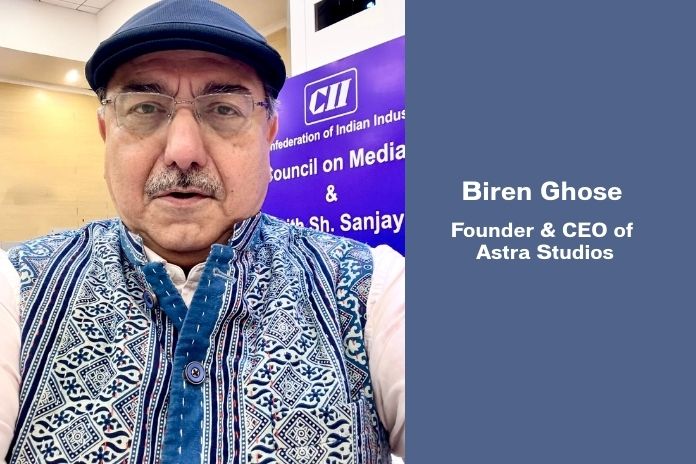
As India puts creativity and technology at the heart of its growth strategy in this annual budget, the real test will be turning vision into reality.
By Biren Ghose
“When a nation learns to export its imagination, it stops competing on cost—and starts leading on culture, technology, and ideas.”
The Union Budget 2026–27 may be remembered as the year India’s “Orange Economy”—the creative sectors of animation, visual effects, gaming, and comics (AVGC)—finally took centre stage. For years, creative technology has been a quiet powerhouse behind India’s digital and entertainment rise. Now, with the Prome Minister having made proclamations of India’s intent and the explicit recognition in the budget, the media and entertainment sector is stepping into the spotlight as a driver of jobs, innovation, and global influence.
Creativity isn’t just art—it’s industry
For most of my career, I’ve seen India’s creative industries celebrated for their artistry but rarely recognized for their economic muscle. This year is posied to change that siloed thought process. When the finance minister singled out AVGC, creator labs, and the need for a new workforce, she sent a message: Creativity is not just cultural “soft power”—it’s a hard economic engine deserving national investment.
This matters. It tells every parent, student, studio, and policymaker that the creative economy is not a niche or a luxury. It’s central to India’s growth story, ready to scale, and be built for global export.
Here’s a more vivid, policy-aware, and punchier rewrite of both sections, with a strong closing line in each and added color around what creator labs could look like inside the core curriculum.
The “Two Million” Talent Mission
One of the most striking announcements in the budget was the projection that India’s AVGC sector will need two million skilled professionals by 2030. That’s not just a big number—it’s a national mandate.
This demand will not fulfill itself. To get there, India must reimagine education for the creative century: modern curricula, deep industry linkages, world-class infrastructure, and a relentless focus on quality. Studios, classrooms, and labs must start speaking the same language.
More importantly, we must shift our identity. For decades, India has been the world’s back office. In the coming decade, we must become the world’s story engine—moving from service providers to creators and owners of original intellectual property. That means training students not just to execute instructions, but to invent characters, design worlds, build games, and author experiences that travel across borders.
Two million creators is not a workforce target—it’s the foundation of India’s next cultural and economic revolution. It’s about cultural exports, digital products, and global influence built on Indian imagination.
Early Access: The Creator Labs Initiative
Perhaps the most visionary step in this budget is the plan to launch AVGC creator labs in 15,000 schools and 500 colleges, led by IICT Mumbai. This is transformative because creative careers often begin by accident—discovered late, after traditional academic pathways have already shaped a student’s choices. Creator labs change that equation entirely.
Imagine a typical school week where, alongside mathematics and science, students step into a creator studio. One day they design a character inspired by local folklore. Another day they build a simple game level. In another class, they use AI tools to animate a short story or create a virtual tour of their hometown. These labs [at varying degrees across the academic pathway] could blend:
- Storytelling and language skills through scriptwriting and comics.
- Mathematics and physics through animation timing, simulation, and game mechanics.
- Art and design through character, environment, and interface creation.
- Technology and coding through interactive media and AI-assisted workflows.
In this model, creativity isn’t an extracurricular activity. It becomes a core literacy—as essential as reading, writing, and arithmetic.
By embedding creator labs across Tier 2 and Tier 3 cities, the government is democratizing access to creative technology. A student in a small town should have the same opportunity to design a game, animate a story, or build a virtual world as a student in a global metro.
It’s not just about supplying talent. It’s about building a nation where creativity is part of everyday education— where every classroom turns into a studio—and every student becomes a potential creator.
Here are crisper, more vivid rewrites of both sections, with clear punchlines built in and highlighted.
IICT: More Than an Institute
From our recommendation for its evolution to the directions we provide as governming council members, The Indian Institute of Creative Technologies (IICT) is being envisioned as the flagship nerve centre of India’s Orange Economy—a place where academics, industry, research, thought leadership and policy converge into one living ecosystem.
This matters because creative industries don’t grow from classrooms alone. They grow from ‘collisions’ between ideas, artists, entrepreneurs, technologists, and investors. The sector needs more than skilled workers; it needs a pipeline of founders, inventors, and global storytellers.
At IICT, a student might learn animation in the morning, collaborate with a startup in the afternoon, and test a new AI tool in the evening. Industry mentors, research labs, incubation programs, and policy think tanks will exist in the same ecosystem—creating a continuous loop from education to innovation to enterprise.
By bringing together global studios, technology partners, startups, and educators, IICT aims to create a hub that is not just reactive to industry trends—but actively shaping the future of the creative economy– a launchpad where education meets enterprise, and talent becomes industry.
India Must Train for the World
India’s creative industries cannot thrive on local standards alone. The world’s leading creative technology schools—such as USC’s School of Cinematic Arts and the MIT Media Lab—set the pace for global storytelling, design, and innovation.
If India wants to lead, our students must be trained to compete—and collaborate—on that same global stage.
Through international partnerships, global faculty exchanges, and industry-aligned curricula, IICT is building an education model that prepares students for the world’s most demanding creative and technological environments.
This means training in:
- Real-time engines and AI-assisted pipelines.
- Global production workflows.
- Cross-cultural storytelling and design.
- Emerging formats like immersive media, games, and virtual worlds.
Because the jobs of tomorrow don’t exist yet—and the tools of the future are being invented in real time. As I have stated before, we cannot train Indian talent for yesterday’s industry—we must train them for the world they are about to create.
Building the Ecosystem: Four Pillars
As a national task for for the “Create In India Mission” and from our 1st mega venture – IICT – our approach rests on four pillars: academics, incubation (startup support), policy advocacy, and research. Each addresses a key gap in the AVGC value chain. Academics create skilled professionals; incubation supports founders; policy ensures long-term growth; research drives innovation.
Industry and International Partnerships
The world is watching—and investing. Major companies like Google, Adobe, Meta, Microsoft, and Wacom, NVIDIA among others have committed to long-term partnerships with IICT. International partnerships, such as the one with the University of York in the UK, and more to follow, further open doors for faculty exchange, research, and global certification. This is how India’s talent pool gains global confidence and credibility.
A Growth Engine for the Broader Economy
The AVGC sector is not an entertainment silo alone. It powers the content economy, streaming, immersive entertainment, tourism branding, and regional culture. Investments here multiply across urban services, cultural exports, and digital platforms.
Policy is the signal—execution is the strategy
The budget gives us a blueprint. Now, execution will decide the outcome. We at CII and FICCI the principal stakeholders with the very active Central Government [I&B] and the Maharashtra Government India are moving quickly, building quality into every step: world-class faculty, infrastructure that reaches every corner, seamless pathways from school to startup, and incentives for original content and global exports. If we get this right, India will not just create jobs. We will create global influence—exporting both technology and imagination.
Create in India isn’t just a slogan
This budget recognizes India’s greatest strengths: technology and imagination. With AVGC creator labs at a national scale, we’re not just growing an industry—we’re building the base for an Orange Economy that can employ millions and export Indian creativity to the world.
I predict “India’s next great economic leap will not come only from what we manufacture, but from the stories, worlds, and experiences we create for the planet.”
Biren Ghose is the Founder & CEO of Astra Studios – focussed on Creative Solutions for Content design and Delivery through Ideation, Visualisation, VFX, Generative AI Solutions. He is a Governing Council Member and former interim CEO of the IICT. And has served as Chair for CII AVGC & XR
Highlights

GET THE BEST OUT OF FILM BAZAAR 2019

TIFF Reveals Plans for Industry Conference

Films by Shekhar Kapur and Shubham Yogi Selected for Toronto Gala

A Selection to Die for

Le Musk: A Brave New Frontier in Cinema

The Path finder: Jyoti Deshpande

Toonz to Honour Aabid Surti, Biren Ghose at Animation Masters Summit

India is the Country of Honour at Cannes

RAVINDRA VELHAL: DRIVING MEDIA TRANSFORMATION

THE PATH FINDER: JYOTI DESHPANDE

INTO THE WORLD OF RRR

Powerkids Appoints Manoj Mishra as CEO

Toonz Join Tunche Films to Co-Produce Spanish-Peruvian Animation Feature Kayara

National Museum of Indian Cinema Hosts Vintage Vehicles

I&B Secretary promises Govt’s Support to Film industry

Tom Cruise’s ‘Top Gun: Maverick’ to Blaze at Cannes

Illumination’s Minions: The Rise of Gru is the Annecy Festival Opener

Now, Shoot at Sight in India!

Lata Mangeshkar, India’s Singing Goddess

Quantum Image Making Has Arrived

Indian Films To Look Out For In 2022

2022: Centenary of Indian Cinema Legends

Singing Legend Lata Mangeshkar, Nightangale of India, Dies at 92

Bhushan Kumar’s T-Series Ventures Into OTT Content Creation Space


