Toronto Is Talking Hanuman Ansh
By Pickle September 16, 2026
Share:


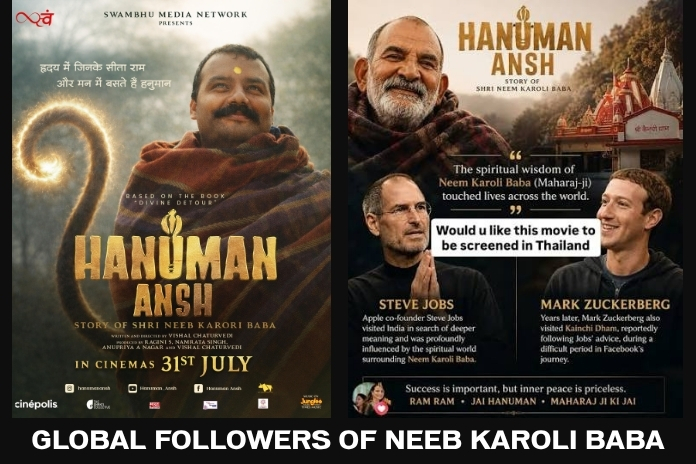
The most discussed Indian title in Toronto’s market conversation this week isn’t a festival premiere from India — it’s a ₹2 crore devotional drama that Pickle, present at TIFF, found interest among buyers and sales agents asking about by name, days after Hombale Films opened it worldwide on 11 September.
What the film is
Hanuman Ansh (“fragment of Hanuman”) is the first film of a planned trilogy on Neem Karoli Baba, (originally Neeb Karoli Baba) adapted by writer-director Dr Vishal Chaturvedi from his own memoir, Divine Detour: That Changed My Life.
The story opens in pre-Independence Braj, where thirteen-year-old Lakshminarayan Sharma loses his mother and leaves Akbarpur convinced that only Shri Rama can reunite them — and that the road to Rama runs through Hanuman. He wanders for years, meditating under trees, sleeping beside rivers, living on alms, meeting Nath and Naga ascetics. A Rajkot mahant tests him; he quietly refuses comfort and praise and walks on. At twenty-five he boards a first-class railway carriage without a ticket; a colonial officer throws him off and the train will not move, no fault found. When the officials apologise, he asks not for money but for two things: that no saint in India be removed from a train for want of a ticket, and that a station be built for local residents. That station gives him his name. He returns home, honours a childhood marriage to Rambeti, and finally walks to the Kainchi hills above Nainital, where the film closes on a lost traveller reciting the Hanuman Chalisa — and being guided home.
Shobhinaw Satyaa plays Baba, cast after the original lead fell ill in the first Chitrakoot schedule; he was the film’s second assistant director at the time. Kirtan artist Krishna Das, a Maharaj-ji disciple known worldwide, sings two tracks.
The Numbers
Day one, 7 August: ₹10 lakh across roughly 250 screens, dropping to about 40 screens in week two. Week three: ₹10.40 crore, with Cinépolis India expanding past 2,000 screens on pure demand. Day 40: ₹222.88 crore nett in India and ₹277.80 crore worldwide gross on a sub-₹2 crore budget — the highest theatrical return on investment in Indian cinema, a distinction it now shares with Jai Santoshi Maa (1975). Uttarakhand made it tax-free after Chief Minister Pushkar Singh Dhami watched it on 5 September. North American advance sales crossed $100,000 before the overseas opening .
Why this story worked
The subject travels without translation. Kainchi Dham’s visitor list is a who’s who of global influence: Steve Jobs, who reached the ashram in 1974; Mark Zuckerberg, who went in 2015 on Jobs’s advice; Google co-founder Larry Page; eBay’s first president Jeffrey Skoll; public-health figure Dr Larry Brilliant; Julia Roberts, who traces her interest in Hinduism to a photograph of Maharaj-ji; and Virat Kohli with Anushka Sharma, who visited in 2022.
Kirtan artist Krishna Das, a Maharaj-ji disciple, contributes two tracks to the soundtrack.
Craft-wise, the film wins on sincerity rather than scale. Film reviewers put it plainly: the filmmaking is humble, the journey is what moves you . Its audience score sits at 97% . Chaturvedi’s research ran from 2009 through field trips to Vrindavan, Akbarpur, Neeb Karori and Lucknow, which is why devotees vouch for it — and devotee endorsement is the cheapest, most durable marketing there is. A streamer had earlier passed on the concept; theatres proved the demand instead.
Rights and what’s next
Hombale Films took international distribution on 3 September for a day-and-date global rollout. The package: 150 minutes, Hindi with Braj and Bundeli subtitles, franchise-ready — part two, covering Baba’s Agra and Mathura years, is already in development.
Highlights

TIFF Reveals Plans for Industry Conference

Films by Shekhar Kapur and Shubham Yogi Selected for Toronto Gala

A Selection to Die for

Le Musk: A Brave New Frontier in Cinema

The Path finder: Jyoti Deshpande

Toonz to Honour Aabid Surti, Biren Ghose at Animation Masters Summit

India is the Country of Honour at Cannes

RAVINDRA VELHAL: DRIVING MEDIA TRANSFORMATION

THE PATH FINDER: JYOTI DESHPANDE

INTO THE WORLD OF RRR

Powerkids Appoints Manoj Mishra as CEO

Toonz Join Tunche Films to Co-Produce Spanish-Peruvian Animation Feature Kayara

National Museum of Indian Cinema Hosts Vintage Vehicles

I&B Secretary promises Govt’s Support to Film industry

Tom Cruise’s ‘Top Gun: Maverick’ to Blaze at Cannes

Illumination’s Minions: The Rise of Gru is the Annecy Festival Opener

Now, Shoot at Sight in India!

Lata Mangeshkar, India’s Singing Goddess

Quantum Image Making Has Arrived

Indian Films To Look Out For In 2022

2022: Centenary of Indian Cinema Legends

Singing Legend Lata Mangeshkar, Nightangale of India, Dies at 92

Bhushan Kumar’s T-Series Ventures Into OTT Content Creation Space

What’s India Looking for at European Film Market