Girish Kasaravalli: Entertainment Is Political
By Pickle November 21, 2026
Share:


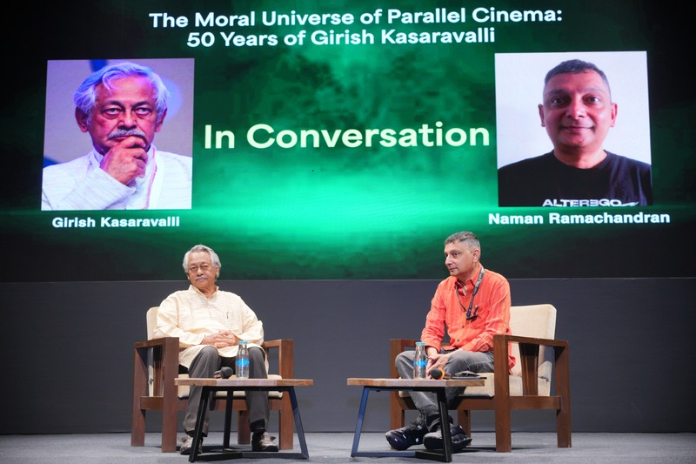
Marking 50 years in cinema at IFFI Goa, the Kannada filmmaker rejected the art-commercial divide and championed culturally rooted storytelling.
Girish Kasaravalli has dismissed the divide between commercial and art-house cinema, saying every film carries an ideological position.
“There is nothing called ‘only entertainment’. Even entertainment is a political form,” the Kannada filmmaker said at the 57th International Film Festival of India (IFFI) in Goa on November 21.
The 14-time National Film Award winner was speaking at the In Conversation session, The Moral Universe of Parallel Cinema: 50 Years of Girish Kasaravalli, at Kala Academy. Film journalist, critic and author Naman Ramachandran moderated the session.
Filmmakers, Girish Kasaravalli said, either endorse or challenge dominant social ideologies. He named “othering”, the marginalisation and exclusion of vulnerable communities through caste, social hierarchy and religious hegemony, as the recurring concern of his work. That work runs from his 1977 debut Ghatashraddha to Tabarana Kathe, Thaayi Saheba and Dweepa.
On New Kannada Cinema, he called for an indigenous cinematic language rooted in India’s social and cultural realities rather than borrowed frameworks. “Style is not imposed on a film; it comes from within the content itself,” he said. “The plot of the story is not important, but the vision of the story is important.”
He also refused easy moral conclusions, citing writer U.R. Ananthamurthy’s practice of ending every answer with a “but”. “To say through a film that ‘this is right, this is wrong’ itself is wrong. I don’t make easy judgments, because that forces the audience to think,” he said.
Discussing the women in his films, Girish Kasaravalli pointed to Nagi, the protagonist of Dweepa, and her line, “Let me make the present pleasant.” Women, he observed, often show an extraordinary ability to negotiate changing circumstances.
He said he prefers meticulously detailed scripts to storyboards, so that collaborators can realise his visual imagination. “Cinema is germinated in my mind, but it is executed by others,” he said, adding that cinema is about imparting an experience, not merely making statements.
He closed by invoking Julio García Espinosa’s idea of “imperfect cinema”, urging Indian filmmakers to stay true to their own cultural and visual identities. “Why should I be ‘perfect’ by someone else’s standards? I should be loyal to my own milieu,” he said.
Highlights

TIFF Reveals Plans for Industry Conference

Films by Shekhar Kapur and Shubham Yogi Selected for Toronto Gala

A Selection to Die for

Le Musk: A Brave New Frontier in Cinema

The Path finder: Jyoti Deshpande

Toonz to Honour Aabid Surti, Biren Ghose at Animation Masters Summit

India is the Country of Honour at Cannes

RAVINDRA VELHAL: DRIVING MEDIA TRANSFORMATION

THE PATH FINDER: JYOTI DESHPANDE

INTO THE WORLD OF RRR

Powerkids Appoints Manoj Mishra as CEO

Toonz Join Tunche Films to Co-Produce Spanish-Peruvian Animation Feature Kayara

National Museum of Indian Cinema Hosts Vintage Vehicles

I&B Secretary promises Govt’s Support to Film industry

Tom Cruise’s ‘Top Gun: Maverick’ to Blaze at Cannes

Illumination’s Minions: The Rise of Gru is the Annecy Festival Opener

Now, Shoot at Sight in India!

Lata Mangeshkar, India’s Singing Goddess

Quantum Image Making Has Arrived

Indian Films To Look Out For In 2022

2022: Centenary of Indian Cinema Legends

Singing Legend Lata Mangeshkar, Nightangale of India, Dies at 92

Bhushan Kumar’s T-Series Ventures Into OTT Content Creation Space

What’s India Looking for at European Film Market