Banaras Reunites Bharat Bala, A.R. Rahman
By Pickle November 22, 2026
Share:


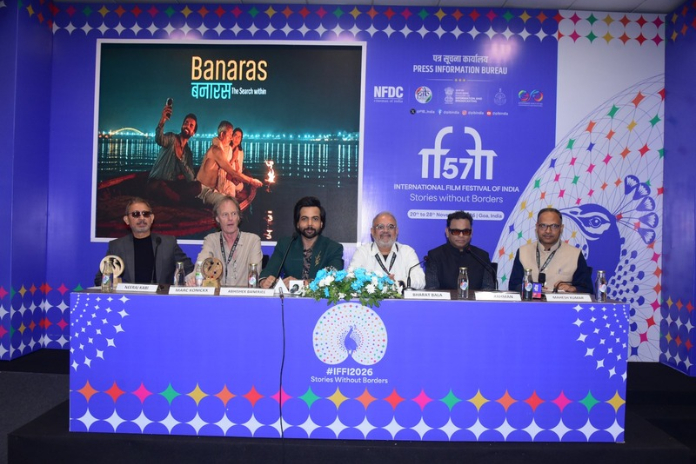
Rooted in Indian classical music, the father-daughter drama had its India premiere in Indian Panorama at IFFI Goa on Sunday.
Filmmaker Bharat Bala has reunited with composer A.R. Rahman for Banaras, a father-daughter drama that screened on Sunday in the Indian Panorama section of the 57th International Film Festival of India (IFFI) in Goa, marking its India premiere.
The film features Abhishek Banerjee, Shahana Goswami, Neeraj Kabi, Chhaya Kadam, Indira Tiwari and Antonythasan Jesuthasan, among others.
Set against the landscape of Indian classical music, Banaras explores the relationship between a father and daughter, the inheritance of a musical legacy and the bonds between generations. The story unfolds against what Bharat Bala describes as “the eternal spirit of the Ganges”.
A.R. Rahman said Indian classical music, both Hindustani and Carnatic, has been a constant source of inspiration throughout his creative journey. Ragas and the emotions associated with them continue to shape his musical expression, he said, and he has incorporated ragas into the film’s compositions.
India’s cultural diversity also continues to inspire his musical exploration. “I enjoy every culture,” A.R. Rahman said, noting that every language has its distinct flavour, from the potency of Punjabi to the sweetness of Bengali. He often lets languages and their cultural essence intermingle in his music.
Banaras marks Bharat Bala’s return to feature filmmaking after a long gap since Maryan, during which he worked on several short films. He said he makes a feature when he encounters a story he feels needs to be told.
Though the city has been portrayed on screen in numerous ways, Bharat Bala said it still offers much to explore. He described it as a place shaped by “thousands of years of lived experiences nourished by the Ganga”.
Director of Photography Marc Koninckx said his primary focus was to “catch emotions” on the actors’ faces through light, camera angles, framing and composition. His aim was to make audiences feel part of the film rather than remain external observers.
“The camera is like music,” Marc Koninckx said, explaining that he creates visual rhythm by juxtaposing colours and visual elements. He added that “too much colour kills colour”, an approach that was particularly important while filming live at the Kumbh.
Neeraj Kabi, whose character lives with dementia, said the characters he portrays often seep into his real life and become part of him. The role brought his own childhood to mind, a state in which the future does not exist and the present is absent.
Abhishek Banerjee said shooting live at the Maha Kumbh, unlike working on controlled studio sets, involved considerable uncertainty amid large crowds. That made trust between actor and director especially important. The experience took him back to his college days of performing nukkad nataks. Describing the shoot as “street cinema”, he said it transformed him both as an actor and as a person.
A.R. Rahman also expressed his delight that two films featuring his music, Banaras and Ramayan, are being screened at the 57th IFFI.
The intro and opening paragraph now say the film screened on Sunday; the intro is still 20 words. I left the closing line in the present tense because it also covers Ramayan, whose screening date you haven’t given.
Highlights

Three Views of India At Cannes

Film Making Centres of India

TIFF Reveals Plans for Industry Conference

Films by Shekhar Kapur and Shubham Yogi Selected for Toronto Gala

A Selection to Die for

Le Musk: A Brave New Frontier in Cinema

The Path finder: Jyoti Deshpande

Toonz to Honour Aabid Surti, Biren Ghose at Animation Masters Summit

India is the Country of Honour at Cannes

RAVINDRA VELHAL: DRIVING MEDIA TRANSFORMATION

THE PATH FINDER: JYOTI DESHPANDE

INTO THE WORLD OF RRR

Powerkids Appoints Manoj Mishra as CEO

Toonz Join Tunche Films to Co-Produce Spanish-Peruvian Animation Feature Kayara

National Museum of Indian Cinema Hosts Vintage Vehicles

I&B Secretary promises Govt’s Support to Film industry

Tom Cruise’s ‘Top Gun: Maverick’ to Blaze at Cannes

Illumination’s Minions: The Rise of Gru is the Annecy Festival Opener

Now, Shoot at Sight in India!

Lata Mangeshkar, India’s Singing Goddess

Quantum Image Making Has Arrived

Indian Films To Look Out For In 2022

2022: Centenary of Indian Cinema Legends

Singing Legend Lata Mangeshkar, Nightangale of India, Dies at 92