Northeast Cinema Commands IFFI Spotlight
By Pickle November 22, 2026
Share:


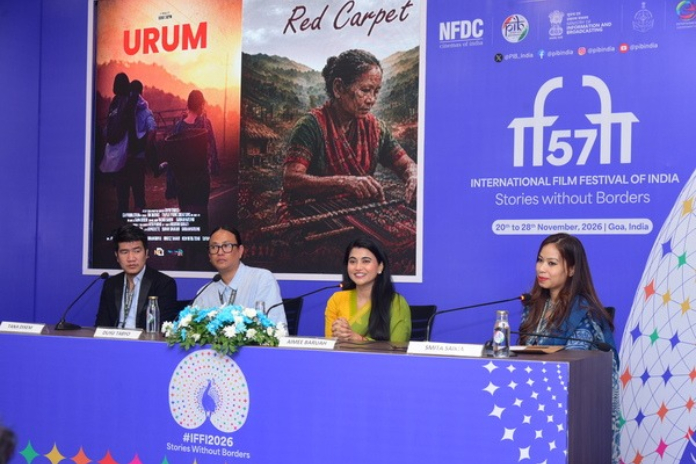
A Karbi weaver’s Cannes journey and a grieving father’s story bring Northeast cinema to IFFI.
Two films from Northeast India, an Assamese documentary on Karbi handloom weaving and a Nishi-language drama about a father’s grief, have put the region’s cinema back in focus at the 57th International Film Festival of India (IFFI) in Goa.
Red Carpet, directed by Aimee Baruah, is screening in the Indian Panorama Non-Feature section. Urum, directed by Duyu Tabyo, is part of the Indian Panorama Feature Film section. Both directors presented their films at a press conference in Goa. The selections extend IFFI’s consistent showcase of cinema from the Northeast across its editions.
Red Carpet documents the handloom tradition of the Karbi community in Karbi Anglong, Assam, where a centuries-old craft is under pressure from modernisation and changing lifestyles. The film follows a traditional weaver from the village of Donkamokam to the red carpet at Cannes. It traces how a handmade fabric became a symbol of cultural identity, pride and hope.
Aimee Baruah, an award-winning actress, producer and filmmaker who is pursuing her PhD, said the international recognition of the attire had brought greater visibility to the region’s indigenous heritage. She credited the craftsmanship of local weavers and called for traditional weaving practices to be preserved. She also urged young people to take pride in their language, culture and traditions.
Urum is set in a remote mountain community of Arunachal Pradesh. It follows a father struggling to accept the tragic loss of his young daughter. Haunted by guilt and visions, he searches for closure amid buried truths, trauma and the unseen forces shaping his people’s lives.
Duyu Tabyo, an independent writer-director and cultural practitioner from Arunachal Pradesh, said the film grew out of an incident he witnessed as a child in Ziro, involving a father who had lost his daughter. He said he wanted to explore the psychological and emotional state of a grieving father, not deliver a moral message.
Duyu Tabyo said filming in the indigenous Nishi language was a conscious decision, made to preserve authenticity and give the language greater visibility. He noted that younger generations are losing touch with their indigenous languages.
He described the IFFI selection as a significant recognition for Arunachal Pradesh’s emerging film industry and hoped it would encourage more young filmmakers from the state. The Northeast, he said, remains an unexplored cinematic landscape that is now drawing interest from mainstream filmmakers and production houses. He added that cinema can drive social awareness and change, and that documenting indigenous stories can help younger generations reconnect with their roots.
Highlights

TIFF Reveals Plans for Industry Conference

Films by Shekhar Kapur and Shubham Yogi Selected for Toronto Gala

A Selection to Die for

Le Musk: A Brave New Frontier in Cinema

The Path finder: Jyoti Deshpande

Toonz to Honour Aabid Surti, Biren Ghose at Animation Masters Summit

India is the Country of Honour at Cannes

RAVINDRA VELHAL: DRIVING MEDIA TRANSFORMATION

THE PATH FINDER: JYOTI DESHPANDE

INTO THE WORLD OF RRR

Powerkids Appoints Manoj Mishra as CEO

Toonz Join Tunche Films to Co-Produce Spanish-Peruvian Animation Feature Kayara

National Museum of Indian Cinema Hosts Vintage Vehicles

I&B Secretary promises Govt’s Support to Film industry

Tom Cruise’s ‘Top Gun: Maverick’ to Blaze at Cannes

Illumination’s Minions: The Rise of Gru is the Annecy Festival Opener

Now, Shoot at Sight in India!

Lata Mangeshkar, India’s Singing Goddess

Quantum Image Making Has Arrived

Indian Films To Look Out For In 2022

2022: Centenary of Indian Cinema Legends

Singing Legend Lata Mangeshkar, Nightangale of India, Dies at 92

Bhushan Kumar’s T-Series Ventures Into OTT Content Creation Space

What’s India Looking for at European Film Market