Animation Travels Further Than Almost Anything We Make: Véronique Encrenaz
By Pickle June 21, 2026
Share:


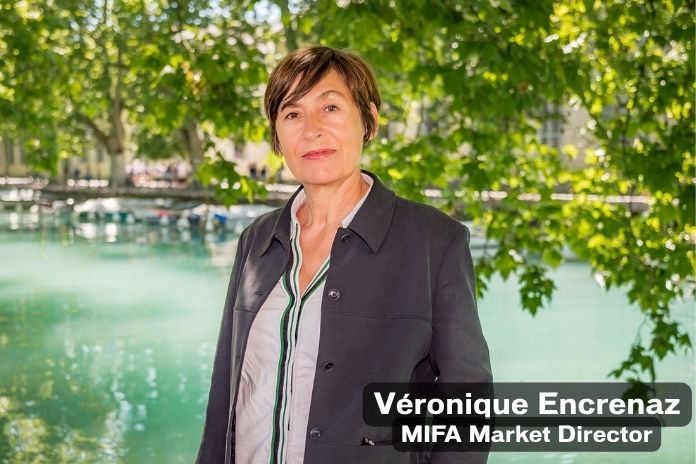
Véronique Encrenazon, MIFA’s market director, brings a visionary yet pragmatic perspective to Annecy 2026, emphasizing not just the event’s global reach but its new role as a catalyst for industry convergence. Her insights reveal how MIFA is redefining how animation, technology, and storytelling communities collaborate—ensuring the world’s leading animation market remains ahead of the curve in a rapidly evolving creative landscape.
MIFA 2026 is very exciting. What should delegates expect?
Four very full days. The market opens on Tuesday, June 23rd, but there is already a significant program on Monday—a full day of workshops we’ve designed specifically around two issues that are keeping the whole industry awake: artificial intelligence and how to attract private investment. These are new programs this year. And then from Tuesday through Friday, the market runs at full pace—the exhibition floor, the pitching sessions, the co-production meetings, and the conferences. It’s dense, by design.
Hollywood, Europe, and Asia give us a sense of the geographic shape of this edition.
The American studios are all here. They’ve made Annecy their primary European event of the year—that’s been building for a long time, but it’s now definitive. Amazon MGM Studios, Netflix, Warner Bros., and BBC Studios have all confirmed their participation. On the European side, the industry is navigating tighter public funding, which is actually one reason the MIFA Invest program matters so much. And then Asia—2023 is a huge year.
MIFA: The Industry’s Beating Heart
The MIFA (Marché International du Film d’Animation) Market runs from June 23–26, facilitating deal-making. In 2026 it relaunches with four sharp pillars: MIFA Business, MIFA Trends, MIFA Talent, and MIFA Exhibition. Two landmark new initiatives debut: MIFA AI, tackling artificial intelligence across creativity, ethics, and environment; and MIFA Cross IP, a first-of-its-kind hub uniting immersive creation, video games, publishing, comics, and webtoons under one roof. The 7,000 m² exhibition floor will host 975 exhibiting companies and an estimated 18,200 accredited professionals—making it the single most important week in the animation industry calendar.
Japan in particular has a major booth presence, pitching sessions, and several films in the festival selection, and TOEI Animation is hosting the opening Mifa cocktail. China, Thailand, Malaysia, Singapore, and Vietnam—all return with expanded delegations and more content in the pipeline. The center of gravity of this industry is shifting eastward, and MIFA reflects that.
Does the inclusion of Baahubali: The Eternal War in the work-in-progress selection and presentation signify that the Indian animation industry is achieving its MIFA moment?
We are very proud to have S.S. Rajamouli’s work in the Work in Progress selection—it brings enormous recognition. And we have an India pavilion and a Karnataka pavilion for this edition. The global appetite for Indian content is real. But it requires a permanent presence at the MIFA exhibition.
The big new structural element is that MIFA is cross-IP. What problem does it solve?
For a long time, professionals in animation visited Annecy to engage with other animation professionals. Cross IP brings the entire story ecosystem into one physical space: game studios, book and comics publishers, manga houses, webtoon creators, immersive producers—all on the first floor of the exhibition zone, with structured one-on-one meetings and a dedicated conference program. The convergence is real, and it runs deep. Gaming studios and animation studios now use similar software pipelines. Talent comes from the same schools. And IP travels very fluidly—from a game to an animated series, from a graphic novel to a feature film, from animation to a webtoon. We are not trying to become a gaming event. We are the place where those adaptation and co-creation conversations happen between animation, publishing, and games.
You’ve also built a cross-market pipeline with EFM and Gamescom. How does that work in practice?
We launched it in February at the European Film Market in Berlin—20 selected companies, ten game studios, and ten animation or production companies, paired together. They worked online through the spring. They are present at MIFA in June.
They follow up at Gamescom Dev in Cologne in August. The entire process takes six to eight months. The first run is an experiment — we’ll assess it and adjust. But the logic is sound: cross-media development needs more than four days, and now it has a proper runway across three of Europe’s strongest markets.
AI is the word on every executive’s lips right now. How is MIFA handling it?
With rigor, not hype. We have created MIFA AI—an exclusive full-day program on Monday the 22nd—built around a new think tank we’re launching called AI4Animation. Conferences, round tables, live demonstrations, and workshops. The goal is to give studios, creators, and policymakers a shared reference: what responsible AI use looks like in production pipelines, what the regulation means, and where creative labor needs to be protected. Studios are already using these tools. What the industry doesn’t yet have is a common language or a common framework. That’s what we’re building.
Is there a specific country that is the focus this year?
No — and that’s intentional. The Cité internationale is the focus of this edition. What our artistic director, Marcel Jean, has done instead is program a special strand on genre animation—horror, dark fantasy, and films that challenge the assumption that animation is only for children. With the new screening infrastructure the Cité provides, we finally have the space to give that conversation the platform it deserves.
Last word: immersive content, AR, VR—where does that sit in 2026?
Still in competition on the festival side and fully integrated into Cross IP—there are dedicated stations in the exhibition area where buyers and commissioners can experience VR works rather than just watching them on a flat screen. Immersive is no longer a sideshow. It belongs at the center of the conversation about where animation is going next.
A World First: The Cité Opens Its Doors
The single biggest story of Annecy 2026 is not a film — it’s a building. On June 19, two days before the festival officially opens, Annecy will inaugurate the Cité internationale du cinéma d’animation, a landmark institution housed inside the historic Haras d’Annecy. There is nothing like it anywhere else in the world. The Cité, designed as a museum, education center, and artist residency, boasts a 332-seat cinema theater and 1,200 m² of exhibition space. It signals Annecy’s ambition to be a year-round animation capital, not just a week-long festival stop.
Highlights

TIFF Reveals Plans for Industry Conference

Films by Shekhar Kapur and Shubham Yogi Selected for Toronto Gala

A Selection to Die for

Le Musk: A Brave New Frontier in Cinema

The Path finder: Jyoti Deshpande

Toonz to Honour Aabid Surti, Biren Ghose at Animation Masters Summit

India is the Country of Honour at Cannes

RAVINDRA VELHAL: DRIVING MEDIA TRANSFORMATION

THE PATH FINDER: JYOTI DESHPANDE

INTO THE WORLD OF RRR

Powerkids Appoints Manoj Mishra as CEO

Toonz Join Tunche Films to Co-Produce Spanish-Peruvian Animation Feature Kayara

National Museum of Indian Cinema Hosts Vintage Vehicles

I&B Secretary promises Govt’s Support to Film industry

Tom Cruise’s ‘Top Gun: Maverick’ to Blaze at Cannes

Illumination’s Minions: The Rise of Gru is the Annecy Festival Opener

Now, Shoot at Sight in India!

Lata Mangeshkar, India’s Singing Goddess

Quantum Image Making Has Arrived

Indian Films To Look Out For In 2022

2022: Centenary of Indian Cinema Legends

Singing Legend Lata Mangeshkar, Nightangale of India, Dies at 92

Bhushan Kumar’s T-Series Ventures Into OTT Content Creation Space

What’s India Looking for at European Film Market