Netflix Rules National Award Films
By Pickle July 20, 2026
Share:


By Pickle News Network
A decade into its India play, Netflix hosts most 72nd National Film Award-winning features — from Article 370 to Amaran
Ten years after Reed Hastings walked on to a Consumer Electronics Show stage in January 2016 and unfurled a world map that included India among 130 new countries switched on overnight, Netflix has quietly turned its Indian decade into an unexpected trophy cabinet. When the Ministry of Information & Broadcasting announced the 72nd National Film Awards for 2024-25 last week, the streamer emerged as the digital home for a staggering share of the winners — a soft-power outcome that no rival on the Indian OTT board can currently match.
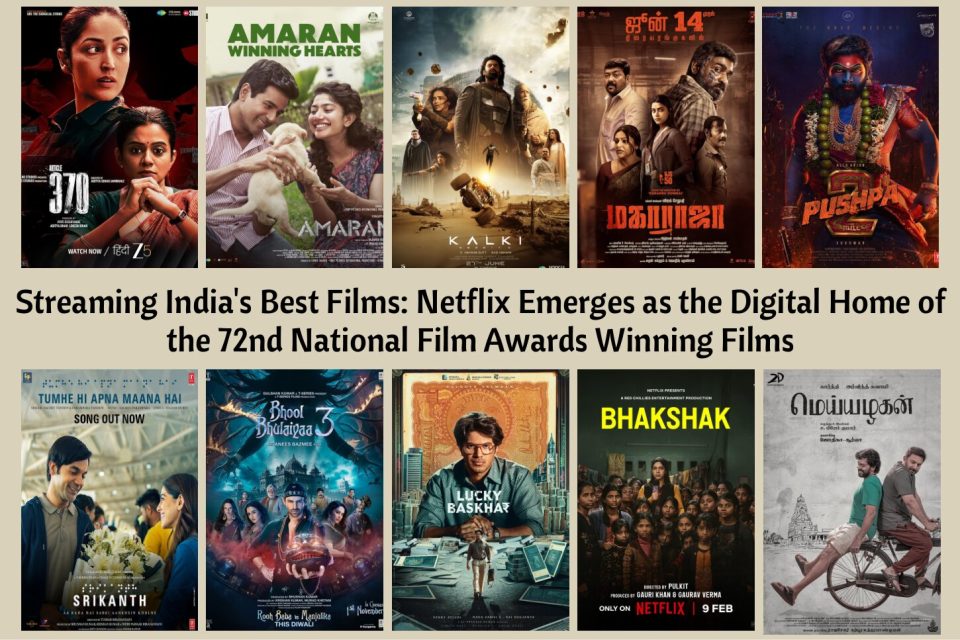
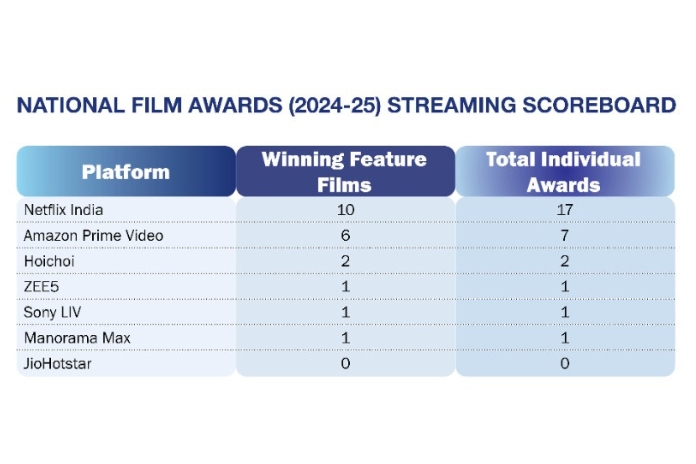
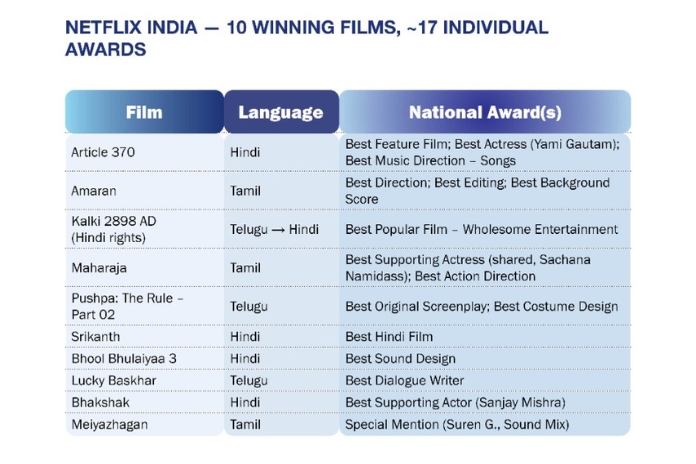
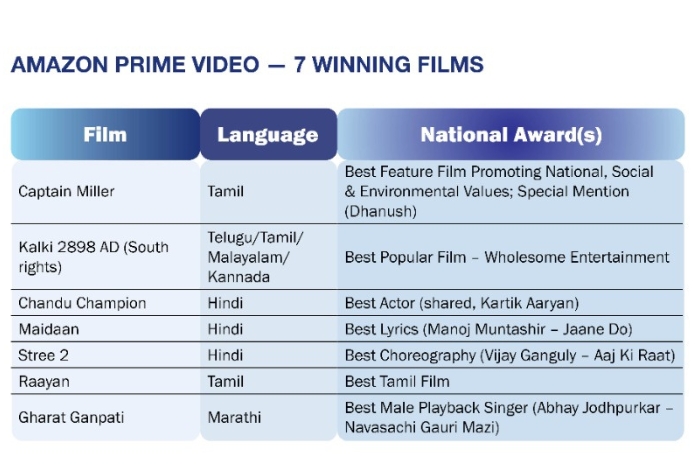
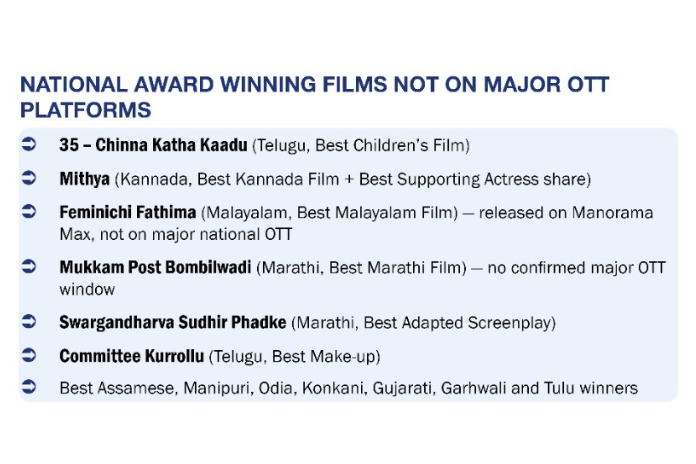
Of the roughly two dozen feature titles that took home a Swarna or Rajat Kamal in Delhi, at least ten are currently streaming on Netflix India, including the Best Feature Film winner Article 370, the Best Direction winner Amaran, both Best Supporting Actress vehicles (Maharaja and, in Kannada, Mithya’s market siblings), the Best Original Screenplay winner Pushpa: The Rule – Part 02 (Hindi), Bhakshak (Best Supporting Actor for Sanjay Mishra), Bhool Bhulaiyaa 3, Srikanth, Lucky Baskhar and Meiyazhagan. Amazon Prime Video anchors the next tier with six winning titles including Captain Miller, Chandu Champion, Stree 2, Maidaan and Raayan, while ZEE5 (Randeep Hooda’s Swatantrya Veer Savarkar) and Sony LIV (Bramayugam) each host one. It is a distribution map, in effect, of India’s officially anointed cinema of 2024-25 — and Netflix owns most of them.
Interestingly, JioHotstar — India’s largest OTT platform by subscribers, home to roughly 300 million viewers after the JioCinema–Hotstar merger — does not currently host a 72nd National Film Award-winning feature title on its slate. That reflects the timing and shape of the 2024-25 acquisition cycle, in which studios released to Netflix, Prime, ZEE5, Sony LIV and Hoichoi for these particular films, rather than any lack of streaming muscle at JioHotstar, whose strengths continue to lie in IPL, Star network catalogue, and a formidable Hindi-mass and regional-mass slate. It is also worth remembering that the two platforms are not adversaries in the household: Netflix India travels, in effect, on Jio’s rails. A large share of Netflix India’s roughly 20 million paid subscribers accesses the service through Reliance Jio’s broadband and mobile bundles — JioFiber and JioHome plans currently offer Netflix at no extra cost on select tiers, with the Netflix bill folded into the monthly Jio invoice. In practice, most Indian homes streaming Article 370 or Amaran on Netflix are doing so over a Jio pipe.
However, Star TV India, operating under JioStar own linear broadcast rights for Natonal Film Award winning films — Amaran, Maharaja and Brahmayugam.
The number lands at an inflection point for the platform. Netflix India crossed roughly 20 million paid subscribers in 2025 and clocked ₹3,769 crore in revenue with a maiden ₹85 crore profit — a 32% year-on-year growth on the top line — according to filings summarised by industry trackers. India has since climbed to Netflix’s number two market for paid net additions, management told investors on the Q4 2025 earnings call. Co-CEO Ted Sarandos, who visited India twice in the last 18 months, has publicly stated that content watching on Netflix India grew 30% and revenue 25% in 2024 alone. “You cannot entertain the world without India,” Sarandos has said in recent India briefings, a line that neatly frames the ambition behind an estimated $2 billion India content commitment through the current cycle.
The National Award tally is the clearest evidence yet that this cheque book is buying jury credibility, not just eyeballs. It has been built on two parallel bets. The first is the mainstream Hindi bet: films like Article 370, Chandu Champion’s theatrical cousin Bhool Bhulaiyaa 3, Srikanth and Bhakshak — mid-budget, script-forward, star-anchored dramas that have quietly become Netflix India’s aesthetic signature. The second, and increasingly the louder one, is the South strategy. Monika Shergill, Netflix India’s Vice President — Content, has publicly called Tamil, Telugu and Malayalam “very strong focus areas… growth markets” for the company, with South viewership on the service growing 50% year-on-year and South titles now on the global non-English Top 10 across 26 countries, up from 17. “South India is a strategic growth engine for Netflix,” she reiterated at a July 2026 industry gathering in Hyderabad.
The awards ratify that framing. Netflix carries the Best Direction winner in Tamil (Rajkumar Periasamy’s Amaran), a Best Supporting Actress winner in Tamil (Sachana Namidass in Maharaja), the Best Original Screenplay winner in Telugu (Sukumar Bandreddi’s Pushpa: The Rule – Part 02, in Hindi rights) and the Best Dialogue winner in Telugu (Venky Atluri’s Lucky Baskhar), alongside Dhanush’s Special Mention performance in Captain Miller on Prime. In one language after another, the jury has pointed at a Netflix thumbnail.
Reed Hastings, who once described India as a “speculative” investment with pricing experiments still to be settled, has been vindicated in a way even Netflix’s own India roadmap did not fully anticipate. The volume race, on paper, has gone the other way — JioHotstar sits atop the Indian streaming market with roughly 300 million subscribers and a 31% SVOD share by some measures. But the National Awards are a different currency: they are the state’s annual signal of what Indian cinema wants to be remembered for. And in 2024-25 crop, the signal points to a red logo.
For a platform that entered India a decade ago as an outsider betting on English catalogue and premium pricing, hosting the majority of a National Award-winning slate — including the Best Feature Film — is more than a marketing line. It is, arguably, the closest Netflix has come to being read as an Indian studio.

Highlights

TIFF Reveals Plans for Industry Conference

Films by Shekhar Kapur and Shubham Yogi Selected for Toronto Gala

A Selection to Die for

Le Musk: A Brave New Frontier in Cinema

The Path finder: Jyoti Deshpande

Toonz to Honour Aabid Surti, Biren Ghose at Animation Masters Summit

India is the Country of Honour at Cannes

RAVINDRA VELHAL: DRIVING MEDIA TRANSFORMATION

THE PATH FINDER: JYOTI DESHPANDE

INTO THE WORLD OF RRR

Powerkids Appoints Manoj Mishra as CEO

Toonz Join Tunche Films to Co-Produce Spanish-Peruvian Animation Feature Kayara

National Museum of Indian Cinema Hosts Vintage Vehicles

I&B Secretary promises Govt’s Support to Film industry

Tom Cruise’s ‘Top Gun: Maverick’ to Blaze at Cannes

Illumination’s Minions: The Rise of Gru is the Annecy Festival Opener

Now, Shoot at Sight in India!

Lata Mangeshkar, India’s Singing Goddess

Quantum Image Making Has Arrived

Indian Films To Look Out For In 2022

2022: Centenary of Indian Cinema Legends

Singing Legend Lata Mangeshkar, Nightangale of India, Dies at 92

Bhushan Kumar’s T-Series Ventures Into OTT Content Creation Space

What’s India Looking for at European Film Market