Chhota Bheem Came Alive
By Pickle October 10, 2026
Share:


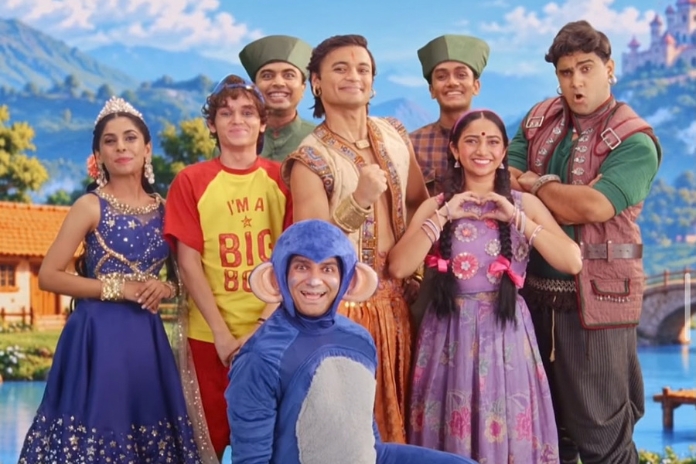
And He Certainly Left No Crumbs!
Chhota Bheem’s journey from screen to stage offers a glimpse of what home-grown Indian IP can become when familiar characters find new ways to connect with audiences. At Mumbai’s Royal Opera House, that possibility takes the form of a live musical. In the review below, Meghaa Chilka, VP Content Production, Greengold Animation shares her personal response to the performance, its craft and its appeal across generations.
Review By Meghaa Chilka
I walked into Mumbai’s iconic Royal Opera House to watch the Chhota Bheem Live Musical with very few expectations and, honestly, very little idea of what I was about to experience.
I had never seen an animated character-based Indian IP translated into a full-scale live musical quite like this.
I walked out thinking: this is what happens when a strong Indian IP is given the ambition, scale and creative treatment it deserves.
For me, this was much more than a children’s show. From an industry perspective, it was a fascinating example of how an original Indian IP can evolve beyond its original medium and create an entirely new kind of audience experience.
And, quite simply, Bheem and his team came, performed, entertained—and left no crumbs!
From Screen to Stage
Created by Rajiv Chilaka nearly two decades ago, Chhota Bheem began as an original Indian animation IP and has since grown into one of the country’s most recognisable home-grown entertainment properties.
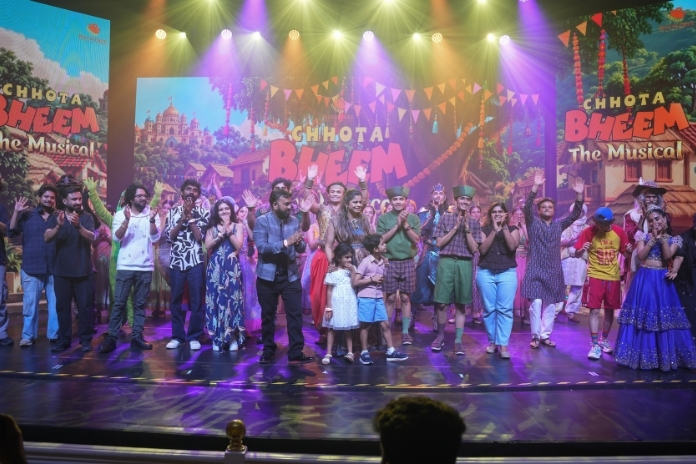
The Chhota Bheem Live Musical, produced by Neem Tree Productions, takes this much-loved IP into an entirely new format, with Mumbai’s iconic Royal Opera House serving as its first stage.
What impressed me most is that the production does not simply attempt to recreate the animated series on stage.
It reimagines the world of Chhota Bheem for a live audience.
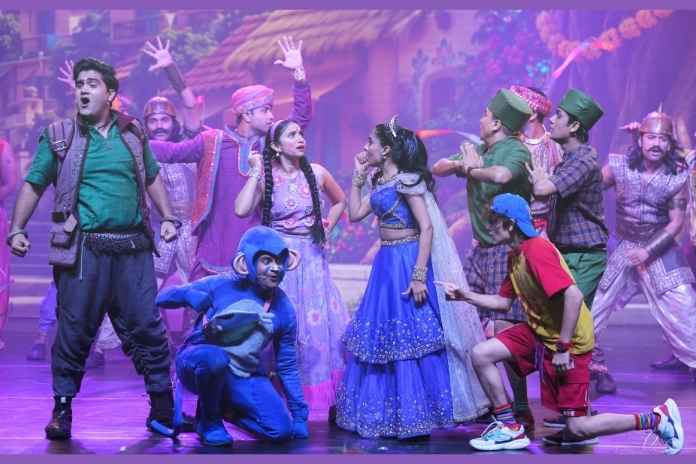
The moment Bheem and his team appeared, there was a genuine sense that the characters we have known on screen had suddenly come alive.
That is not an easy transition.
When an animated IP moves into live entertainment, it has to preserve the DNA that audiences already love while creating something fresh, physical and immersive.
This production manages to achieve that balance remarkably well.
It Isn’t Just About Bheem
One of my biggest takeaways was the strength of the ensemble.
The name may be Chhota Bheem, but the show understands that the real strength of the property lies in the entire Bheem universe.
Chutki, Raju, Kalia, Dholu, Bholu and Indumati all have meaningful moments, performances and roles within the story. No character feels like they are simply there to support Bheem.
From an IP perspective, this is particularly important.
When a successful character franchise expands into a new medium, the entire character universe becomes an asset. The musical uses that universe extremely well.
Thunderroc Drives the Adventure
The story is built around a strong antagonist, Thunderroc, who drives the central conflict and takes Bheem and his friends on an adventure across different locations as they attempt to unravel a mystery and save the day.
There is also a clever twist where Thunderroc disguises himself as Bheem in an attempt to discover the location and crack the mystery.
But Thunderroc is more than a superficial villain. He is central to the narrative and creates the adventure that takes Bheem and his friends into different worlds and situations.
Magic, mystery, friendship, adventure and humour are woven throughout the journey, eventually leading to the inevitable moment when Bheem steps up to do what Bheem does best—save the day.
The World-Building Was Fantastic
The production design deserves special mention.
The changing stage environments and large visual backdrops successfully transport the audience from one location to another, creating a world that extends well beyond the stage itself.
There were also wonderful surprises outside the main performance area. Characters appeared along walkways and corridors, while clowns and birds welcomed audiences into the world of Dholakpur.
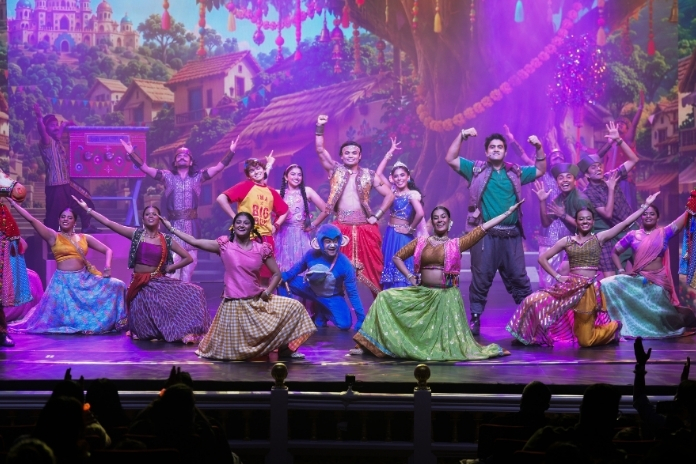
These details made the experience feel less like simply watching a show and more like entering the world of Chhota Bheem.
And that, to me, is what good live IP entertainment should do.
Music, Dance and Choreography
As a musical, the music and choreography naturally play a central role—and they work beautifully together.
The songs are energetic, catchy and interactive, with plenty of opportunities for children to participate rather than simply sit and watch.
The choreography has the scale and energy expected from a live musical while retaining the innocence, humour and familiarity of the Chhota Bheem universe.
The costumes also deserve recognition. Seeing these familiar characters physically represented on stage creates a completely different emotional connection.
It is one thing to see Bheem on a screen.
It is another thing entirely to see him standing in front of you, performing.
The Show Doesn’t Just Entertain the Audience It Makes Them Part of the Experience
This was perhaps one of my favourite aspects of the production.
The creators clearly understand one fundamental truth about children: you cannot expect them to simply sit quietly and watch for 90 minutes.
They need to be part of the story.
The performers constantly engage with the audience through questions, quizzes and call-and-response moments.
And then there is the infectious:
“Hu Hu Ha Ha!”
Bheem and the team say it—and the entire auditorium responds.
The energy that creates inside the Royal Opera House is something that simply cannot be replicated on a television screen.
The Chhota Bheem Bands Were a Brilliant Touch
Another element I particularly loved was the light-up Chhota Bheem wristband given to the audience.
It had a distinctly Broadway-style quality to it.
The bands changed colours in response to what was happening on stage. When Bheem and his team needed support, the audience became part of that moment. When Bheem performed, the bands responded. When the forest or another part of the story came alive, the colours changed again.
And when darker forces entered the narrative, the lighting shifted accordingly.
Suddenly, the audience was not just watching the story.
The audience was helping light up the story.
From an experience-design perspective, I thought this was a very smart idea.
It also works beautifully as a souvenir—something children can take home and continue to associate with the experience.
A New-Age Bheem Team
I particularly enjoyed how the characters have been adapted for today’s generation.
Raju is probably the best example.
The animated Raju that many of us remember has been reimagined for today’s children. He has his hair, shorts, T-shirt and cool cap—and, most importantly, he is completely plugged into the digital world.
He is constantly taking pictures, recording videos, making reels and vlogging with his selfie stick.
And it works.
The children immediately connect with him.
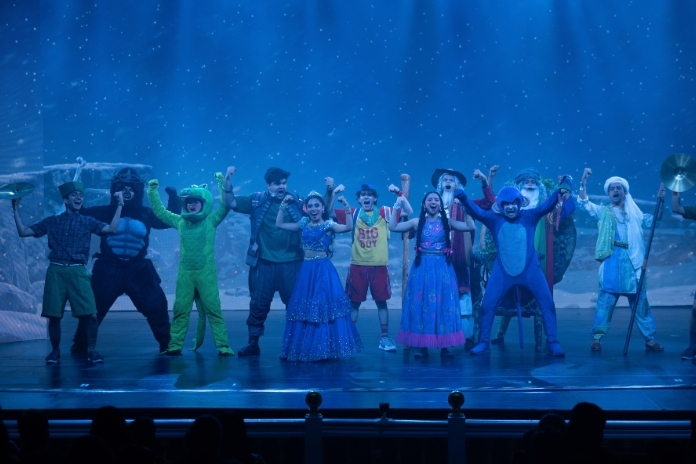
It feels as though the creators are saying: This is Raju today.
He has grown with the audience.
Similarly, Chutki and Indumati are portrayed as confident, capable characters rather than simply supporting figures.
Even Dholu and Bholu retain the spirit and mannerisms of the animated twins, despite the practical challenges of translating them into live performance.
And Then There Was Jaggu!
And how can I not mention Jaggu?
In the animation, Jaggu is the mischievous monkey who has always been an integral part of Bheem’s world.
Bringing an animal character from animation into live theatre is not easy. You have to retain the character’s recognisable personality and mannerisms without making the performance feel artificial or disconnected from the world around the other characters.
The actor playing Jaggu did a fantastic job.
The costume, physicality and movement captured Jaggu’s mischievous energy beautifully. The way he moved around the stage and interacted with the other characters genuinely brought the animated Jaggu to life.
It was delightful to see a character we have always known as a cartoon monkey suddenly become a living, moving presence on stage.
For me, these are the details that make an IP adaptation successful.
You are not simply putting a familiar name on a live show. You are asking:
“What makes this character recognisable and loved?”
And then you find a live-performance language to express it.
Jaggu absolutely found his place in that world.
Seeing him live was also one of those wonderfully nostalgic moments that made the experience even more special.
These may seem like small adaptations, but they demonstrate an important IP principle:
An IP has to retain its DNA while evolving with its audience.
The Message Beneath the Entertainment
What stayed with me most was the underlying message about individuality and self-belief.
Kalia, traditionally seen as the bully and often positioned against Bheem, finds himself in a situation where others question whether he is capable of taking on a challenge.
Bheem’s response is not to take over.
He encourages Kalia.
He tells him that he can do it—and that he has to prove himself in his own way.
It is a beautiful message for children:
Every child is different. Every child has different strengths. And being capable does not mean being exactly like someone else.
The message is subtle, but it lands.
The story also brings in themes of friendship, courage, teamwork and compassion towards animals, giving children something meaningful to take home beyond the spectacle.
And Then There Was the Audience
This was perhaps the biggest surprise for me.
I expected to see children.
Of course, there were plenty of them—four-, five-, six- and seven-year-olds completely glued to the stage.
But what surprised me was how invested the parents and grandparents were as well.
Young parents in their late twenties and thirties, many of whom had grown up watching Chhota Bheem, were now experiencing it alongside their own children.
Grandparents were there too.
They were laughing, clapping and enjoying the show alongside everyone else.
That is when you realise that Chhota Bheem is no longer simply a children’s animation property.
It has become a multi-generational Indian IP.
A Personal Moment That Stayed With Me
There was one moment outside the show that particularly stayed with me.
A mother came up to me and said something along the lines of:
“Your husband created this show. It is so amazing. My daughter is five, and this is the one show I allow her to watch. She gets about an hour of screen time on Sundays, and I am completely comfortable with her watching Chhota Bheem and Mighty Little Bheem on Netflix.”
That meant a lot.
Because in a world where parents are increasingly conscious about what their children watch, hearing that a parent feels comfortable allowing her child to watch an Indian character—and considers that character a positive influence—means something.
It reminded me that Chhota Bheem is not simply a cartoon character.
For many families, he has become part of their childhood, their children’s childhood and, increasingly, their grandchildren’s childhood.
Can You Hold a Child’s Attention for 90 Minutes?
For me, this is one of the biggest achievements of the show.
Keeping a four- or five-year-old engaged for 90 minutes is difficult.
Keeping the parents engaged is harder.
And keeping the grandparents entertained at the same time is an entirely different challenge.
Yet, sitting in that auditorium, I saw all three generations laughing, clapping, responding and remaining glued to the stage.
That is a significant achievement for the director and the entire creative team.
A Special Word for the Director and Creative Team
Amatya Goradia, the director, deserves enormous credit for bringing together so many moving parts— performances, music, choreography, storytelling, audience interaction, comedy, changing environments and technology—and making them feel like one cohesive experience.
The pacing and transitions are particularly important in children’s live entertainment, where a production can quickly lose momentum.
Here, the energy keeps moving.
Creative producer Shruti Sharma has played an important role in shaping and holding together the larger creative vision of the production.
The writing team, Driti Bhatt and Aashitosh Solanki, have taken a familiar IP and created a contemporary story around it without losing the essence of its characters.
Anik Sharma, the music director, has given the show a distinct musical identity, with the songs working as part of the storytelling rather than feeling like numbers inserted between scenes.
Varsha Jain, the production designer, has done a fantastic job translating the visual world of Dholakpur into a live theatrical environment.
A special mention also goes to Bhoomi Natwani from Neem Tree Productions, who is also a producer on the show, and to the entire Neem Tree team for taking on the ambitious challenge of bringing an original Indian animation IP into live musical theatre.
Why This Matters for Indian IP
For me, the larger significance of this show goes beyond Chhota Bheem.
India has created some incredible original characters and stories. But traditionally, we have been much better at creating successful screen properties than turning those properties into broader experiential entertainment ecosystems.
The Chhota Bheem Live Musical demonstrates what is possible when an Indian original IP moves beyond its original medium.
Animation → Television → Digital → Films → Merchandise → Live Entertainment
That is the kind of IP expansion that can create deeper, longer-lasting relationships with audiences.
And perhaps the most exciting part is that this is happening with an Indian-origin character rooted in Indian storytelling, culture and sensibilities.
We do not always have to look outside India for global-scale entertainment experiences.
We can build them around our own characters.
My Verdict
⭐ 4.5/5
For a first-of-its-kind live musical experience built around an original Indian animation IP, I would give the Chhota Bheem Live Musical a 4.5/5.
The performances, music, choreography, costumes, stage design, storytelling, interactive technology and production scale come together beautifully.
But what I enjoyed most was the feeling of seeing a character that has lived on our screens for almost 20 years suddenly become three-dimensional, physical and alive in front of us.
It was nostalgic for adults, magical for children and entertaining for everyone in between.
And I genuinely hope this is only the beginning.
I hope the musical travels from Mumbai to cities across India and eventually internationally, giving Indian audiences around the world the opportunity to experience Bheem and his team live.
Because if Mumbai was the beginning, I am very excited to see where Bheem goes next.
Congratulations to Neem Tree Productions, Amatya Goradia, Shruti Sharma, Driti Bhatt, Aashitosh Solanki, Anik Sharma, Varsha Jain, Bhoomi Natwani, the entire cast and crew, and everyone who worked behind the scenes to bring this ambitious production to life.
And a very special shout-out to Rajiv Chilaka, the original creator of Chhota Bheem, for creating an Indian IP that continues to evolve, grow and find new ways to connect with audiences.
Chhota Bheem and team came, performed, entertained—and left no crumbs. ❤️
I am already looking forward to seeing what comes next.
Afterword
The larger promise lies in Indian stories finding a life beyond the medium in which they began. As Meghaa’s account suggests, live theatre can turn familiarity with a character into a shared family experience. Bheem’s new wings point towards an opportunity for home-grown IP: to grow through thoughtful adaptation while retaining the imagination, values and cultural identity that made audiences care in the first place.
Highlights

A R Rahman’s Covid-19 Anthem Resurfaces in Social Media

TIFF Reveals Plans for Industry Conference

Films by Shekhar Kapur and Shubham Yogi Selected for Toronto Gala

A Selection to Die for

Le Musk: A Brave New Frontier in Cinema

The Path finder: Jyoti Deshpande

Toonz to Honour Aabid Surti, Biren Ghose at Animation Masters Summit

India is the Country of Honour at Cannes

RAVINDRA VELHAL: DRIVING MEDIA TRANSFORMATION

THE PATH FINDER: JYOTI DESHPANDE

INTO THE WORLD OF RRR

Powerkids Appoints Manoj Mishra as CEO

Toonz Join Tunche Films to Co-Produce Spanish-Peruvian Animation Feature Kayara

National Museum of Indian Cinema Hosts Vintage Vehicles

I&B Secretary promises Govt’s Support to Film industry

Tom Cruise’s ‘Top Gun: Maverick’ to Blaze at Cannes

Illumination’s Minions: The Rise of Gru is the Annecy Festival Opener

Now, Shoot at Sight in India!

Lata Mangeshkar, India’s Singing Goddess

Quantum Image Making Has Arrived

Indian Films To Look Out For In 2022

2022: Centenary of Indian Cinema Legends

Singing Legend Lata Mangeshkar, Nightangale of India, Dies at 92

Bhushan Kumar’s T-Series Ventures Into OTT Content Creation Space