Cinema Plants Seeds of Change
By Pickle November 21, 2026
Share:


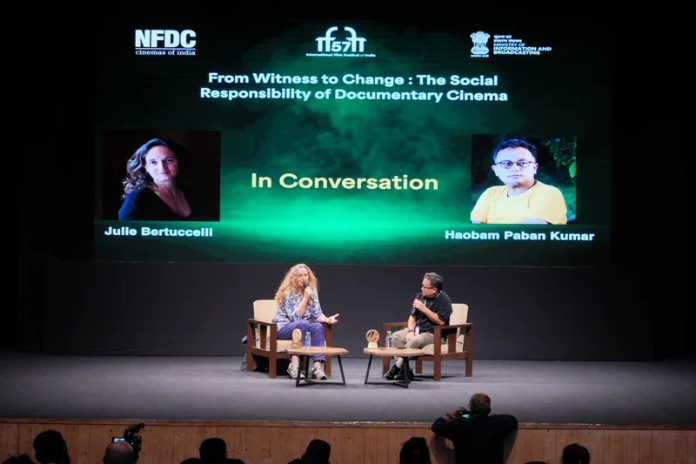
Films cannot transform society overnight, but they can shift perceptions and inspire hope, French filmmaker Julie Bertuccelli says at IFFI.
Cinema may not change society overnight, but it can change the way people see it, acclaimed French filmmaker and screenwriter Julie Bertuccelli said at the 57th International Film Festival of India (IFFI) in Goa.
“If I just put a little bit of a seed in the brain of some people, this is a lot,” Julie Bertuccelli said, arguing that films work by shaping individual perceptions and encouraging change. She said she preferred films that offered hope and showed positive examples, inspiring people to believe that change was possible.
Julie Bertuccelli was in conversation with National Award-winning Indian filmmaker Haobam Paban Kumar at Kala Academy, Panaji. The session was titled “From Witness to Change: The Social Responsibility of Documentary Cinema”.
That influence carries responsibility, she said. Documentary filmmaking is an intimate process that can have a profound impact on the lives of its subjects and, in some cases, even put them at risk. Filmmakers must build trust, spend time with communities and let people grow comfortable with the camera.
A young filmmaker asked how to document untouchability and patriarchy in his village. Julie Bertuccelli advised sustained engagement, genuine interest in the community and clarity about the purpose of the work.
She said her documentary ideas often come from unexpected encounters, places or subjects, citing School of Babel and Since Otar Left as films that began in real-life experience. Scripts and proposals help secure funding, she said, but the filmmaking itself stays open to the unpredictability of real life.
Julie Bertuccelli also outlined France’s institutional support for documentaries, including cinema ticket revenues that go towards film financing and protected theatrical windows. Acknowledging India’s rich documentary tradition, she said preparations were underway for a retrospective of Indian documentaries in Paris in the coming years.
She expressed reservations about the growing use of Artificial Intelligence, citing concerns over creativity, copyright and its consumption of water and electricity. Excessive dependence on it, she cautioned, could undermine human memory, independent thinking and creative authenticity.
Documentary cinema, she said, captures what Artificial Intelligence cannot replicate: the spontaneous emotions, silences, gestures and imperfections of real human interactions.
Highlights

STRAIGHT ANSWERS FROM AMIT KHANNA

ads2OTT set to Launch in Oct 2020

TIFF Reveals Plans for Industry Conference

Films by Shekhar Kapur and Shubham Yogi Selected for Toronto Gala

A Selection to Die for

Le Musk: A Brave New Frontier in Cinema

The Path finder: Jyoti Deshpande

Toonz to Honour Aabid Surti, Biren Ghose at Animation Masters Summit

India is the Country of Honour at Cannes

RAVINDRA VELHAL: DRIVING MEDIA TRANSFORMATION

THE PATH FINDER: JYOTI DESHPANDE

INTO THE WORLD OF RRR

Powerkids Appoints Manoj Mishra as CEO

Toonz Join Tunche Films to Co-Produce Spanish-Peruvian Animation Feature Kayara

National Museum of Indian Cinema Hosts Vintage Vehicles

I&B Secretary promises Govt’s Support to Film industry

Tom Cruise’s ‘Top Gun: Maverick’ to Blaze at Cannes

Illumination’s Minions: The Rise of Gru is the Annecy Festival Opener

Now, Shoot at Sight in India!

Lata Mangeshkar, India’s Singing Goddess

Quantum Image Making Has Arrived

Indian Films To Look Out For In 2022

2022: Centenary of Indian Cinema Legends

Singing Legend Lata Mangeshkar, Nightangale of India, Dies at 92