“Animation Is Not only for Children — It Never Was”
By Pickle June 21, 2026
Share:


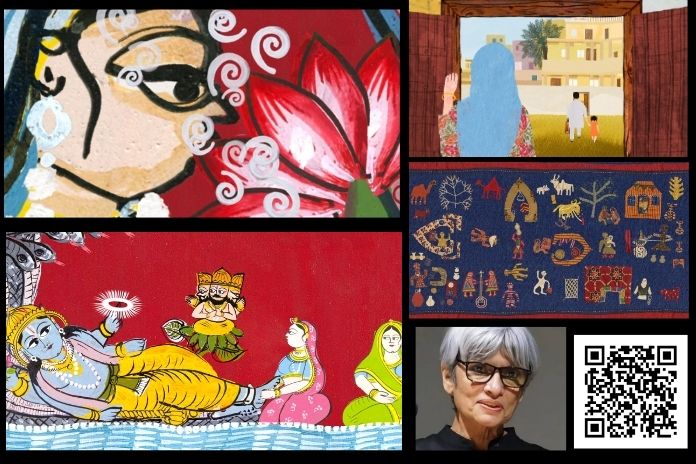
An interview with Prof. Nina Sabnani, Festival Director, AniMela
You have been in this space for over four decades. Are you optimistic about where Indian animation stands today?
Absolutely. If you had asked me twenty years ago, I would have had some reservations. When we started the animation programme at NID in 1985, we were the only ones teaching animation formally — the only institution in the country. IDC IIT Bombay started a dedicated animation programme only in 2006. Today, India has 5,000+ universities, and 500+ of them teach animation. That is extraordinary. People at least know the word animation now. In my time, they called it cartoons. My own friends from fine arts thought I had taken a step down.
A step down? Fine arts to animation?
Yes. I remember a friend visiting my studio when I was experimenting with sand, found material, leaves — animating them. She looked at it and said, “Oh, I guess this could be called art.” That was the attitude. And now you see artists like Nalini Malani doing amazing installation animation. The world has shifted. And it is shifting faster for the young people coming up now — they are not as colonised as we were. They are comfortable in their own skin, their own visual language, their own stories.
Yet the challenge of reaching an adult audience remains. Why has animation in India been boxed in as “children’s content”?
There is a history to this. I wrote a paper on it — “Challenges of a Sleeping Giant,” published in the MIT Press journal in 2005 — about why animation in India became associated exclusively with children. It began as a propaganda tool of the state. The only animation unit was at Films Division. All the early masters — Ram Mohan, BhimSen, Rani Burra — they learned on the job there, making public service films. Then Disney shorts came before every cinema feature in cinema halls, and children identified animation as their own world. Television reinforced this. Nickelodeon, cartoon channels, all imported content, all for children. We never built an adult audience. Even The Simpsons, a global phenomenon, did not last here.
But that is changing?
Yes, with the OTT platforms and in the independent sector, very clearly. Look at the five film pitches going to MIFA this year — see how those young filmmakers talk about their themes, how immersed they are. They are not doing this as a commercial activity. They really feel strongly about their stories. When one of them makes something that breaks through, it will lift everyone.
What role does AniMela play in building that ecosystem?
AniMela’s mission is to make industry meet young talent. That bridge has to be built. It is like mainstream and independent cinema — both have to understand each other. We have been doing this for three editions now. But I will be honest — finding even two lakh rupees for an event at a national venue is a struggle. YouTube influencers make lakhs out of fashion content, and here we are working hard just to keep the lights on.
You co-mentored a Netflix skilling project that reached Tier-2 and Tier-3 cities. Tell us about it.
This was with Munjal Shroff of Graphiti Multimedia Studio. He was doing a project for Netflix — eight social innovators, with a one-minute animated introduction before each live-action segment. This content was for their web presence. He had this idea and asked me to work alongside his amazing team to identify students from smaller cities and skill them. We identified eight schools — students from Jorhat, Ujjain, Chandigarh, Dehradun, Amravati, Kolkata, Kurukshetra, outside Delhi. We met once at the beginning and once at the end. Everything else was online training. And here is what was beautiful: each student’s visual language was different — and that was acceptable. That acceptance of plurality is new. It is definitely changing.
AI: embrace or resist?
Neither blanket embrace nor paranoid resistance. In the West, they are scoffing and debating. We are embracing — perhaps that gives us an advantage. The key is to use AI ethically and creatively, with your own visual language. If you feed it your own drawings and ask it to extrapolate, that is a legitimate creative tool. But you cannot train it on Miyazaki’s work and call it yours. What AI does well is open pathways for imaginative people who may lack certain technical skills — like how a phone camera democratised photography. The average bar of visual literacy rises. And that is what we need.
Your most recent film, Home, is about your mother and the Partition. It uses cloth and watercolour. Why those materials?
My mother loved sewing. And memory is like cloth — it fades, it frays, it tears, but it also stays. Some things you never forget, no matter what. I made that connection between cloth and memory and built the film from there. She passed away last year. I haven’t put it on YouTube yet, but I will. It has been shown at an oral history conference in Poland and was received beautifully. It has its own peculiar audience — it is not a mainstream film. But that is exactly why it exists.
Final question: What gives you hope?
My students give me hope. My teachers give me hope. KG Subramanyan was thinking about his next project until the day he died. Gulam Sheikh is still exhibiting. I cannot stop when they will not stop. And when I see a student like Somnath producing another student’s film — with his own money, because he believed in it — and that film wins an award at Annecy, I think: we are going to be fine.
Filmography & Key Works
| Film | Year | Medium/Technique | Distinction |
| Shubh Vivah | Early 1980s | Madhubani painting-style animation | First student film; screened at Annecy 1987 (student section) |
| A Summer Story | ~1985 | Animated from KG Subramanyan’s illustrated book | On her YouTube channel |
| All About Nothing | ~1990s | Stop-motion | Conjecture on birth of zero in India, made for Discovery of India, Nehru Centre |
| Mukand and Riaz | 2005 | Textile, appliqué, embroidery — Partition story | Certificate of Merit, Tokyo Broadcasting System; published in India, France, Pakistan |
| Tanko Bole Chhe (The Stitches Speak) | 2009 | Digital cutout animation from Kutch embroidery | Best Documentary Cinequest 2011; Humboldt Best Immigration Story 2011; IFFR Rotterdam 2025 |
| Baat Wahi Hai (It’s the Same Story) | 2011 | Experimental narrative discourse | International screenings |
| Thank You Many Times | 2013 | Animation | International screenings |
| Hum Chitra Banate Hain (We Make Images) | 2015–16 | Bhil art; collaboration with artist Sher Singh | Rajat Kamal National Award, 64th National Film Awards, 2017 |
| Home | ~2022–24 | Watercolour + cloth; mother’s Partition story | Shown at oral history conference IOHA, Poland; festival circuits |
Honours & Recognition
- 1985 — Best Animation Film, Calcutta Short Film Festival, for Drawing! Drawing!
- 1987 — UNDP Fellowship to study animation in Belgium, Holland, UK
- 1997 — Fulbright Fellowship, Syracuse University, New York
- 1998 — State Lalit Kala Academy Award for Painting
- 2017 — Rajat Kamal National Award, Best Animation Film (Non-Feature), Hum Chitra Banate Hain, 64th National Film Awards
- 2018 — Lifetime Achievement Award for Illustration, Tata Trusts, Tata LitLive Festival, Mumbai
- 2021 — Legend of Indian Animation Award, Toonz Media Group / Animation Masters Summit
- 2024 — Jury Member, Annecy International Animation Festival (Commissioned and Television Films jury)
- 2024 — Ram Mohan Excellence in Animation award, Animation Express and Graphiti Multimedia
Highlights

Media News Digest June 23, 2021

TIFF Reveals Plans for Industry Conference

Films by Shekhar Kapur and Shubham Yogi Selected for Toronto Gala

A Selection to Die for

Le Musk: A Brave New Frontier in Cinema

The Path finder: Jyoti Deshpande

Toonz to Honour Aabid Surti, Biren Ghose at Animation Masters Summit

India is the Country of Honour at Cannes

RAVINDRA VELHAL: DRIVING MEDIA TRANSFORMATION

THE PATH FINDER: JYOTI DESHPANDE

INTO THE WORLD OF RRR

Powerkids Appoints Manoj Mishra as CEO

Toonz Join Tunche Films to Co-Produce Spanish-Peruvian Animation Feature Kayara

National Museum of Indian Cinema Hosts Vintage Vehicles

I&B Secretary promises Govt’s Support to Film industry

Tom Cruise’s ‘Top Gun: Maverick’ to Blaze at Cannes

Illumination’s Minions: The Rise of Gru is the Annecy Festival Opener

Now, Shoot at Sight in India!

Lata Mangeshkar, India’s Singing Goddess

Quantum Image Making Has Arrived

Indian Films To Look Out For In 2022

2022: Centenary of Indian Cinema Legends

Singing Legend Lata Mangeshkar, Nightangale of India, Dies at 92

Bhushan Kumar’s T-Series Ventures Into OTT Content Creation Space