Jyoti’s Deshpande’s Cinematic Coup
By Pickle February 11, 2026
Share:


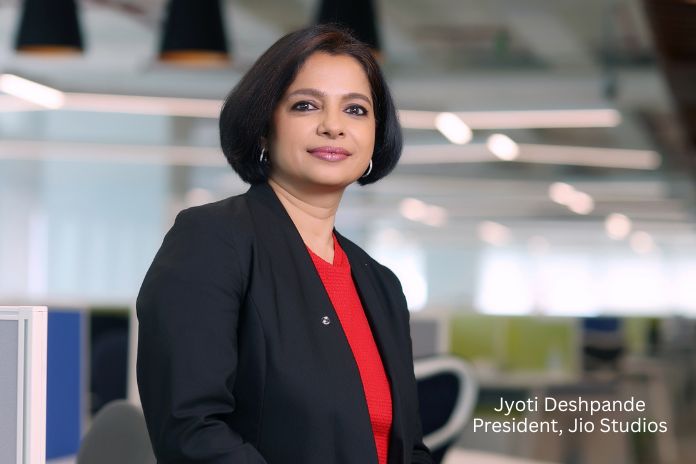
With Dhurandhar breaking box office records and redefining Indian storytelling, Jyoti Deshpande, President, Jio Studios is proving that authentic, unapologetic cinema can captivate audiences worldwide. Her vision is transforming Indian cinema to the World
By Natarajan Vidyasagar & Vivek Ratnakar
Jyoti Deshpande stands at a threshold few studio heads ever reach. With Dhurandhar shattering every box office record in Indian cinema—crossing ₹1,350 crore worldwide and becoming a cultural juggernaut that transcends national borders—she has accomplished something far more significant than commercial success. She has fundamentally repositioned how India’s stories are told, who tells them, and for whom they are told.
Directed and written by Aditya Dhar—the National Award-winning creator of Uri: The Surgical Strike—the film ventures into territory Indian cinema has rarely explored with such narrative ambition and honesty. The film is produced by Jio Studios and B62 Studios.
Ranveer Singh leads the film through deliberate restraint, transforming into undercover operative Hamza Ali Mazhari with patience conveyed through subtle eye work. Akshaye Khanna steals the ensemble as Rehman Dakait, wielding masterful, layered charisma tinged with unpredictable and razor-edged intensity.
Sanjay Dutt commands with seasoned gravitas and measured authority; R. Madhavan injects an intellectually sharp strategic dimension; Arjun Rampal exerts control through calculated, threatening silence. Sara Arjun, in her high-profile debut, brings unexpected emotional authenticity.
Backed by Reliance’s Jio ecosystem, Jyoti Deshpande challenges decades of subservience to Western narratives, building a studio philosophy that speaks to India first—authentically and unapologetically
Dhurandhar, now streaming globally on Netflix, is the first Indian film in a generation to compete internationally without diluting its identity.
Backed by Reliance’s Jio ecosystem, Jyoti Deshpande has positioned herself as India’s preeminent film producer, architecting a studio philosophy that challenges decades of subservience to Western narrative frameworks.
Over thirty years navigating India’s media landscape, Jyoti Deshpande has witnessed every technological revolution that reshaped storytelling. Yet she speaks of none with the urgency she reserves for what happened after Jio’s launch.
“I always think of it as the era before Jio and after Jio,” she reflects, her tone carrying the weight of witnessing transformation firsthand.
“India was 155th in the world in data consumption before Jio. Today, we’re number one. That’s not just about internet speed. That’s about democratizing information, about rewriting who gets to speak and who gets to listen.”
This democratization, she argues, obliterated cinema’s old guardrails. The opening weekend no longer controls a film’s fate. Critics’ reviews no longer manage narrative momentum. Information travels instantaneously, unfiltered.
Audiences immediately know whether a film is worth their time, their money, and their collective energy. There is no place left to hide.
Three Decades: From Single Screens to Global Stages
Deshpande began her career in the single-screen era, a time when distribution was challenging and audience reach was a logistical feat.
She witnessed the multiplex revolution that democratized theatrical access. She navigated the birth of satellite television in the 1990s and watched VHS yield to VCD and VCD to DVD. She saw OTT arrive and initially threaten the cinema’s extinction.
“What I’ve seen in these three decades is a medium constantly forced to justify its existence,” Deshpande says. “Every new technology that arrived was supposed to kill cinema. Yet cinema survived because it offers something else—collective experience, emotional resonance, and cultural meaning.”
Jyoti’s strategic pivot to prioritize cinematic excellence over quantity redefined Jio Studio’s identity, proving that audiences demand a big-screen experience that truly captivates
But survival required evolution. And it required someone with the conviction to reimagine Indian cinema without its Western market apologetics.
In an earlier era, films were made—in air-conditioned boardrooms, by executives deciding what stories India should tell, often through a lens warped by assumptions about what “international audiences” wanted.
She arrived at Jio Studios with a revolutionary mandate: build something that spoke to India first, authentically, and without apology. And trust that if the story were told with sufficient conviction, it would find audiences everywhere.
The OTT Paradox and the Cinematic Excellence Imperative
The rise of streaming platforms seemed to doom cinema. When quality content is streaming at home, why go to the multiplex? Deshpande saw this as a catalyst, not a threat. Three years ago, she made a strategic shift that defined Jio Studios.
“Unless you make films with massive cinematic excellence, there’s no urgency to go to the theater,” she states with clarity.
“Audiences now know that after eight weeks, a film will arrive on a streaming platform. They’re educated consumers. So the only reason to go is if the theatrical experience itself is non-negotiable—if it demands a big screen.”
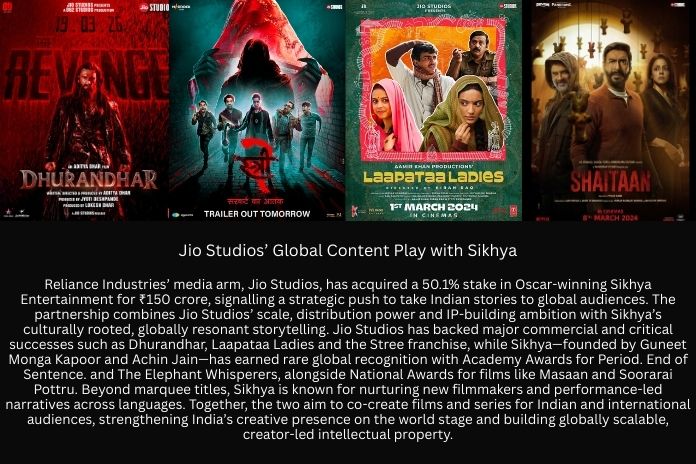
Recalibration followed this realization. A new distribution strategy was needed for small-budget sleeper hits like Laapataa Ladies, which became cult classics.
Dhurandhar’s audacious narrative—from the perspective of a terrorist mastermind—was a career gamble that paid off, becoming a global phenomenon without diluting its Indian identity
They were great films, but not cinematic enough to warrant theater attendance. Bedroom screens mimic their viewing experience. The multiplex doesn’t help.
So Deshpande decided: Jio Studios would make fewer, more ambitious films. A harsh standard would examine every project: Does this require theater? Does this clarify the narrative? Does it have cinematic weight?
The following films showed a fast-learning studio. Laapataa Ladies, despite modest box office, became India’s Oscar entry—proving excellence travels. Stree 2 broke records without an A-list star, creating a horror-comedy universe that rivaled Hollywood.
Shaitaan reimagined genre conventions, casting Madhavan as a psychological thriller antagonist rather than a romantic lead. Each film targeted different demographics, employed diverse genres, and featured wildly different budgets and talent configurations.
Yet they shared an obsessive focus: script excellence, casting precision, and technical rigor.
But the successes compounded. Outliers may be coincidences. Two may be lucky. The narrative flipped when Jio Studios’ films broke its own records and were box office hits, critical darlings, and cultural phenomena. Not a coincidence. This was philosophy in action.
Dhurandhar: The Audacious Bet
Then came Dhurandhar.
Aditya Dhar’s plot was nearly career suicide: a film set entirely in Pakistan, narrated by a terrorist mastermind, exploring the 26/11 attacks from his perspective.
The story required investigating motivation, geopolitical complexity, and political violence’s human side. The film was morally ambiguous in a genre known for moral clarity.
Most studios would have passed.
“When I heard the narration, I had goosebumps,” Deshpande recalls, the emotion still present.
Jyoti Deshpande rejects Western Media lens of India, demanding stories with strong conviction and vision that break clutter and elevate Indian cinema to world-class standards
“The script hadn’t been shot. I was just listening to the story. And I had goosebumps. I immediately knew this would be an extraordinarily difficult film to make. It’s set in Pakistan. How will Indian audiences receive it? But I felt this was a story too important not to be told.”
Conviction alone prompted action.
The production was a collaboration masterclass. The film’s cinematography, Shashwat’s score, Smriti Chauhan’s costume design, set direction, and virtuoso performances by a cast of dedicated actors.
Putting together such talent causes chaos. Everyone has strong opinions. Nobody just obeys. Magic crystallized from friction.
Physical production was grueling. The script was longer than typical Indian film scripts and included elaborate action sequences.
After forty days of shooting in Thailand, Jyoti Deshpande and Aditya Dhar reviewed rushes and realized the script could not be condensed into a single film. The budget ran over. Abort the project, cut the script, or venture into uncharted territory.
Jyoti Deshpande made the bet that would define her career. “We decided to shoot the entire script without thinking about parts,” she explains.
“Not to tell anyone the budget was doubling. We would shoot it all. Then Aditya would edit. If the narrative didn’t hold as two parts, if it needed to be one film, we’d make it one film anyway, whatever the cost. As a studio, I took a massive gamble.”
The end of the first part would be Rehman Dakait’s death. Everything beyond—the best action sequences, Hamza’s backstory, the climactic revelation—was preserved for a second instalment.
Dhurandhar Takes Over Netflix!
Dhurandhar has taken the world by storm, currently holding the No. 1 spot in non-English film category on Netflix in Bahrain, Oman, Qatar, Pakistan, and Mauritius. Its remarkable international appeal is also reflected in its Top 10 ranking across diverse regions, including Australia, Lebanon, Bangladesh, Maldives, Canada, Kuwait, Hong Kong, Jordan, the UK, Morocco, Singapore, Sri Lanka, New Zealand, Saudi Arabia, and Nigeria. The film’s success highlights the growing global appetite for diverse storytelling and marks a significant milestone for Indian cinema, proving that compelling stories transcend language and cultural barriers on the world stage.
When they examined the first cut, the answer was undeniable. Three hours and forty-five minutes of cinema that never dragged, never lost momentum. After trimming to three hours and forty-five minutes, it remained a cinematic colossus.
“We knew we had a winner,” Jyoti Deshpande states. “Not because we designed it, but because of how each scene was being executed—the cinematography, the background score, the music licensing, and the performances. It all came together as magic.”
The Box Office Earthquake and Cultural Phenomenon
Dhurandhar released into a landscape primed for provocation. The film’s perspective—sympathetic to the terrorist, exploring his motivations, his conviction, his humanity—invited immediate criticism from multiple vectors.
Leftists called it jingoistic propaganda. Right-wing viewers questioned why it sympathized with a Pakistani operative. Politicians from all sides claimed their interpretation.
Jyoti Deshpande’s response proved both defiant and philosophical: “This film is nothing about left-wing or right-wing. It’s about the deep state—about how narratives are controlled, about how foreign elements sponsor certain media voices to push contrarian positions. That’s what we showed.”
She believes a film’s power is in starting debates, not ending them. Films move audiences and cause reactions. Provocation, in her view, is a key metric of success.
Box office response was unprecedented. Dhurandhar grossed ₹1,350 crore worldwide, breaking Khan-led records and setting new standards for Indian cinema.
It beat Gadar 2’s lifetime haul by day 15. It surpassed RRR, Jawan, and every historical comparison point. International markets that had never engaged with Indian cinema as serious cinema suddenly recognized Dhurandhar as an unmissable cultural event.
More significantly, audiences returned. They returned because the film had become more than entertainment—it had become a statement about India’s right to tell its own stories, its own way, without seeking Western validation.
Now streaming globally on Netflix, Dhurandhar has achieved what Indian cinema has long aspired to but rarely accomplished: it competes on the world stage not as “Indian cinema” (a category that often implies exoticism or cultural specificity) but as cinema itself.
With Dhurandhar shattering every box office record and becoming a cultural juggernaut, Jyoti Deshpande has fundamentally repositioned how India’s stories are told and who gets to tell them
It’s watched by audiences who don’t speak Hindi, who have never been to India, and who encounter it as a geopolitical thriller of extraordinary ambition and technical precision.
The film has transcended its status as content to become a cultural artifact.
Think pieces proliferate not just in Indian publications but in international media examining how a non-English film executed such a sophisticated narrative about terrorism, statecraft, and moral complexity.
“Any discussion is great,” Jyoti Deshpande says. “Whether you like it, don’t like it, or agree or disagree—if you’re discussing it, that’s the true success. Movies want to move the audience. They must touch that person, and they must react. That’s when a film becomes part of popular culture.”
India’s Narrative: No Longer for Sale
Yet Dhurandhar’s significance extends far beyond its commercial or critical success. For Jyoti Deshpande, the film represents a turning point in how Indian cinema positions itself globally.
“How many Indian actors or music stars are crossing over to the West right now?” she asks, invoking Korea’s cultural revolution as a counterpoint.
“Korean pop stars became hot property in America. K-drama became a thing. Korean food got Michelin stars. It happened across culture—food, fashion, music, and content—because they controlled their narrative.”
However, India has let its narrative be manipulated. In cinema, this meant portraying India as poor, corrupt, and exotic—Indian stories filtered through a Western lens. Brainwashing began in the black-and-white era and lasted decades.
Her larger mission transcends cinema: restoring pride in India’s youth and reclaiming control over India’s narrative on the global stage, without compromise or apology
Western studios, international festivals, and global distribution channels—all reinforced the message that Indian cinema existed to serve Western audiences’ consumption of India.
“We’ve all accepted: ‘We are a poor country,'” Jyoti Deshpande says, the frustration evident.
“But what about the narrative that Indians are leading some of the biggest tech companies in the world? What about Indian entrepreneurs, Indian startups, and the reversal of brain drain? Why isn’t that the India shown in cinema? Why are we still showing poverty, corruption, and exoticism?”
She speaks of filmmakers who arrive with pitches constructed entirely around Western reference points. “Extraction meets Fast and Furious,” they’ll pitch. Or they’ll reference some Hollywood success and ask, “Can we make an Indian version of that?”
Jyoti Deshpande rejects this framework entirely. “As a studio, I’m not fixated with big stars. I’m not fixated with whether something’s like a successful Hollywood movie that’s been tried and tested. Those are never my criteria for greenlighting. What I demand is strong conviction from the storyteller. That the story breaks clutter. That it has vision. That’s it.”
Dhurandhar, in her reading, represents a reclamation. It’s a film with a distinctly Indian voice, operating from an Indian consciousness, exploring Indian anxieties and Indian geopolitical interests.
“I think Indian cinema has arrived with this film,” she says, weighing the words carefully. “I’ve had other successes—Stree 2, the franchises, the commercial victories. But of thousands of films across my lifetime, Dhurandhar holds the deepest personal meaning. It’s like how a great tennis player might retire after winning Wimbledon. That’s the emotional weight this carries for me.”
Building the Legacy: March 19 and Beyond
With Dhurandhar: The Revenge scheduled to release on March 19, 2026, Jyoti Deshpande prepares to complete what many consider the most ambitious film project in Indian cinema history.
“The best scenes are still in the second part,” she explains. “The best action sequences, the best dramatic moments, the climax—all of it. Hamza’s backstory, how he evolved, and the names he’s crossed out. There are so many more years spanning across the second part. It’s going to be an extraordinary payoff for everyone who invested their time and emotion in the first part.”
When Indians tell Indian stories—with conviction, with technical excellence, with artistic integrity— that’s when the world listens
But beyond Dhurandhar, Jyoti Deshpande articulates a studio philosophy that’s countercultural in Indian cinema. She’s not interested in releasing more films—in meeting arbitrary production targets or ensuring constant content flow. Her mandate for 2026 and beyond is to “get more right than wrong.”
Upcoming releases include Raja Shivaji (a Marathi film about the legendary warrior), Khashaba (another Marathi project centered on an Olympian), and select OTT releases. But the approach is deliberately constrained.
“I’m increasingly greenlighting things for the big screen, which takes time,” she explains. “I want to do fewer films with greater meaning. I want to work with filmmakers like Aditya Dhar who have strong voices, who are geniuses at their craft, and who can bring Indian stories to the world. Because how do we project Indian narratives globally without filmmakers who can compete at a world-class level?”
She speaks of her dream with unusual candor: “I want to be a studio that gives wings to young filmmakers, that backs stories nobody else will back, that proves Indian cinema can compete with anything made anywhere in the world—not on spectacle alone, but on craft, on artistic integrity, on the power of the story itself.”
Instead, she asks, “Does the storyteller have strong conviction?” Is the story clutter-breaking? Is the vision compelling? And crucially—has every penny gone on screen? When actors consume the maximum budget and few resources remain for production design, cinematography, and execution, mediocre cinema results.
“In Dhurandhar, every penny went into the film,” she emphasizes. “You can feel it. Every moment is rich in production value. Every image, every action sequence—it’s all evident. That’s what we pursue.”
The Larger Mission: Restoring Pride Without Jingoism
Jyoti Deshpande repeatedly discusses restoring pride in India’s youth, changing global perception, and reversing decades of Western-dominated media’s narrative of national inferiority.
She’s careful to distinguish this from jingoism. There’s no flag-waving rhetoric. Instead, it’s grounded in facts: Indian leadership in global tech companies, Indian entrepreneurship driving innovation, and India’s emerging economic trajectory toward superpower status.
“Movies have the power to influence young minds,” she says. “If we give them the message that America is Big Daddy, that we’re a poor country, they internalize that shame. If we give them the right message—with substantial backup, with merit—they internalize pride. It’s important we bring that pride back. Because in the next decade, I want to see India as the superpower the world will look to, not out of fear, but out of respect for what we’ve built.”
Her vision extends beyond cinema into the broader cultural project of national narrative.
“When Indians tell Indian stories—with conviction, with technical excellence, with artistic integrity—that’s when the world listens. Not because we’re seeking validation, but because the authenticity itself becomes undeniable.”
The Moment Before History
With Dhurandhar having already redefined what Indian cinema can achieve, and Dhurandhar: The Revenge poised to complete that statement on March 19, 2026, Deshpande has accomplished something that transcends box office records or critical acclaim.
She has changed the conversation about who gets to tell India’s stories and from what vantage point.
“If I had to call it a day now and retire, Dhurandhar would be the moment I’d point to,” she says, and the emotion in her voice is unmistakable.
Across three decades, Jyoti has evolved the infrastructure of Indian storytelling. But with Dhurandhar, she’s made something grander. That’s the real measure of a studio leader — not the blockbusters they greenlight, but the impossible films they find the courage to make
“Like a great tennis player… winning Wimbledon. That level of meaning. But I know this will go down as one of the most defining moments of my career.”
She pauses, then adds with quiet conviction, “What we’re building here isn’t just a studio. It’s a mission to ensure that Indian voices tell Indian stories to the world. No apologies. No compromise. Just cinema, crafted with the rigor and artistry it deserves. That’s the legacy I want to leave.”
Highlights

56 Films: Cannes Reveals 2020 Lineup

TIFF Reveals Plans for Industry Conference

Films by Shekhar Kapur and Shubham Yogi Selected for Toronto Gala

A Selection to Die for

Le Musk: A Brave New Frontier in Cinema

The Path finder: Jyoti Deshpande

Toonz to Honour Aabid Surti, Biren Ghose at Animation Masters Summit

India is the Country of Honour at Cannes

RAVINDRA VELHAL: DRIVING MEDIA TRANSFORMATION

THE PATH FINDER: JYOTI DESHPANDE

INTO THE WORLD OF RRR

Powerkids Appoints Manoj Mishra as CEO

Toonz Join Tunche Films to Co-Produce Spanish-Peruvian Animation Feature Kayara

National Museum of Indian Cinema Hosts Vintage Vehicles

I&B Secretary promises Govt’s Support to Film industry

Tom Cruise’s ‘Top Gun: Maverick’ to Blaze at Cannes

Illumination’s Minions: The Rise of Gru is the Annecy Festival Opener

Now, Shoot at Sight in India!

Lata Mangeshkar, India’s Singing Goddess

Quantum Image Making Has Arrived

Indian Films To Look Out For In 2022

2022: Centenary of Indian Cinema Legends

Singing Legend Lata Mangeshkar, Nightangale of India, Dies at 92

Bhushan Kumar’s T-Series Ventures Into OTT Content Creation Space