This Side of Paradise: A Dalit Filmmaker’s Odyssey from Nanded to Stuttgart
By Pickle February 16, 2026
Share:


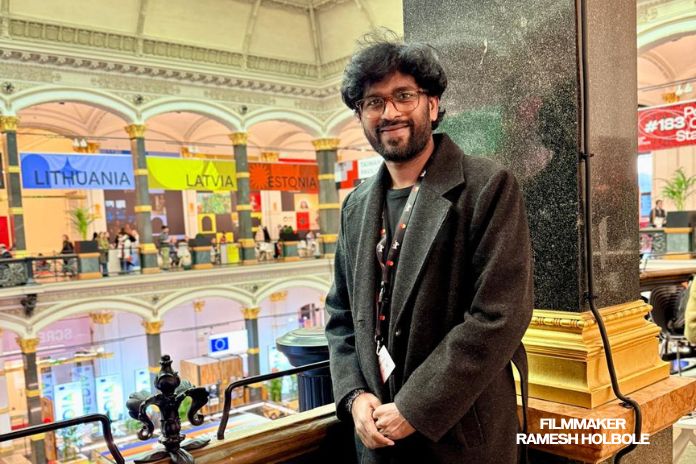
Here’s a discovery of the new voice of Indian cinema at Berlnale. From the tin-roofed shanties of Nanded to the pristine studios of Stuttgart, filmmaker Ramesh Holbole’s journey is a cinematic script in itself—one written with the ink of resilience and directed by an unwavering stubbornness to be heard.
Currently based in Germany, the 40-year-old Dalit filmmaker is on the cusp of history, helming This Side of Paradise, the first-ever Indo-German co-production in the Marathi language. While his location has changed, his lens remains fixed on the world he left behind: the invisible struggles of India’s working class.
The Long Road from Nanded
Ramesh Holbole’s story begins in a “tin-shed” home in Nanded, Maharashtra, where the sounds of heavy rain meant fear of destruction rather than romance. The son of a construction labourer, Lakshman Rao, Ramesh grew up surrounded by the harsh realities of physical labour and systemic neglect.
“I saw neighbours with concrete homes and wondered why we were like this,” Ramesh recalls. “Why was our destiny only hard physical work?”
His journey out of Nanded was paved by an education that came at a heavy price. He is the first graduate in his family, a milestone achieved despite crushing financial constraints. With five sons to raise on daily wages, English schooling—and its higher fees—was out of reach. Ramesh studied entirely in the Marathi medium until his post-graduation, a linguistic divide that would haunt him later.
As a post-graduate student of Marathi literature at Pune’s prestigious Fergusson College (2007-2009), Ramesh Holbole initially found himself silenced by the city’s cultural gatekeeping. Alienated by his rural dialect and lack of “fashionable” clothes, he retreated into the college library for two years, reading voraciously to “get rid of this baggage” of inferiority. It was a silent incubation period that would eventually birth his unique voice.
The Epiphany in the Dark
The turning point came not in a classroom, but in a dark theatre at the Pune International Film Festival (PIFF). Long before he ever boarded a plane, Ramesh travelled to Europe through the screen.
“I travelled Europe without coming here… with the films,” he muses. “I was just seeing the pictures… I have seen already the Helsinki.”
It was at PIFF that he stumbled into a screening of The Man Without a Past by Finnish auteur Aki Kaurismäki. The theatre was nearly empty—most attendees had flocked to more commercial fare—but Holbole sat riveted.
“That film broke all my barriers,” he says. Seeing a story centered on garbage collectors, waiters, and the unemployed—treated with dignity and deadpan humor—was a revelation. He realized that the “superior” cinema he feared didn’t require stars or spectacle; it required truth. “I realized you don’t need a star. You can make films about people like us—the people society neglects.” He walked out of that empty theatre wiser, armed with the knowledge that his reality was worthy of the screen.
Inspired, he set his sights on the Film and Television Institute of India (FTII). It was a siege rather than an entry; Ramesh Holbole knocked on FTII’s doors for seven years, failing four times before finally cracking the entrance exam on his fifth attempt in 2016.
A Tale of Two Cities: Production Update
Today, Ramesh Holbole navigates a surreal dual existence. In Stuttgart, he walks the halls of the Filmakademie Baden-Württemberg, where he completed his studies in the International Class program. It was here that he forged the partnerships for This Side of Paradise.
The film, produced by his own Volksfilms India and the German production house Lightning & Thunder and Film Crew Media, is a semi-autobiographical account of rural youth migrating to metropolitan slums. It explores the gritty “hustle” of Mumbai life—labor exploitation, wage inequality, and the dehumanizing grind of the city.

The project is moving swiftly toward reality. Ramesh Holbole confirms that casting and location scouting are complete, with the team now finalizing permissions. The shoot is scheduled to begin in mid-May, specifically timed to capture the ferocious Mumbai monsoon. “Because in the Mumbai film there is a lots of monsoon… to show the real different city life,” he explains.
The project has attracted heavyweight support but not yet fully completed. Payal Kapadia, the Cannes Grand Prix-winning director and his senior from FTII, has stepped in as an Executive Producer, lending her global acclaim to amplify his voice. The film features an Indian cast and editor, backed by a German technical crew handling color, sound, and music—a true cross-cultural synthesis.
The Cost of Passion
Despite the international prestige, Ramesh Holbole remains grounded in a precarious reality. He speaks candidly about his “midlife crisis”—at 40, he has no house, no savings, and no insurance, a stark contrast to the stable lives of his peers.
“I am in a midlife crisis with no money, but I still follow my passion.
He credits his father, Lakshman Rao, for making this impossible journey possible. “He didn’t know what I was doing, but he gave me the freedom. Without him, I would still be a labourer in Nanded.”
A Voice for the Voiceless
Ramesh Holbole places himself proudly in the lineage of Dalit filmmakers like Pa. Ranjith, Mari Selvaraj, and his mentor Nagraj Manjule. But for Ramesh, the ultimate architect of this possibility is Dr. B.R. Ambedkar.
“There is a like inspiration is Dr. Babasaheb Ambedkar,” he says with reverence. “He is the role model to open the whole life for us. Without him, we are nothing.”
For him, cinema is not just entertainment; it is an assertion of identity and a moral responsibility. “We have come from nothing,” he says. “Now that we have education and a voice, we want to show our identity to the world.”
Looking beyond his own debut, Ramesh Holbole is determined to build an alumni community for Dalit filmmakers—a network to support those whose stories are “close to reality” but who lack the privilege to tell them. As he prepares to shoot in the Mumbai monsoons, capturing the very rain that once terrified him as a child, Ramesh Holbole is no longer just watching the world from a tin shed. He is building a new one, frame by frame, where stories like his are finally the main attraction.
Highlights

TIFF Reveals Plans for Industry Conference

Films by Shekhar Kapur and Shubham Yogi Selected for Toronto Gala

A Selection to Die for

Le Musk: A Brave New Frontier in Cinema

The Path finder: Jyoti Deshpande

Toonz to Honour Aabid Surti, Biren Ghose at Animation Masters Summit

India is the Country of Honour at Cannes

RAVINDRA VELHAL: DRIVING MEDIA TRANSFORMATION

THE PATH FINDER: JYOTI DESHPANDE

INTO THE WORLD OF RRR

Powerkids Appoints Manoj Mishra as CEO

Toonz Join Tunche Films to Co-Produce Spanish-Peruvian Animation Feature Kayara

National Museum of Indian Cinema Hosts Vintage Vehicles

I&B Secretary promises Govt’s Support to Film industry

Tom Cruise’s ‘Top Gun: Maverick’ to Blaze at Cannes

Illumination’s Minions: The Rise of Gru is the Annecy Festival Opener

Now, Shoot at Sight in India!

Lata Mangeshkar, India’s Singing Goddess

Quantum Image Making Has Arrived

Indian Films To Look Out For In 2022

2022: Centenary of Indian Cinema Legends

Singing Legend Lata Mangeshkar, Nightangale of India, Dies at 92

Bhushan Kumar’s T-Series Ventures Into OTT Content Creation Space

What’s India Looking for at European Film Market