An Academic Lens on Dhurandhar
By Pickle April 21, 2026
Share:



Cinema, Nationalism and Market Power. A strategic reading of Dhurandhar’s BO dominance and nationalist resonance by Prof S Raghunath, IIM Bangalore
The Dhurandhar franchise represents more than a cinematic success, it is a landmark case study in the exposition of national sentiment. By examining the trajectory from the first instalment in late 2025 to the record-breaking sequel in March 2026, a clear pattern emerges: the fusion of high-octane technical craft with aggressive political messaging has created a new standard for blockbuster realpolitik in the Indian market.
Part one and part two of the movie establish that the intersection of high-stakes storytelling and nationalist sentiment is the most potent commercial force in contemporary Indian cinema.
The data indicates that the Indian audience is increasingly drawn to films that provide a sense of agency and victory in the face of complex geopolitical realities. Ultimately, the Dhurandhar franchiee’s legacy will be its demonstration that in the modern era, a movie’s truth is often measured by its ability to provide emotional closure to real world frustrations, regardless of how contentious the methods of that closure may be. The Dhurandhar duology is far more than a high-octane entertainment franchise, as it successfully translates complex realpolitik into an emotionally charged format.
The box office data suggests three primary inferences regarding the current state of the Indian entertainment industry:
First, there is an immense, untapped market for content that aligns with the current national assertive zeitgeist. The audience is no longer just buying a movie ticket, they are investing in a vision of national strength. Conviction, even when polarizing, is currently more bankable than neutral, generic entertainment.
Second, the success of Dhurandhar proves that for political messaging to be effective on a mass scale, it must be wrapped in world-class technical production.
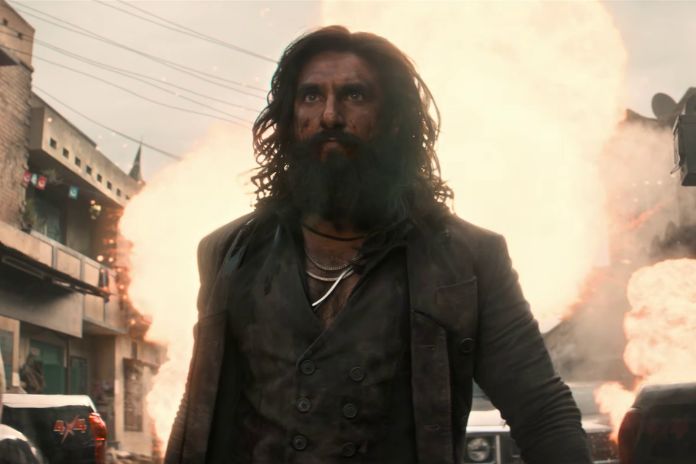
The praise for Aditya Dhar’s direction and Ranveer Singh’s performance across all ideological divides suggests that high production value acts as a bridge, drawing in even those who might be skeptical of the film’s underlying politics.
The Dhurandhar duology stands not only as a visual benchmark for Indian cinema but also as a definitive moment in contemporary film scoring.
While both films are anchored by the sound of composer Shashwat Sachdev, the evolution of the background music (BGM) from Part 1 to Part 2 mirrors the franchise’s transition from a clandestine spy thriller to a political epic. This sonic shift is crucial to understanding how the films manipulate audience emotion and reinforce their underlying ideological messages.
In Dhurandhar Part 1 the BGM functions as a techno-organic pulse. Its primary objective is to maintain a state of high-alert tension and anxiety. Sachdev utilized staccato beats, electronic synth pulses, and rhythmic percussion to mimic the psychological state of an operative behind enemy lines.
The score for Part 1 frequently employed low-frequency hums and tactical silence to build suspense, a technique that gave the film a clinical, high-tech westernized feel. However, this restraint was punctuated by moments of heroic hype, most notably through the fusion of Punjabi folk and modern rap beats e.g.,Aari Aari. Here, the music served to make the act of infiltration feel like an exhilarating, high-stakes heist, prioritizing the game of intelligence over the consequence of war.
By the second part, the sonic landscape shifts as the narrative escalates from infiltration to direct confrontation and political fallout, the music abandons its subtle pulse for heavy orchestration and booming, floor-shaking bass.
A defining characteristic of the Dhurandhar 2 score is its reliance on nostalgia and familiarity. The BGM in the sequel is darker and more melancholic, utilizing Arijit Singh’s raw vocal energy to underscore the cost of war, effectively moving the audience from the excitement of the shadow warrior to the grim weight of national survival.
Third, the film’s massive success in the US alongside its absence in Gulf markets highlights the specific geopolitical edge of the franchise. It thrives where the diaspora seeks a strong connection to a new India identity but remains restricted in regions where its narrative conflicts with local sensitivities.
In contrast, if we consider the YRF Spy Universe, it is a celebration of physicality and stardom. These films are designed as escapist fantasies where the primary draw is the superhero-like invincibility of the protagonist.
Conversely, the Dhurandhar franchise by leaning into a gritty, raw and unapologetic realism, it demands a different kind of engagement from its audience. It is a geopolitical saga that prioritizes atmospheric tension and psychological depth over traditional hero entry tropes. Its massive runtime and two-part structure indicate that the modern audience is willing to invest intellectual, emotional energy and time into a narrative that feels authentic and uncompromising.
Franchise films such as Pathaan and Tiger Zinda Hai operate within a logic of spectacle. Their appeal lies in high-octane action sequences, exotic locations, stylized combat, and the magnetic presence of stars like Shah Rukh Khan and Salman Khan. The narrative structures are typically straightforward such as clear moral binaries, escalating conflict, and climactic resolution allowing audiences to focus less on cognitive processing and more on sensory immersion. The psychological reward here is rooted in adrenaline and awe. Viewers are transported into a heightened reality that offers escape from the ordinariness of daily life. Engagement is immediate, visceral, and often anchored in a few memorable peak moments.
Unlike the pure spectacle of the YRF Spy Universe, Dhurandhar attempts to blend action with psychological and moral depth. It seeks to combine the forward momentum of a thriller with the introspection of a character-driven narrative. In doing so, it creates what might be called a heightened reality, a world that is neither fully escapist nor fully familiar. Consequently, the audience hook in Dhurandhar differs from both spectacle films and realism-driven cinema. It is neither awe nor warmth, but tension, an engagement driven by uncertainty and moral conflict. Viewers are drawn in by questions rather than answers: What will happen? Who is right? What is at stake beyond the visible plot? This creates a more cognitively demanding form of engagement.
The YRF Spy Universe, featuring iconic characters like Tiger and Pathaan, represents the pinnacle of aspirational spectacle.In these films, filmmaking is a celebration of the superstar. The camera lingers on slow-motion entries, the color palette is vibrant and glossy, and the action is choreographed with the precision of a dance.
Here, violence is largely sanitized.It serves as a vehicle for heroism rather than a depiction of pain. The audience is not drawn to the reality of the conflict, but to the thrill of seeing a beloved icon perform the impossible. This model relies on escapism the promise that no matter how global the threat is, a charismatic hero will save the day with a witty one-liner and a gravity defying stunt.
In stark contrast, Aditya Dhar’s Dhurandhar saga operates on the principle of grounded immersion. The filmmaking pointers here focus on atmospheric tension and psychological depth. The runtime stretching over seven hours across two parts is used not for more action, but for deeper character exploration.
In Dhurandhar, violence is visceral. It is designed to make the viewer feel the cost of espionage. The attraction is not the coolness of the fight, but the authenticity of the struggle. By casting actors like Akshaye Khanna and Ranveer Singh in roles that prioritize vulnerability over invincibility, the franchise treats the audience as mature observers of a complex geopolitical reality.
To suggest that violence is the primary draw of these films would be a surface-level assessment. The true core attraction is a combination of geopolitical resonance, technical excellence and cultural relevance. Both franchises tap into the Indian zeitgeist, using themes of national identity and intelligence operations that feel immediate and relevant. Whether through the broad strokes of YRF or the detailed political maneuvering in Dhurandhar, the films mirror the audience’s real world interests.
In the age of streaming, a movie must justify its ticket price. Audiences are now rewarding technical craft, the sound design, the cinematography, and the editing. They go to the theater for a sensory experience that cannot be replicated on a smartphone.
The success of these two models indicates that the middle-ground film is disappearing. Bollywood is moving toward extreme specialization. If a film aims for the mass audience, it must be larger and more spectacular than ever before. Conversely, if it aims for a serious narrative, it must be more rigorous and uncompromising than ever.
Ultimately, Dhurandhar and the YRF Spy Universe prove that Indian audiences are no longer just looking for popcorn entertainment. They are seeking conviction. Whether that conviction is found in a superhero-based spectacle or a gritty, long-form saga, the future of the theatrical release lies in the filmmaker’s ability to create a world so immersive that the audience has no choice but to step inside.
The Dhurandhar franchise has done more than just shattered box office records. It has rewritten the manual for theatrical success in a post-streaming world. By delivering an unapologetically long, gritty, and performance-driven saga, the two-part series offers a masterclass in how cinema can survive and thrive. The audience response to these films signals a profound shift in consumer behavior, suggesting that the future of the theatrical experience lies in immersive conviction.
In this new paradigm, the theatre is not just a venue, it is a filter for excellence, where only the most compelling, emotionally resonant, and creatively confident works can thrive. And in that sense, the resurgence of theatres is not just a commercial trend, it is a reaffirmation of cinema’s enduring power to move, unite, and transform its audience.
Highlights

TIFF Reveals Plans for Industry Conference

Films by Shekhar Kapur and Shubham Yogi Selected for Toronto Gala

A Selection to Die for

Le Musk: A Brave New Frontier in Cinema

The Path finder: Jyoti Deshpande

Toonz to Honour Aabid Surti, Biren Ghose at Animation Masters Summit

India is the Country of Honour at Cannes

RAVINDRA VELHAL: DRIVING MEDIA TRANSFORMATION

THE PATH FINDER: JYOTI DESHPANDE

INTO THE WORLD OF RRR

Powerkids Appoints Manoj Mishra as CEO

Toonz Join Tunche Films to Co-Produce Spanish-Peruvian Animation Feature Kayara

National Museum of Indian Cinema Hosts Vintage Vehicles

I&B Secretary promises Govt’s Support to Film industry

Tom Cruise’s ‘Top Gun: Maverick’ to Blaze at Cannes

Illumination’s Minions: The Rise of Gru is the Annecy Festival Opener

Now, Shoot at Sight in India!

Lata Mangeshkar, India’s Singing Goddess

Quantum Image Making Has Arrived

Indian Films To Look Out For In 2022

2022: Centenary of Indian Cinema Legends

Singing Legend Lata Mangeshkar, Nightangale of India, Dies at 92

Bhushan Kumar’s T-Series Ventures Into OTT Content Creation Space

What’s India Looking for at European Film Market