A Boy, A Mother, and the Weight of the World
By Pickle May 10, 2026
Share:


Chidambaram arrives in Cannes with his third story with a vision clearer than ever.
“My state of mind,” he says, sitting in Cannes as the Marche du Film buzzes with organized frenzy, “is like a pregnant woman. The is within me. Now I have to put it out into the world.” He pauses and smiles. He is not anxious. He is ready.
This is the Chidambaram that Marche du Film is about to meet — a filmmaker from Kerala’s Thrissur district who, as a thirty-something and three films into his career, has already changed the Indian regional cinema game.
His second film, Manjummel Boys (2024), became the highest-grossing Malayalam film of that year and won him the Kerala State Film Award for Best Director, Best Screenplay, and Best Film.
His third, Balan: The Boy, is at the Marché du Film for a market screening on May 14, produced by KVN Productions and Thespian Films — a film that by all accounts refuses to be contained within the borders of a state and a language.
The journey to this point has not been a smooth arc. It has been, like most things Chidambaram finds interesting, a story with an unlikely protagonist.
The Dropout Who Learned to See
The first filmmaker Chidambaram ever knew was his father — a longtime associate director who spent 13 to 15 years working alongside celebrated directors including Jayaraj and K. G. Jayan. As a child, Chidambaram listened to his father’s stories of sets and sequences, but he wasn’t particularly interested.
He enrolled in a BCA computer science programme after school, and was promptly expelled within the first semester for poor attendance. “I never connected with the subject,” he says. “I still don’t know why I chose it.”
That gap — between a failed college semester and the rest of his life — was filled by the industry his father had always inhabited. Director Jayaraj, who was shooting a film in Chidambaram’s native town of Kandur, called him to assist, a connection made possible by his father’s introductions. “That was my first film, Pagar Natara. I have to thank Jayarajan sir for making me an assistant director. From there, I slowly started developing my taste for cinema.”
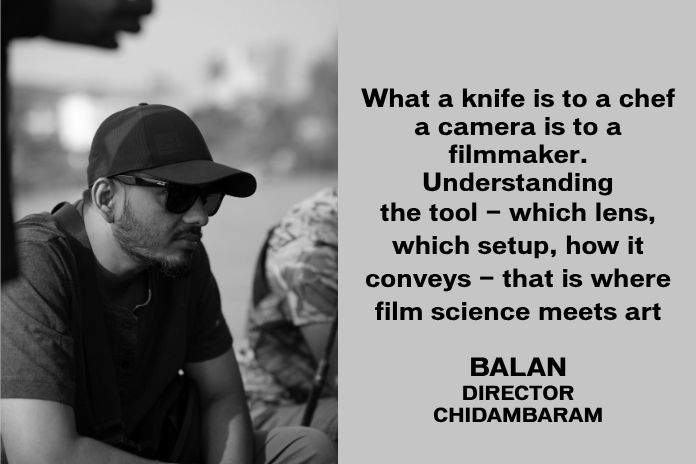
From assistant direction, Chidambaram crossed over into the camera department, working alongside master cinematographers like Rajeev Ravi and K. U. Mohanan. The decision shaped his visual language. “What a knife is to a chef a camera is to a filmmaker,” he says. “Understanding the tool — which lens, which setup, how it conveys — that is where film science meets art.”
The lessons he absorbed in those years are visible on screen in every frame he makes: a controlled, purposeful visual grammar that never wastes an image.
He taught himself to write because he could not find a writer who in sync with his vision for his debut, Jan.E.Man (2021). “Necessity forced me into writing. Writing is still the hardest part — and the most pivotal. Everything is essentially decided in the writing itself.”
The Cave, The Boys, The Truth
The story of Manjummel Boys is, in some ways, the story of Chidambaram discovering what kind of filmmaker he wanted to be. It began in a drinking session. His friend and producer Shawn took him to meet a group of men in Kochi who had, years earlier, survived an extraordinary ordeal: one of their number had fallen into the Guna Caves in Tamil Nadu, and a friend had descended alone on a rope to pull him out — an act of courage so improbable that it was, as Chidambaram says, “stranger than fiction.” He had, in fact, first read about the incident in a newspaper in 2006.
“We took a car, me and Shawn, went to Manjummel to see the boys, had a small drinking session. Everyone narrated his own version of what happened. Immediately I knew there was a film in it — a common theme of good versus evil, light versus dark, the cave. And above all, a human story of resilience and the value of life.”
What a knife is to a chef a camera is to a filmmaker. Understanding the tool — which lens, which setup, how it conveys — that is where film science meets art
As a child, he had been haunted by a Malayalam film in the tradition of the great director Bharathan — about a child falling into a well. “The child and the mother’s anguish. It left an everlasting impression on me.”
There are, as Chidambaram acknowledges, only seven basic plots, and “a man falls into a hole” is one of them. “The hardest challenge was to make it new. What makes it fresh — that was the first thing I tried to find within the film.”
His answer was authenticity. He cast only real friends in the roles, brought the real Manjummel boys and the actors together for a night, and let the chemistry develop organically. “I made sure the real boys met the actors. We spent a night together. That’s how the actors came to understand their counterparts.” The film that emerged had no conventional villain. “In Manjummel, the villain is the cave, the situation and you,” he says. “That’s a structure I find myself returning to.”

Balan: A Universal Story, An Unexpected Gift
After Manjummel Boys became a phenomenon, Chidambaram found himself in the one territory that success can create without warning: confusion. “All the doors were open, and I didn’t know what to do. I was seeing stars I didn’t expect to see, being invited to meet them, offered their dates. It was overwhelming and I was not prepared for it.” He admits, without self-pity, that he got briefly lost in it. “I was very confused about what to make next.”
It was a friend and actor named Sajan who suggested that Chidambaram meet writer-director Jithu Madhavan, known for the blockbuster Aavesham. “I went to Jitu’s house. He narrated the story. I liked it. The next day itself, I flew to Bangalore with Satish. Within two days, the film was locked.” Balan was not in his plans. “It fell into my lap,” he says.
Balan tells the story of a mother and a child — a universal relationship that Chidambaram believes can travel across any cultural border. “A child cannot be without a mother. That universality is one of the key reasons I decided to make it. The emotions are not subject to nationality or creed
The film tells the story of a mother and a child — a universal relationship that Chidambaram believes can travel across any cultural border. “A child cannot be without a mother. That universality is one of the key reasons I decided to make it. The emotions are not subject to nationality or creed.”
And like Manjummel Boys, this film too will have no clear villain. “In Balan, the villain is just you and your doings.” It is a quiet but consistent philosophy: that our most dramatic struggles are interior ones.
A Perfect Partnership at the Marché
Bringing Balan: The Boy to Cannes required producers willing to invest not just money but faith. Chidambaram is unstinted in his admiration for what KVN Productions and Thespian Films have built together. KVN Productions, led by Venkat K Narayana, brings the scale and ambition of a production house whose 2025–26 slate spans Kannada, Tamil, Hindi and now Malayalam. Thespian Films, helmed by Shailaja Desai Fenn, brings a producer’s personal commitment to the craft.
“Satish and Shailaja are go-getters,” Chidambaram says, using a warmth that speaks to creative partnership, not just a contractual one. “There is never a ‘no’ to anything. They clearly understand my vision. The support is great.” More than the financial backing, what he values is their willingness to do this: to bring the film to a festival first, to place it in front of international buyers and critics before a domestic release.
“As soon as a film is made, the practical thing is to release it. But taking the time off and sending it to festivals — it shows goodwill towards the craft, more than the monetary aspect of it.” It is a rare alignment between a director and his producers: a shared belief that the film has something to say to the world, and that the world deserves to hear it at the right address.
Chidambaram comes to Cannes not with the wide-eyed wonder of a first-timer, but with the focused appetite of someone who has waited for this moment. “Cannes is the mecca for filmmakers,” he says. “It is a pilgrimage, in a way. I always wanted to come, but I never could. This time I’m going with a film. That is very, very good. I am happy and grateful.”
He plans to meet people, to engage with the market, to absorb the festival in full. There are 1,000 films in his head — bigger subjects, larger themes, every genre he has not yet touched — and he knows that clarity about what to make next often comes not from sitting alone, but from being in a room full of people who love cinema as much as you do.
“I just feel like I’m beginning,” he says. “I’m only three films old. I have many stories to tell. I’m still understanding the craft.” In Cannes, in May 2026, that is perhaps the most compelling credential any filmmaker can carry through the door.
Highlights

Accreditations Are Open For Cannes 2021

TIFF Reveals Plans for Industry Conference

Films by Shekhar Kapur and Shubham Yogi Selected for Toronto Gala

A Selection to Die for

Le Musk: A Brave New Frontier in Cinema

The Path finder: Jyoti Deshpande

Toonz to Honour Aabid Surti, Biren Ghose at Animation Masters Summit

India is the Country of Honour at Cannes

RAVINDRA VELHAL: DRIVING MEDIA TRANSFORMATION

THE PATH FINDER: JYOTI DESHPANDE

INTO THE WORLD OF RRR

Powerkids Appoints Manoj Mishra as CEO

Toonz Join Tunche Films to Co-Produce Spanish-Peruvian Animation Feature Kayara

National Museum of Indian Cinema Hosts Vintage Vehicles

I&B Secretary promises Govt’s Support to Film industry

Tom Cruise’s ‘Top Gun: Maverick’ to Blaze at Cannes

Illumination’s Minions: The Rise of Gru is the Annecy Festival Opener

Now, Shoot at Sight in India!

Lata Mangeshkar, India’s Singing Goddess

Quantum Image Making Has Arrived

Indian Films To Look Out For In 2022

2022: Centenary of Indian Cinema Legends

Singing Legend Lata Mangeshkar, Nightangale of India, Dies at 92

Bhushan Kumar’s T-Series Ventures Into OTT Content Creation Space