Cannes Calling Shailaja Desai Fenn’s Scale-up Moment
By Pickle May 9, 2026
Share:


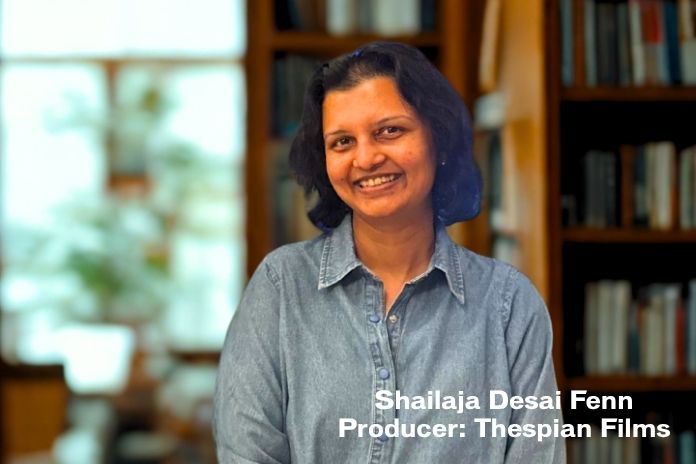
Shailaja Desai Fenn, first-time producer, on grit, gut, and the grammar of filmmaking. A Chat with Pickle
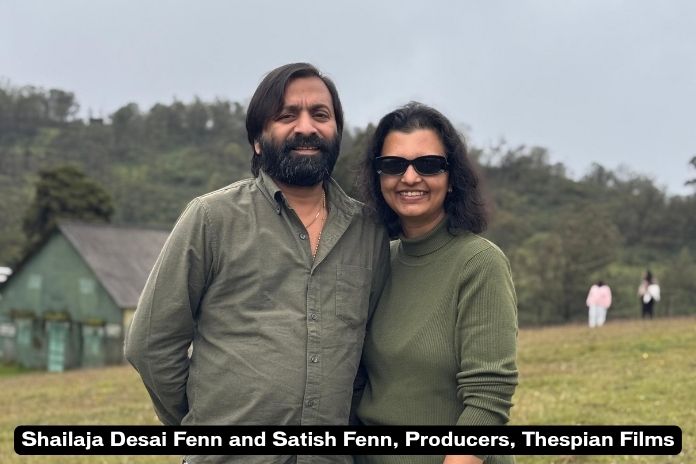
Shailaja Desai trained in Gandharva classical dance, ran a momand-pop talent and ad production shop with husband Satish Fenn for many years, and quietly kept the books while he chased the big idea. Now, with Balan: The Boy heading to a market screening at the Cannes Film Market and Haiwaan close behind, the scale-up moment has arrived. KVN-Thespain Film LLP jointly co-produces both films. Both films
backed completely by Venkat K Narayana, a real estate tycoon (founder of KVN Productions).
Production has always been your world. What finally tipped you into actually producing a film?
It happened naturally. We started by managing talent for brands, then brands said, “Make our ad,” so we produced. We line-produced a song and shot across Kashmir, Rajasthan, Chennai, and Hyderabad
— everything in-house.
It was working with Priyadarshan Sir that really opened the door; he gave us our first real entry into the producer’s room.
While we were already developing Haiwaan, we connected with Chidambaram and greenlit Balan: The Boy. So Haiwaan came first, Balan followed.
Define a producer in your own words.
A producer takes the ship ahead in all weathers. You manage egos, tantrums, fears — everyone’s. The thing people get wrong is expecting respect to come with the title. It doesn’t. You get plenty of
stabs in the back instead. But your single job is to do what is right for the film – not for the actor, not for the director, but for the film. The director may want a certain name in the cast that blows your budget.
Your job is to find the money or find the alternative and still give him the film he deserves
How brutal has the journey been since January 2024?
Constant up and down. Actors saying yes, then no. Money coming in, then walking away, then having to be returned. My hair has turned grey. I joked with a friend: the film is the reason. Satish says he got glasses [laughs]. Both films were not planned to be released simultaneously — God had his own calendar. We designed a staggered flow, but they went on the floor together and wrapped together. Now they release together.
Seventy per cent of people around you said, ‘Don’t do it.’ How did you hold it?
Satish has this particular wiring: the louder people say no, the more energy he puts in. A “no” to him is a 200 per cent accelerant. I am the counterweight — I backed his vision, but I kept the existing business running so salaries got paid. Someone has to keep the engine room functional while the captain steers into the storm. That’s always been our division.
You didn’t hear the script of Balan before saying yes?
Satish went ahead on gut and friendship — Chidambaram is a close collaborator he trusted completely. I heard the script. It was fantastic. That is how it works, really. You believe a certain gut in you that says this is the right film to walk into the room as a producer for the first time. And this is the right filmmaker. Chidambaram has proved himself over two earlier films. This is his third.
You chose not to upgrade your office despite producing two films simultaneously. That’s a deliberate statement.
Several people told us: move, take a bigger office, and look the part. But that is an additional cost on our head. Every rupee we spend, we should know where it went. Satish is intensely hands-on — he gets into daily nitty-gritties, cost sheets, and every line item. That is a style I genuinely respect. You should know if someone has taken you for a ride. You should know even when you’re okay with it. Sitting in a fancy office does not make the film better.
Your Gandharva training — does it show up anywhere in how you run a production?
More than I realised. My class started with fifty students; by graduation, two of us remained. I stayed because I had started, and finishing is non-negotiable for me. That is exactly how I approach production. Once you are in, you are in. There are very few people in this industry who actually finish what they start. I
am one of them.
What does the Cannes market screening mean for Balan: The Boy?
It is a validation that the film belongs in international conversation. The market is where business happens, and being there means we are not just making a film for our neighbourhood. It signals intent — that we are producers who are thinking about the life of a film beyond its opening weekend, beyond one territory. That is the scale we are building towards.
Is money a fear to you?
Money means fear? Why should it? We all work for money. I was training Marwadi families to perform at weddings when I was in college – for pocket money, for the thrill. I have never been frightened of
money; I have been respectful of it. There is a difference. Fear makes you freeze. Respect makes you careful.
What is next after two films land simultaneously?
It is going to be a marathon from here. Every day something new is going to be thrown at us. But when I see Balan in its finished form, there is a quiet pride. We did it for the right reason. Both films are
content-first, both filmmakers are brilliant, and we have protected that. The next film? It has to be romantic. We have had enough of everything else for now.
Highlights

TIFF Reveals Plans for Industry Conference

Films by Shekhar Kapur and Shubham Yogi Selected for Toronto Gala

A Selection to Die for

Le Musk: A Brave New Frontier in Cinema

The Path finder: Jyoti Deshpande

Toonz to Honour Aabid Surti, Biren Ghose at Animation Masters Summit

India is the Country of Honour at Cannes

RAVINDRA VELHAL: DRIVING MEDIA TRANSFORMATION

THE PATH FINDER: JYOTI DESHPANDE

INTO THE WORLD OF RRR

Powerkids Appoints Manoj Mishra as CEO

Toonz Join Tunche Films to Co-Produce Spanish-Peruvian Animation Feature Kayara

National Museum of Indian Cinema Hosts Vintage Vehicles

I&B Secretary promises Govt’s Support to Film industry

Tom Cruise’s ‘Top Gun: Maverick’ to Blaze at Cannes

Illumination’s Minions: The Rise of Gru is the Annecy Festival Opener

Now, Shoot at Sight in India!

Lata Mangeshkar, India’s Singing Goddess

Quantum Image Making Has Arrived

Indian Films To Look Out For In 2022

2022: Centenary of Indian Cinema Legends

Singing Legend Lata Mangeshkar, Nightangale of India, Dies at 92

Bhushan Kumar’s T-Series Ventures Into OTT Content Creation Space

What’s India Looking for at European Film Market