Still Playing for the Gallery
By Pickle May 10, 2026
Share:


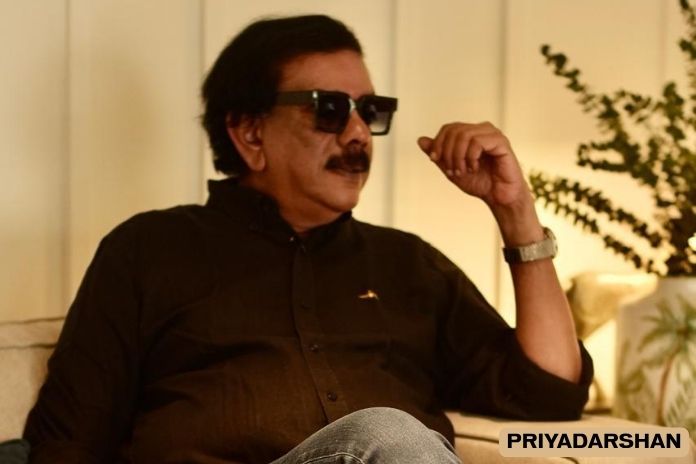
At 98 films and counting, Priyadarshan remains one of Indian cinema’s most restless voices – a man who fought his father, outlasted his era, and is now marching toward a record-setting 100th.
There is a particular kind of authority that only four decades and 98 films can bestow. Priyadarshan wears it lightly, almost mischievously, leaning into a conversation about cinema the way a man does when he has genuinely nothing left to prove – and yet cannot stop proving things. “I am 98, feeling old,” he says with a laugh that suggests the very opposite.
The man who gave India Hera Pheri, Malamaal Weekly, Chup Chup Ke and, just now, the runaway comedy hit Bhoot Bhangla sits across from you not as a legend in repose but as a craftsman still sharpening his tools. He has just wrapped his 98th film and is already blueprinting the 100th.
That centenary project carries a detail so singular it feels less like a career milestone and more like a twist in one of his own screenplays. “My first film’s actor is acting in my 100th film also, which is a record in the world,” he says quietly, the weight of the number landing slowly.

Mohanlal was there at the very beginning, in 1983. And Mohanlal will be there at the summit. Forty-four years, a partnership so long and so deep that Priyadarshan no longer needs to direct the man so much as think alongside him.
“I understand all his calibre like I understand myself,” he says. “We grew up together. We went to the cinema together. We have about 85% success in our careers together.” The 100th film will be a thriller — the first of that genre he has attempted with Mohanlal. “I feel excited. This is something I’ve not tried before.”
The Boy Who Defied His Father
Priyadarshan’s journey to the camera began not with encouragement but with a door shut in his face – and shut firmly, by the one person whose approval he most wanted.
“After school, I wanted to go to the Pune Film Institute,” he recalls. “My father asked me, ‘What is the plan?’ I said, ‘I want to go to Pune.’ He asked, ‘What do they teach there?’ I replied, ‘Cinema.’ He asked, ‘Is it a profession?’ So there ended my dream.”
It is a conversation remembered with the precision of scar tissue. His father was no ordinary man — a chief librarian, a writer who translated Russian plays, a man surrounded by what Priyadarshan describes as a “big literary circle”.
He was comfortable with literature, theatre, and ideas. But cinema, in the Kerala of those years, carried a social stigma that terrified him. “He was afraid my sister’s marriage would not happen. Good family will not come,” Priyadarshan says. The son who wanted a film career was, in the father’s accounting, the “black sheep of the family”. Their conversations across the years from school to graduation, if you stitched every exchange together, Priyadarshan estimates, “would be hardly three minutes”.
He learnt cinema not from an institution but from the films themselves—watching Fellini, absorbing masters, and understanding through observation what no syllabus could teach.
“I still believe no one can be taught cinema,” he says with conviction. “They can teach the technology of cinema, but you can’t teach somebody. Everybody has a mind, his observations, and the world around which he moves – that builds his experience. What he reads and what he experiences – that is what makes a filmmaker.”
And then came the day everything shifted. He won his first National Award. His father — cold and distant for years — hugged his son and wept. “He said, ‘I never thought that…'” Priyadarshan cannot quite finish the sentence, but he doesn’t need to.
“He was very close to my sister because she was into education; she was an English professor. So they used to communicate. But there was a day when I won — he actually hugged me, and he cried.” The reconciliation was not in words but in tears — a father finally seeing what his stubbornness had nearly buried.
Later, his father warmed enough to suggest Priyadarshan adapt a book he admired. “He asked me one day, ‘Why can’t you make this book? If you ever make it, it will be a classic.'” The son smiled to himself: “I can’t survive on that.” And when Kireedam came — a film rooted in human dignity, family and consequence — the father was finally, fully happy. “He was expecting me to do such kinds of films.”
The Comedy Inside the Craftsman
Bhoot Bhangla has been a roaring success, and he accepts the acclaim with the wry equanimity of a man who has never confused box-office triumph with personal artistic satisfaction. “This kind of film works easily for me,” he admits. “But a film like Alapani or Anjiram — I really have to do hard work. When it comes to humour, so far I have not failed. But I am also trying to stop that, because I don’t want to get repeated.”
Comedy, he insists, is among the hardest things in cinema today — not because humour has changed, but because audiences have. “There is a huge scarcity of humour in the world today. You cannot see a good Hollywood comedy.” His method is rooted in a philosophy of restraint.
“There is a thin line between humour and buffoonery. I play only with situations, and I try my best not to cross into that buffoonery area.” The secret, he believes, is that every adult carries a child inside them, and his job is to find that child in the audience. “What I am playing is — I’m trying to exploit that child in my films. To make the audience laugh in today’s time is a very, very difficult thing to do.”
The bigger commercial success does not give him the satisfaction that a quieter, more personal film does. “I get more satisfaction and happiness by making a film like Anjiram,” he says. But commercial cinema is how filmmakers survive, and he has never been naive about the industry’s mathematics. He got his one personal film made by striking a deal with Percept Films: deliver them a hit first, then earn the right to the film he really wanted to make. “Finally, thank God for Percept. I gave them a hit, with the condition that if the film works, you are going to back me.” It happened. “For me, it was a big relief.”
Between Commerce and Culture
There is, in Priyadarshan’s worldview, no false choice between commercial cinema and meaningful cinema — only lazy filmmakers who refuse to do the harder thing, which is to be both at once.
“Technology is taking over cinema a lot,” he observes. “Today, you consume things, and execution is done by your team. So instead of my film, it is becoming our thing.” He accepts this evolution without nostalgia, but it sharpens his concern about what the content of those collaboratively executed films actually says.
“As far as Indian cinema is concerned, my only problem is that we are not selling our culture. So-called big filmmakers, including corporates, want to do films which are a kind of cheap aping of Hollywood”. He makes the distinction carefully — he is not against mainstream cinema, not against commercial ambition. He is against the erasure of India from Indian films.
His benchmark is Korea. “Korean cinema is actually making cooperation with global cinema, but they are not removing their culture from any of their films. We should also stick to our culture and make commercial films so that our values will be identified in the world.”
Iran offers another model — filmmakers working under intense censorship restrictions who, paradoxically, produced some of the most internationally admired cinema of the last three decades. “They are bound to find interesting plots within that restriction. What can we show? We show everything — but we’re not finding the plot.” Restriction, he suggests with a wry smile, can be a creative gift that Indian filmmakers have never been forced to unwrap.
The arthouse versus commercial divide itself, he believes, is a false war that Malayalam cinema has quietly dissolved. “Those days, artistic cinema was far ahead of commercial cinema. But what has happened is that commercial cinema today has become as realistic — especially Malayalam commercial films, which have become as good as the storytelling of the old realist filmmakers.”
The gap has closed not because art cinema won, but because the commercial films absorbed its virtues. “Regional cinema has actually become much better than the mainstream.” And the NFDC, which once existed to fund the experimental and the bold, has itself drifted towards business logic. “NFDC is also looking at business, where the experimental filmmakers are not being encouraged much.”
He reserves his most provocative lines for the debate about cinematic legacy. When asked whether India misses its great old arthouse directors, he is disarmingly direct. “Today’s audience is not missing them,” he says flatly.
He once, as a young man interviewing a celebrated filmmaker, told his subject that perhaps there comes a time to stop. “There is a saying: when your sur is good, stop singing.”
The filmmaker was furious. Priyadarshan was unmoved. “There is an evolution happening in filmmaking. You have to catch up with that. Don’t say that this is right and others are wrong.” Classics, he concedes, have their own permanent value. “But they are not for today’s people.” For him, the greatest artistic act is not the preservation of a form but the courage to move with the living.
Haiwaan: A Director Remakes Himself
This July, Priyadarshan re-enters the Hindi market with Haiwaan, a remake of his own acclaimed Malayalam thriller Oppam, produced by KVN Productions and Thespian Pictures in a co-production, starring Akshay Kumar and Saif Ali Khan. Slated for a mid-July release, the film sees a director completing a circle — revisiting his own material with fresh eyes, new stars, and the accumulated confidence of 98 films.
He is unafraid of the remake as a form. “I learned big frames from two people — David Lean and Ramesh Sippy,” he says. “They excited me with showing the ambience of where things happen.”
That visual expansiveness makes him equally comfortable in intimate Malayalam drama and large-canvas Hindi commercial spectacle. Akshay Kumar and Saif Ali Khan bring a different register to what was, in its original form, a deeply textured Mohanlal vehicle.
The challenge is to honour the original’s emotional intelligence while unlocking something new for a Hindi audience that may never have seen Oppam. It is also, he acknowledges, a natural extension of his philosophy: make it Indian, make it true to its setting, and the audience will follow. “It should look like an Indian scenario. It could happen only in India.”

When you ask him about the distinction between Haiwaan and his own creative ambitions, he draws the line he has always drawn with characteristic bluntness: “Here I’m playing for the gallery. When I’m playing for the gallery, I have to think about what the gallery people want. This clarity should be there.”
It is not self-deprecation but strategic honesty — a craftsman who has always known exactly which canvas he is painting on.
Daughter, Son and a Filmmaker’s Instinct
For all his certainty about cinema, Priyadarshan is disarmingly honest about his own family. His daughter came to filmmaking entirely by accident. “She’s an architect,” he explains.
“She came and asked me about an offer — she said, ‘I have nothing to do; I have no clue. Let me try — if it doesn’t work, I have a job.’ But it worked for her. I never thought there was a potential like this in her.”
The revelation still surprises him. “She never wanted to come to a film set in her whole life — she found it very boring. His son, meanwhile, graduated in visual graphics from an academy in Los Angeles and has been making his own short films. “At least he showed his activity.”
There is something quietly moving in the confession that he – a man who has shaped the cinematic imaginations of millions – did not see his own daughter’s talent coming. “Everyone finds something early, something they find late,” he says gently.
It is perhaps the most profound thing he says in the entire conversation: that the gift, when it chooses someone, does not always announce itself. His father could not see it in him. He could not see it in his daughter. Cinema keeps its own counsel.
At 98 films and four decades, with a historic 100th film with Mohanlal on the horizon, Priyadarshan is precisely where he wanted to be when he was a young man in Kerala dreaming of Pune.
“I just wanted to do one film before I die,” he says. “But now – sitting here – I can’t ask for anything more.” He smiles. The child inside him, the one he has spent a career coaxing out of audiences, is still very much alive.
Haiwaan, a KVN Productions–Thespian Pictures co-production starring Akshay Kumar and Saif Ali Khan, releases mid-July 2026. Priyadarshan’s 100th film with Mohanlal is currently in development.
Highlights

Prateek Vats’ Eeb Allay Ooo! in Berlinale Panaroma

TIFF Reveals Plans for Industry Conference

Films by Shekhar Kapur and Shubham Yogi Selected for Toronto Gala

A Selection to Die for

Le Musk: A Brave New Frontier in Cinema

The Path finder: Jyoti Deshpande

Toonz to Honour Aabid Surti, Biren Ghose at Animation Masters Summit

India is the Country of Honour at Cannes

RAVINDRA VELHAL: DRIVING MEDIA TRANSFORMATION

THE PATH FINDER: JYOTI DESHPANDE

INTO THE WORLD OF RRR

Powerkids Appoints Manoj Mishra as CEO

Toonz Join Tunche Films to Co-Produce Spanish-Peruvian Animation Feature Kayara

National Museum of Indian Cinema Hosts Vintage Vehicles

I&B Secretary promises Govt’s Support to Film industry

Tom Cruise’s ‘Top Gun: Maverick’ to Blaze at Cannes

Illumination’s Minions: The Rise of Gru is the Annecy Festival Opener

Now, Shoot at Sight in India!

Lata Mangeshkar, India’s Singing Goddess

Quantum Image Making Has Arrived

Indian Films To Look Out For In 2022

2022: Centenary of Indian Cinema Legends

Singing Legend Lata Mangeshkar, Nightangale of India, Dies at 92

Bhushan Kumar’s T-Series Ventures Into OTT Content Creation Space