The Men Who Took Bollywood Across Seven Seas
By Pickle May 9, 2026
Share:


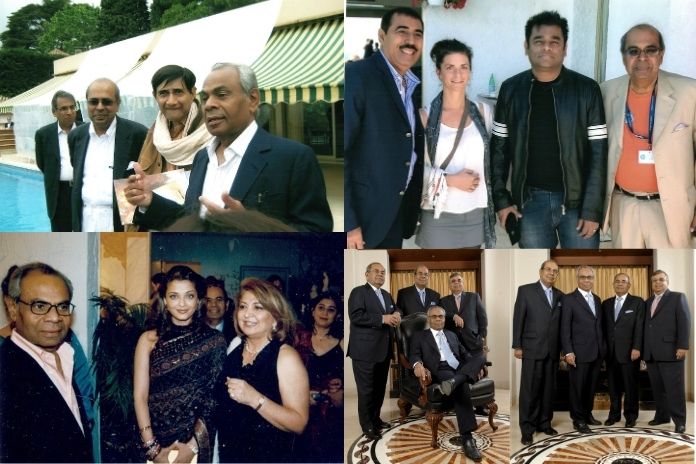
In Remembrance: Srichand Parmanand Hinduja (1934–2023) and Gopichand Parmanand Hinduja (1940–2025)
When the Cannes Film Festival raises its curtain this May, an absence will quietly register among those who have attended long enough to notice. For more than five decades, the annual gathering at Villa Paradise— the Hinduja family’s Croisette estate — was as much a fixture of the festival calendar as the Palme d’Or itself. Those evenings drew directors, diplomats, and movie stars into a single room under the Mediterranean sky, served always a vegetarian Indian feast. The symbolism was never accidental.
Srichand Parmanand Hinduja, fondly known as SP, moved to his heavenly abode in London in May 2023 at the age of 87, leaving behind an extraordinary legacy of leadership and values. His brother Gopichand, known as GP, followed in November 2025, aged 85 after continuing to guide the Hinduja Group with vision and dedication. Together, they constitute perhaps the most undersung chapter in the story of how Indian cinema became a global phenomenon.
A Market Where None Existed
The achievement is difficult to appreciate without understanding the landscape they entered. In the early 1950s, Hindi cinema was almost entirely invisible beyond the subcontinent. There were no diaspora communities to court in Iran, Jordan, or Egypt. Audiences in Tehran had never seen a Bollywood film — many had never heard Hindi spoken.
Into this void, the brothers carried a conviction that borders on the irrational in retrospect: that a market existed; it simply needed to be built. They used to hire local voice-over artists to dub Indian films into French, Arabic, and English at a time when the very concept invited ridicule. They flew Indian stars like Raj
Kapoor and Dev Anand to premieres in Tehran when no commercial flights connected Mumbai to Iran. When a local exhibitor was approached about hosting one such premiere, his response was baffled
incredulity: “Do you know what the meaning of a premier is?” The Hindujas organised it anyway.
They opened offices across the Middle East — Iran, Jordan, Egypt, Turkey, Israel, Thailand — and eventually in London, naming their corporate entity Sangam Limited after Raj Kapoor’s 1964 epic. The name was earned. Sangam ran for a full house for almost a month in London, till the cinema owner was constrained to pull it down owing to his other Hollywood commitments, for three consecutive years in Iranian cinemas and five unbroken years in Egypt. Adjusted for currency shifts, those box-office receipts rival the inflation-corrected performance of many modern Indian blockbusters.
The Financiers Behind the Legends
Their contribution was not only logistical. More than 1,200 films were financed, edited, dubbed, and distributed internationally by the Hindujas. They thoroughly backed Raj Kapoor, Dev Anand, Manoj Kumar, and Manmohan Desai — the architects of Hindi cinema’s golden age. A trade maxim emerged: a picture backed by the Hindujas would reach either a silver jubilee or a golden one. Their name was, in the industry’s shorthand, a guarantee. The Hinduja Brothers made money on all those 1200 plus films, irrespective of their run in the domestic market.
They also understood that cinema’s power is cultural before it is commercial. In 1973, they began hosting the Indian film fraternity at Villa Paradise, a gathering that grew to 250 or 300 attendees — directors,
producers, and ambassadors from multiple countries. It was, in effect, a lobby for Indian cinema as a category deserving serious international attention. The roll call of those who first encountered Cannes through the Hinduja door reads like a syllabus of contemporary Indian cinema: Aishwarya Rai Bachchan,
Sanjay Leela Bhansali, A.R. Rahman, etc.
An Inheritance Intact The family’s engagement with cinema did not end with SP and GP. The younger
brothers, Ashok and Prakash, have maintained the Villa Paradise tradition. The third generation has ventured into production. The institutional commitment assembled over half a century has proven durable.
But durability is not replication. What the two eldest brothers possessed — beyond capital and connections — was the audacity of men who act on a vision before the evidence supports it. As Cannes
2026 convenes, the film world they helped build will be very much on display. Two of the men most responsible for that presence will not be.
Highlights

TIFF Reveals Plans for Industry Conference

Films by Shekhar Kapur and Shubham Yogi Selected for Toronto Gala

A Selection to Die for

Le Musk: A Brave New Frontier in Cinema

The Path finder: Jyoti Deshpande

Toonz to Honour Aabid Surti, Biren Ghose at Animation Masters Summit

India is the Country of Honour at Cannes

RAVINDRA VELHAL: DRIVING MEDIA TRANSFORMATION

THE PATH FINDER: JYOTI DESHPANDE

INTO THE WORLD OF RRR

Powerkids Appoints Manoj Mishra as CEO

Toonz Join Tunche Films to Co-Produce Spanish-Peruvian Animation Feature Kayara

National Museum of Indian Cinema Hosts Vintage Vehicles

I&B Secretary promises Govt’s Support to Film industry

Tom Cruise’s ‘Top Gun: Maverick’ to Blaze at Cannes

Illumination’s Minions: The Rise of Gru is the Annecy Festival Opener

Now, Shoot at Sight in India!

Lata Mangeshkar, India’s Singing Goddess

Quantum Image Making Has Arrived

Indian Films To Look Out For In 2022

2022: Centenary of Indian Cinema Legends

Singing Legend Lata Mangeshkar, Nightangale of India, Dies at 92

Bhushan Kumar’s T-Series Ventures Into OTT Content Creation Space

What’s India Looking for at European Film Market