Nolan is Never Far From Home – and Homer
By Pickle July 17, 2026
Share:


By Saibal Chatterjee
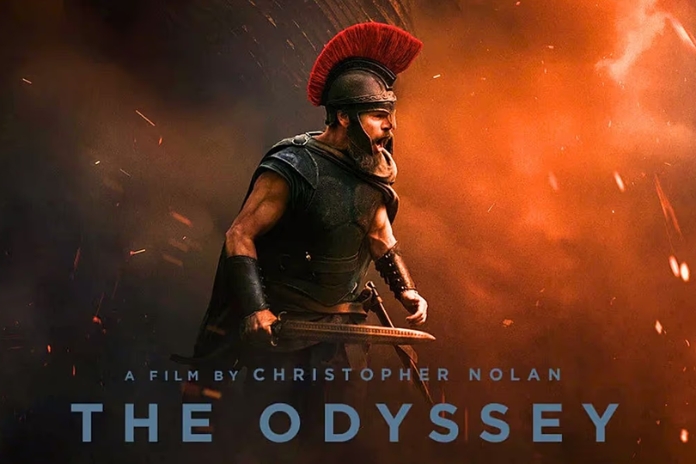
Christopher Nolan’s The Odyssey is a magnificent film – bewitching, enlightening and thrilling all at once. It is the kind of cinematic work that keeps on giving even when you think you are satiated.
Elevated by incredibly sharp and aware performances by actors who know they are in a story and a film way, way bigger than them, stunning cinematography (by Hoyte van Hoytema) and a period-appropriate score (by Ludwig Goransson working with the sounds of gongs, cymbals, aulos lyres and thumps that feel primal), the film grips the audience from beginning to end.
Its heady momentum never flags, which is a marvel given the degree of visual and informational detailing that the vaulting cinematic enterprise has to cram into three hours. It never feels rushed or riddled with gaps.
VFX (by DNEG) is at its best when it does not stick out. That is exactly how it is in The Odyssey. It is unobtrusively embedded in the film. It becomes an integral part of the flow and does not draw undue attention to itself .
Unfortunately, India has no theatre that can screen a film shot entirely with IMAX 70mm cameras. What we get to see is only a shadow of how Nolan would have wanted it to be seen. Be that as it may, we can still ‘see’ that The Odyssey is no mean cinematic feat.
The story spans the 20 years that Odysseus (Matt Damon), King of Ithaca, spends away from his beloved wife Penelope (Anne Hathaway) and son Telemachus (Tom Holland).
The Trojan War (the film depicts its culmination, drawing upon details from Homer’s other epic poem, The Iliad), the perilous journey back home after achieving victory, and the climactic confrontation between Odysseus (who returns incognito) and the unctuous, gluttonous suitors who hope to marry Queen Penelope and wrest the throne of Ithaca fill up the time-span.
Nolan does not deviate much from the Homeric text but masterfully grafts a modern, anti-war sensibility on the story by playing up its emotional and moral underpinnings. Men do terrible things when they fight wars. They not only bay for each other’s blood and kill and maim, they run humanity as a whole into the ground and hasten the death of civilisation.
But there are forces larger and more fearsome than the greatest of warriors and armies and when they confront humans returning from war there is hell to pay. That Odysseus’s voyage home drags him through hell (and, in one instance, literally so) is no coincidence.
Homecoming, as the warrior himself admits, is not always an easy thing. Who would know better than him? He encounters one storm after another, one life-threatening impediment after another, as he struggles to find his way back.
Storms blow his ship off its course. He runs into terrifyingly powerful creatures bent upon annihilating him and his men. The death toll among his troops rises even as his feckless second-in-command Eurylochus (Himesh Patel) warns him of the dangers ahead. Odysseus leaves the dead behind without honouring them because survival is of the essence.
Polyphemus the Cyclops, Circe the sorceress (a brilliant Samantha Morton), the deceptive nymph Calypso (Charlize Theron), the invincible man-eating Laestrygonians, the six-headed monster Scylla and the deadly whirlpool Charybdis turn the voyage into an obstacle course that seems to have no end.
The Odyssey wends its way through a busy, eventful narrative using non-linear methods that are tightly dovetailed into the overarching structure of the tale.
One half Homer’s epic is divided between the story of Telemachus and Odysseus’s homeward journey that takes him further and further away from his destination. The other half is devoted to Odysseus’ return to Ithaca and revenge on the smarmy suitors.
The film does not opt for a neat division. It uses only its final one-third for the return of Odysseus in the garb of a ragged beggar, which Athena (Zendaya), goddess of wisdom and his ‘guiding angel’, bestows upon him.
Nolan’s film rebels against the entrenched arcs of studio-mandated storytelling styles as well as against the predominantly male perspectives that have tended to infect translations and interpretations of the Homeric epic that it adapts for the screen with striking skill and precision.
Nolan takes a difficult-to-film Greek epic, one of the oldest surviving works of literature that is still disseminated and dissected around the world, and turns it into a compelling and captivating movie experience that is as much for the ages as for the times that we live in.
The transposition of The Odyssey (which has been told and retold across history in a manner that has led some scholars to question the authorship of the 24 books that constitute it) to the big screen for a contemporary audience weaned on CGI-heavy superhero tentpole productions demands a certain magic that is not too different from the kind that propels the plot forward.
The film never loses its way. It hits home at every turn. Not since Peter Brook and Jean-Claude Carriere distilled the philosophical essence of The Mahabharata into a nine-hour play, a six-hour miniseries and a three-hour film with diversity casting much more expansive than what Nolan achieves here has a movie director grasped the ethical and logical nuances of a story of timeless civilisational import.
Highlights

TIFF Reveals Plans for Industry Conference

Films by Shekhar Kapur and Shubham Yogi Selected for Toronto Gala

A Selection to Die for

Le Musk: A Brave New Frontier in Cinema

The Path finder: Jyoti Deshpande

Toonz to Honour Aabid Surti, Biren Ghose at Animation Masters Summit

India is the Country of Honour at Cannes

RAVINDRA VELHAL: DRIVING MEDIA TRANSFORMATION

THE PATH FINDER: JYOTI DESHPANDE

INTO THE WORLD OF RRR

Powerkids Appoints Manoj Mishra as CEO

Toonz Join Tunche Films to Co-Produce Spanish-Peruvian Animation Feature Kayara

National Museum of Indian Cinema Hosts Vintage Vehicles

I&B Secretary promises Govt’s Support to Film industry

Tom Cruise’s ‘Top Gun: Maverick’ to Blaze at Cannes

Illumination’s Minions: The Rise of Gru is the Annecy Festival Opener

Now, Shoot at Sight in India!

Lata Mangeshkar, India’s Singing Goddess

Quantum Image Making Has Arrived

Indian Films To Look Out For In 2022

2022: Centenary of Indian Cinema Legends

Singing Legend Lata Mangeshkar, Nightangale of India, Dies at 92

Bhushan Kumar’s T-Series Ventures Into OTT Content Creation Space

What’s India Looking for at European Film Market