Tamil Filmmaker R Gowtham Makes Waves at Berlinale Forum with Debut ‘Members of the Problematic Family’
By Pickle February 19, 2026
Share:


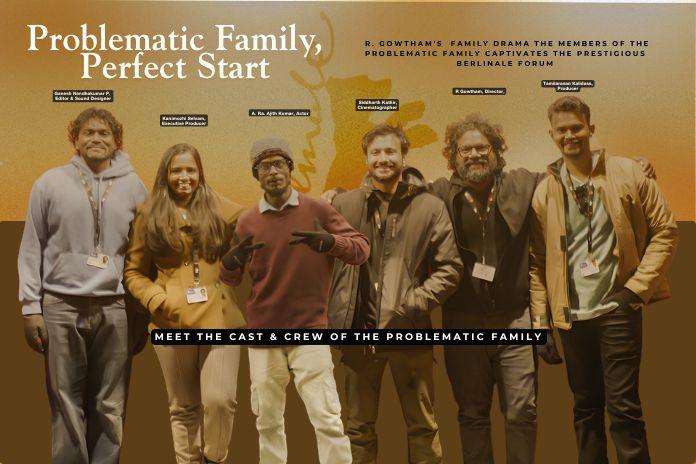
First-time director’s raw exploration of grief captivates Berlin audiences, as crew of childhood friends celebrate Tamil cinema’s growing global recognition By Natarajan Vidyasagar
Director R Gowtham’s debut feature “Members of the Problematic Family” has captivated audiences at the prestigious Berlinale Forum section, marking a significant milestone for Tamil independent cinema. The 105-minute film represents not just the arrival of a promising new director, but the debut production of Labyrinth Narratives, with producer Tamilarasan Kalidass backing his childhood friend’s uncompromising vision.
“This is not only about a debut director, but also about a debut producer who believed in the film,” Gowtham emphasized during an interview with Pickle in Berlin, his first-ever visit to Europe. The significance runs deeper—this is the first Tamil film from a debutant director to be selected for the Berlinale Forum, following earlier Tamil entries like Alai Payuthey, Paruthiveeran, and the recent Kottukali.
The Financial Reality of Independent Cinema
While Gowtham received hospitality from Berlinale for his stay as the director, bringing his crew of six to Berlin required considerable financial effort. The team had to raise funds independently to ensure the producer, executive producer, cinematographer, editor, sound designer, and lead actor Prabha Ajit Kumar could attend the premiere. “I promised to bring the crew to the festival if selected,” Gowtham recalls.
The struggle to maintain half-a-dozen crew members in Berlin for ten days exposes a glaring gap in how we support our filmmakers. These young artists represent Indian cinema at one of the world’s most prestigious film festivals, yet they must scramble for resources to even be present at their own triumph. However, It has to be greatly appreciated that the Ministry of Information & Broadcasting has approved Rs 10 lakh for Berlinale Forum Films and Gowtham’s crew must be relieved by this gesture.
A Crew Bound by Decades of Friendship
What sets this production apart is the remarkable history shared by its core team. Gowtham and his crew represent friendships forged over decades, with many having studied together since elementary school. “We are all childhood buddies. We studied together from second standard… from sixth standard onwards, everybody is connected,” Gowtham explained, describing how they are all connected from schooldays. The producer himself is a long-time schoolmate, while the executive producer Kani is Gowtham’s cousin.
The director proudly describes his team as “a kind of problematic crew”—young, technically accomplished professionals from premier film institutes. The cinematographer Siddharth Kathir trained at SRFTI, while editor and sound designer Ganesh Nandhakumar studied at FTII, Pune. Ganesh’s versatility is remarkable—he handled sound recording, editing, sound design, and even poster design for the film. Gowtham, a self-described “no film school guy,” brings a different credential to the table: he is a published poet in Tamil, with his collection titled ‘Maarvalayangal’ (Aerola).
Poetry, Mood, and Cinematic Influences
Gowtham’s background as a poet profoundly shapes his approach to filmmaking. Influenced by master filmmakers Shaji N Karun and G Aravindan, as well as innumerable poets, Gowtham has developed a distinctive cinematic voice. “I won’t give any reference as a movie. I will give reference on poetry or for mood paintings,” he explains, emphasizing his commitment to originality in form rather than imitating other films. This poetic sensibility translates into a cinema focused on emotions and mood rather than conventional narrative structures.
The influence of Aravindan is particularly evident, with Gowtham citing how “Thampu’s introduction scene is somewhat similar to our opening”. The Potato Eaters Collective maintain restored versions of Aravindan’s films on their YouTube channel, which the team watches together. This deep engagement with cinematic masters, combined with his immersion in Tamil poetry and literature, gives Gowtham’s work a unique layered quality.
Despite his literary pedigree and previous work heading content at Zee Tamil and working on director PS Vinothraj’s “Kottukali,” Gowtham and his team remain grounded. “We have already started shooting weddings and birthday events, so we will survive somehow,” he says matter-of-factly, finding artistic value even in commercial work. “There is a mood and emotion in a wedding film,” he adds, revealing how he perceives storytelling potential in unexpected places.
His philosophy of cinema is deliberately provocative: “You watch the film and you don’t sleep. But I wanted to watch the film and you don’t get sleep and you have to go smoke or go somewhere else”. For Gowtham, cinema should disturb, provoke thought, and linger in the viewer’s consciousness long after the credits roll. This stands in stark contrast to streaming content where “you watch a film in half-sleep or sleep happily after watching a film” That’s what a film is to Gowtham.
Breaking the ‘South Asia’ Box
Gowtham is passionate about changing how Indian regional cinemas are perceived globally. “Putting us in South Asia—India, Pakistan, Bangladesh, Sri Lanka—and there is Maharashtra, Mumbai, Kerala, we are all producing beautiful films. There is Marathi, Bengal, but putting them together in South Asia is an injustice,” he argued forcefully.
”We are equivalent to France, I would say,” Gowtham asserts, advocating for individual recognition for Tamil, Malayalam, Bengali, Hindi, Telugu, and Kannada cinemas—similar to how European national cinemas are treated distinctly by festival selectors globally. “We wanted individual Tamil pavilion presentation here at Berlin. We are competing with my brothers—some Bengali and Marathi film both are good and they were able to choose one right?”.
This perspective challenges the homogenization of Indian cinema under broad regional categories, arguing that each language cinema has its distinct aesthetic, cultural context, and cinematic traditions that deserve separate recognition on the world stage.
The Film: An Unflinching Portrait of Grief
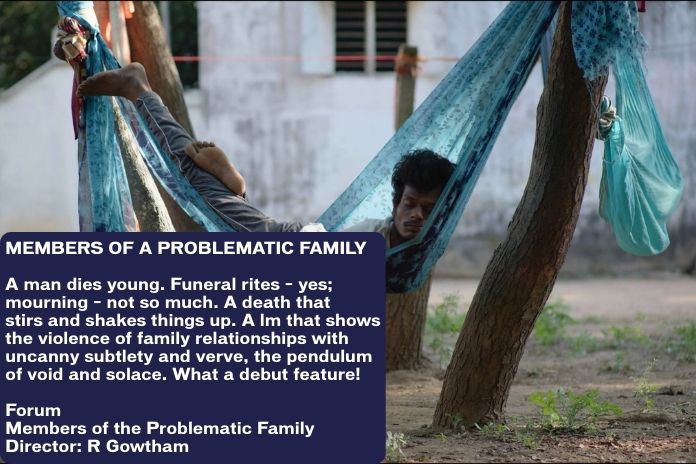
“Members of the Problematic Family” follows the aftermath of Prabha’s mysterious death, as his widowed mother Santhi, paternal uncle Sellam, and extended family navigate a 16-day funeral ritual. The raw, unflinching narrative weaves through a dozen characters, examining how grief manifests in unexpected moments and objects, embracing human nature with all its “mad outpourings, sordid habits, abusive love, misplaced pride and casual cruelty”.
With an anthropologist’s eye, Gowtham traces the complexities of bereavement, creating what the press materials describe as “a work of deep and uncompromising humanism”.
Looking Forward with Measured Optimism
The producer’s immediate goal is pragmatic: recoup the investment to fund future films they believe in. “When we recover, that’s the plan, we will do another thing,” says Gowtham. Yet there’s also palpable anxiety about maintaining relevance in an unforgiving independent film landscape where “the first film has to be bigger”.
”The most important thing I am telling people is that it’s not about me debuting. It’s about our company Labyrinth Narratives,” Gowtham emphasizes, highlighting how this Berlin selection validates not just him but the entire production house’s vision. The producer worked with meticulous professionalism, releasing funds before the 10th of each month for two and a half years, maintaining clear boundaries between friendship and business.
Still, having attended only one film festival before—MAMI in 2015, when his mentor Bramma’s “Kutram Kadithal” screened—Gowtham’s arrival at Berlinale represents a vow fulfilled: to attend festivals only with his own film. “I had a vow that we have to go to the festival only with the movie,” he recalls.
For this crew of childhood friends turned filmmaking collaborators, the future is bright, even as they acknowledge the pressures ahead. One hopes that “Members of the Problematic Family” finds acquisition deals, travels to more festivals, and eventually receives a theatrical release in India, allowing local audiences to experience the film that has captured Berlin’s attention. As Gowtham and his team navigate Berlinale and the European Film Market, they carry with them not just a film, but the collective dreams of a generation of independent Tamil filmmakers seeking to contribute to world cinema’s evolving form.
Highlights

Watan Adds Colour to Indian Independence Day

TIFF Reveals Plans for Industry Conference

Films by Shekhar Kapur and Shubham Yogi Selected for Toronto Gala

A Selection to Die for

Le Musk: A Brave New Frontier in Cinema

The Path finder: Jyoti Deshpande

Toonz to Honour Aabid Surti, Biren Ghose at Animation Masters Summit

India is the Country of Honour at Cannes

RAVINDRA VELHAL: DRIVING MEDIA TRANSFORMATION

THE PATH FINDER: JYOTI DESHPANDE

INTO THE WORLD OF RRR

Powerkids Appoints Manoj Mishra as CEO

Toonz Join Tunche Films to Co-Produce Spanish-Peruvian Animation Feature Kayara

National Museum of Indian Cinema Hosts Vintage Vehicles

I&B Secretary promises Govt’s Support to Film industry

Tom Cruise’s ‘Top Gun: Maverick’ to Blaze at Cannes

Illumination’s Minions: The Rise of Gru is the Annecy Festival Opener

Now, Shoot at Sight in India!

Lata Mangeshkar, India’s Singing Goddess

Quantum Image Making Has Arrived

Indian Films To Look Out For In 2022

2022: Centenary of Indian Cinema Legends

Singing Legend Lata Mangeshkar, Nightangale of India, Dies at 92

Bhushan Kumar’s T-Series Ventures Into OTT Content Creation Space