Ashutosh Gowariker Defines the Six Borders of World Cinema
By Pickle November 18, 2026
Share:


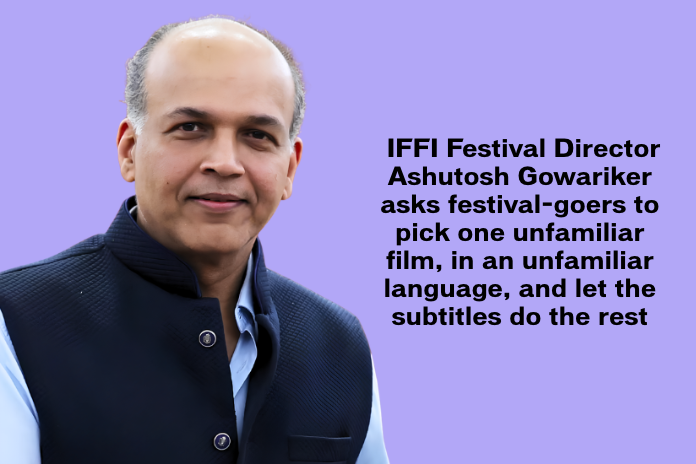
Ashutosh Gowariker brings a director’s instinct to IFFI, programming 159 international films around the idea that borders are also habits
Twenty-five years ago Ashutosh Gowariker persuaded audiences far beyond India to sit through a near four-hour film about a cricket match between drought-stricken villagers and their colonial rulers. Lagaan earned an Academy Award nomination. This week it returns to the screen in Goa, where its director has taken on a harder sell: getting people to watch films they would never normally choose.
Ashutosh Gowariker, 62, was appointed director of the 57th International Film Festival of India in May, succeeding Shekhar Kapur. The festival, which runs from November 20 to 28, is a state enterprise, organised by the information and broadcasting ministry through the National Film Development Corporation with Goa’s government. Its themes this year’s, “Stories Without Borders”, looks no different.
He insists otherwise. “It is not a slogan for a poster,” he told its curtain-raiser on November 13. “It is the question we put to every section and every screening.”
The reasoning is tidier than most festival manifestos. An age of connection, he argued, has made it easier to stay inside one’s own language, screen and point of view. “Borders today are not only lines on a map. They’re also habits. A story is one of the few things that can cross such a line without a passport.”
He counted six such borders and hung the programme on them. The first is geography: 159 international films from 86 countries, opening with Fatherland by Paweł Pawlikowski, joint winner of the best director prize at Cannes, and closing with We Are All Strangers by Anthony Chen, who sat on the jury he chaired in 2024. Nine films are world premieres.
The second border is language at home. Indian Panorama opens with Dhurandhar, a Hindi spy thriller, alongside Becoming, a Ladakhi-language non-feature. The third is time: a centenary tribute to Andrzej Wajda, whose work he watched in his “learning years”, sits beside FW Murnau’s Sunrise and homages to Indian artists born a century ago. “Good films do not carry an expiry date.”
The fourth is form, blurred by two new sections on animation and films about films. The fifth divides those who have told their stories from those just beginning. At Cannes in May, he stated his focus as “new talent, the young film-makers, even the one-time film-makers who have got stories to tell”. The international line-up includes 52 films by women and 62 by first-time directors. “If a story is never told, it cannot cross anything.” The sixth lies between a festival and its host city, bridged by open-air family screenings in Margao and on the beaches at Miramar and Vagator.
The scheme is a storyteller’s, and recognisably this one’s. Ashutosh Gowariker made his acting debut in Ketan Mehta’s Holi in 1984, attended the festival that year and turned director with Pehla Nasha in 1993. His best-known films each place someone on the wrong side of a line: villagers against empire in Lagaan, a Nasa project manager returning to rural India in Swades, a Mughal emperor and his Rajput bride in Jodhaa Akbar. The theme turns the filmography into a programme.
On his appointment he spoke of carrying forward a legacy “created, nurtured, and expanded” since 1952 by “innumerable festival teams”, the language of a custodian, not a revolutionary. Yet he noted that film-makers and countries had approached Goa wanting to premiere there, “a very welcome change”.
Whether a theme can alter habits is another matter; festival queues tend to form for the familiar. His own request is modest: watch at least one film you would not normally choose, in a language you do not understand, from a country you have never visited.
“Let the subtitles do their work,” he said. “I think you’ll find that the border was never as wide as you thought.”
Highlights

CII BIG PICTURE SUMMIT 2012: Growth Triggers From Ronnie

TIFF Reveals Plans for Industry Conference

Films by Shekhar Kapur and Shubham Yogi Selected for Toronto Gala

A Selection to Die for

Le Musk: A Brave New Frontier in Cinema

The Path finder: Jyoti Deshpande

Toonz to Honour Aabid Surti, Biren Ghose at Animation Masters Summit

India is the Country of Honour at Cannes

RAVINDRA VELHAL: DRIVING MEDIA TRANSFORMATION

THE PATH FINDER: JYOTI DESHPANDE

INTO THE WORLD OF RRR

Powerkids Appoints Manoj Mishra as CEO

Toonz Join Tunche Films to Co-Produce Spanish-Peruvian Animation Feature Kayara

National Museum of Indian Cinema Hosts Vintage Vehicles

I&B Secretary promises Govt’s Support to Film industry

Tom Cruise’s ‘Top Gun: Maverick’ to Blaze at Cannes

Illumination’s Minions: The Rise of Gru is the Annecy Festival Opener

Now, Shoot at Sight in India!

Lata Mangeshkar, India’s Singing Goddess

Quantum Image Making Has Arrived

Indian Films To Look Out For In 2022

2022: Centenary of Indian Cinema Legends

Singing Legend Lata Mangeshkar, Nightangale of India, Dies at 92

Bhushan Kumar’s T-Series Ventures Into OTT Content Creation Space