Beyond the Postcard: Goa’s Deliberate Push for a Creative Economy
By Pickle November 18, 2026
Share:


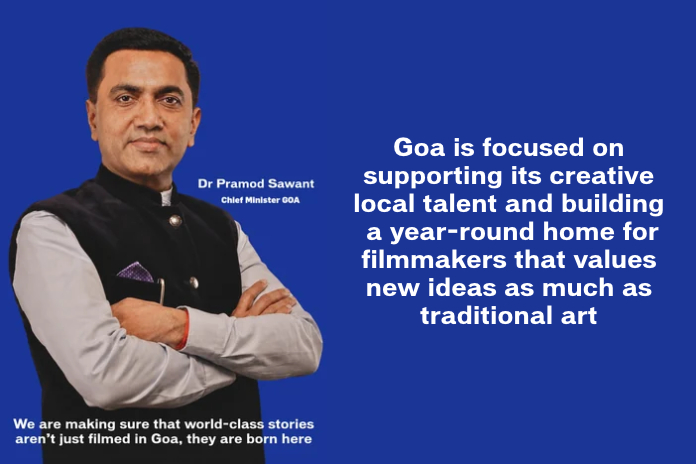
With single-window permissions, film finance, IFFI and Waves Film Bazaar, the state is moving from film backdrop to production partner.
There is a stretch of tree-lined road in Parra where a cyclist, in a single scene of Dear Zindagi, came to stand for calm and self-discovery. There is a sea-facing fort at Aguada that became, after Dil Chahta Hai, a shorthand for friendship. Goa has always had a way of slipping into the movies. What the state government is now attempting is more ambitious: to make sure the stories are not merely shot in Goa, but born, financed, produced and sold from it.
The ambition is stated clearly by Hon’ble Chief Minister Dr. Pramod Sawant. “Goa is focused on supporting its creative local talent and building a year-round home for filmmakers that values new ideas as much as traditional art,” he says. “We are making sure that world-class stories aren’t just filmed in Goa, they are born here.”
A legacy on screen, a stronger future ahead
The depiction of Goa in screen history is long and varied, from the comic road-trip of Bombay to Goa and the Golmaal franchise to international productions such as The Bourne Supremacy and The Sea Wolves. That history has made Goa a familiar location for the industry. Familiarity, however, is not the same as trust: a unit may come simply for the scenery or for the short hop from Mumbai. Trust is earned through process, and that is where the state has acted, with the Goa (Regulation of Film Shooting) Act, 2021, notified film shooting rules and, since September 2025, an online single-window clearance system run by the Entertainment Society of Goa (ESG). What is changing now is the intent to build on that history in a more structured way.
Filmmakers arriving today are not starting from scratch; they arrive in a state that already knows how a film unit works and what it needs. The goal of the government is to convert this legacy into an even more formidable ecosystem, consistent work and more meaningful participation in the process of film making. The same can be achieved through productions that base their full schedule in Goa rather than a few days of outdoor shooting; web series, advertising and OTT work that keeps local crews and vendors employed through the year; post-production, animation and VFX work that is retained in the state; and co-productions in which Goan producers hold a stake rather than only provide services.
Goa’s screen legacy is not only that of a location for others; the state has a cinema of its own. Mogacho Aunddo, the first Konkani film to be released, opened on 24 April 1950, a date now observed as Konkani Cinema Day. In recent years Konkani films have won repeated national recognition: Nachom-ia Kumpasar took three honours at the 62nd National Film Awards, and K Sera Sera, Amori and Kaajro have each since been adjudged Best Konkani Film at the National Film Awards. Earlier, Paltadacho Munis won the international critics’ prize at the Toronto International Film Festival in 2009. It is this home-grown tradition, as much as the visiting productions, that the state now seeks to build on.
Removing the friction
For a producer, it is not enough for a location to be beautiful. It has to be practical: well connected, well administered, and backed by experienced line producers, dependable local vendors and a working ecosystem. The business end of a shoot weighs as heavily in a producer’s decision as the scenery. Goa’s pitch rests on a compact geography, with heritage architecture, beaches, hinterland villages and modern infrastructure within short distances. That saves travel time and cost, and allows tighter scheduling. Predictable weather windows make shooting viable across seasons, part of the government’s push to shed the image of a seasonal, leisure-only destination. Two airports, together with rail and national highway links, bring cast, crew and equipment in from Mumbai, Bengaluru, Hyderabad and beyond, while a wide range of hotels can accommodate units large and small. Line producers registered with the ESG, local crews and vendors support shoots on the ground. The proposed Film City at Loliem in Canacona is planned to add pre- and post-production studios, VFX and CGI labs and a film school.
The administrative backbone is the ESG, which runs a single-window mechanism for permissions. A published framework of film shooting rules defines the steps, expected timelines and designated points of contact, so production teams know what to expect before they land. With one dedicated body coordinating clearances across departments and local authorities, a production no longer has to go from office to office for approvals. That reduces the bureaucratic hurdles and the friction in the process, and lets filmmakers keep their attention on the creative work rather than the paperwork. The approach is simple: come, work and finish on time. On the ground, skilled crews, reliable vendors and strong connectivity are meant to keep that promise.
Widening access for grassroots filmmakers
Ease of shooting is one half of the equation; access to finance is the other. The Goa Scheme of Financial Assistance for Films, implemented through the ESG, grades films by Goan producers on quality and provides up to ₹50 lakh, ₹30 lakh or ₹10 lakh for feature films, and up to ₹10 lakh, ₹5 lakh or ₹3 lakh for non-feature films, capped in each case at 50 per cent of the audited cost of production. It currently covers feature films in Konkani and Marathi, and non-feature films in Konkani, Marathi, Hindi and English.
The scheme was notified in 2016, before the rise of OTT platforms and the wider use of VFX, animation and digital production changed how films are made, financed and watched. The government is now revising the scheme to cover a wider range of formats and to bring more producers within its reach, so that filmmaking in Goa is open to talent at the grassroots and not only to those with established backing. The revision is meant to bring the benefits available to Goans in line with the industry as it works today, so that Goa stays at the forefront of that change.
A stage at home: International Film Festival of India (IFFI) and Waves Film Bazaar
If the finance scheme nurtures talent, the International Film Festival of India (IFFI) brings the world to it. Held in Goa, IFFI has kept the state wired into global cinema conversations. Such platforms bring in voices, ideas and networks, and that exposure matters even beyond the festival itself. In the curtain raiser press conference to the 57th IFFI, Hon’ble Chief Minister of Goa, Dr. Pramod Sawant expressed pride in Goa’s association with IFFI; he described the festival as an integral part of the state’s cultural identity and calendar. He also highlighted the state government’s preparations to welcome the global film fraternity, with arrangements spanning screening venues, transport, hospitality and public facilities.
Alongside the festival, the NFDC’s Waves Film Bazaar, South Asia’s best-known film market, gives that exposure a commercial edge. Writers, directors, producers, sales agents and financiers meet to pitch projects, find co-producers and close deals. For a young Goan filmmaker with a script and little else, a festival that screens the best of world cinema and a market that connects stories with funding sit in the same city, within walking distance of home. That combination is central to the government’s aim of making international visibility a tangible reality for more filmmakers.
The larger vision is that Goan projects should travel to the world’s leading festivals as a regular feature rather than an exception, while the world keeps coming to Goa.
From backdrop to partner
The Chief Minister in his previous interview also mentioned that scenery alone will not sustain a creative economy of Goa. “Cinema today is not limited to theatres,” he says. “The world of filmmaking is moving toward Virtual Production, AI, and advanced VFX, and we want Goa to be the place where that tech lives.” The aim is to move from being a backdrop to becoming a high-tech production partner. Within Prime Minister Narendra Modi’s emphasis on the “Orange Economy,” the idea of treating creativity, heritage and technology as a single industry, Goa is determined to push this initiative ahead.
We are looking to move the needle from being just a ‘backdrop’ to becoming a high-tech production partner.
In practice, that means building infrastructure where a creator can easily find what they need, and encouraging experimentation with new formats, shorter timelines and diverse narratives.
The way forward
The government’s vision for the next five to ten years is clear. It wants a producer with big ideas in Mumbai, London or any other global destination to see Goa as a formidable first choice and the place where production friction ends.
International co-productions are meant to become the norm, local animators and technicians to win global awards, and creative output to serve as a primary engine of the state’s growth.
Behind it lies a larger ambition: a legacy in which Goa is defined not only by its geography but by the quality of the work produced here, and an open invitation to the world to see the state as a true partner in its creative journey.
For a state long photographed as a backdrop, it is a bid to move behind the camera, and into the producer’s chair.
More information: https://esg.co.in/
Highlights

Singing Legend Lata Mangeshkar, Nightangale of India, Dies at 92

TIFF Reveals Plans for Industry Conference

Films by Shekhar Kapur and Shubham Yogi Selected for Toronto Gala

A Selection to Die for

Le Musk: A Brave New Frontier in Cinema

The Path finder: Jyoti Deshpande

Toonz to Honour Aabid Surti, Biren Ghose at Animation Masters Summit

India is the Country of Honour at Cannes

RAVINDRA VELHAL: DRIVING MEDIA TRANSFORMATION

THE PATH FINDER: JYOTI DESHPANDE

INTO THE WORLD OF RRR

Powerkids Appoints Manoj Mishra as CEO

Toonz Join Tunche Films to Co-Produce Spanish-Peruvian Animation Feature Kayara

National Museum of Indian Cinema Hosts Vintage Vehicles

I&B Secretary promises Govt’s Support to Film industry

Tom Cruise’s ‘Top Gun: Maverick’ to Blaze at Cannes

Illumination’s Minions: The Rise of Gru is the Annecy Festival Opener

Now, Shoot at Sight in India!

Lata Mangeshkar, India’s Singing Goddess

Quantum Image Making Has Arrived

Indian Films To Look Out For In 2022

2022: Centenary of Indian Cinema Legends

Bhushan Kumar’s T-Series Ventures Into OTT Content Creation Space

What’s India Looking for at European Film Market