Seeding India’s Next Creative Spring
By Pickle November 18, 2026
Share:


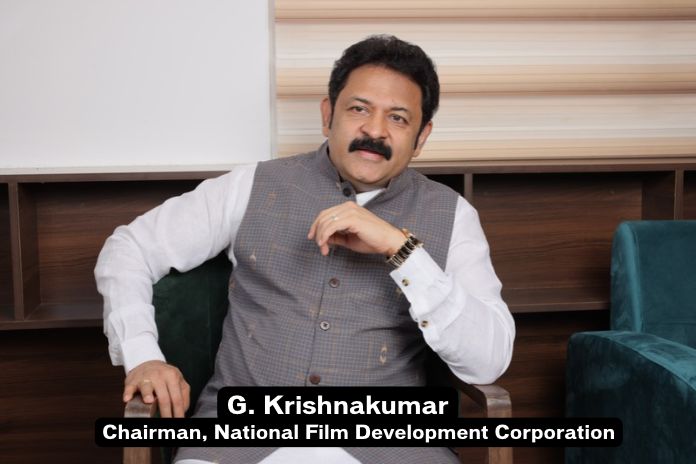
As WAVES Film Bazaar reaches its 20th edition, NFDC’s opportunity is to nurture distinctive voices, build lasting careers and seed the creative confidence that will shape India’s journey towards 2047.
By G. Krishnakumar: Chairman, National Film Development Corporation
A film begins long before the camera turns. It begins when someone believes an unfamiliar voice deserves to be heard. As an actor, I know what that belief can mean. As Chairman of NFDC, I see a responsibility to extend it to talent still waiting for an opportunity.
Filmmaking is, above all, a collective endeavour. Behind every performance are writers, technicians, designers and producers whose work makes it possible. Supporting a filmmaker therefore means supporting a wider community of craft, and recognising the livelihoods that depend on each production, from the earliest discussions to the final encounter with an audience.
That is the perspective I bring to Goa for the 57th International Film Festival of India. A festival renews ambition; an institution must help sustain it. A young filmmaker should return home with more than inspiration: useful advice, a professional relationship or a partner willing to take the next step.
I thank the Ministry of Information and Broadcasting and the Government of Goa for sustaining this meeting ground. Their partnership affirms that creative ambition belongs at the heart of national development.
NFDC’s production legacy shows what such belief can achieve. Mira Nair’s Salaam Bombay! won the Caméra d’or at Cannes in 1988. Anup Singh’s Punjabi film Qissa received Toronto’s NETPAC Award in 2013. Ritesh Batra’s The Lunchbox, which NFDC co-produced, sold to around 37 territories during its Cannes breakthrough. These journeys carry a clear lesson: Indian stories can reach the world without losing their local character.
WAVES Film Bazaars’ VFX and Tech Pavilion brings startups into closer contact with cinema, connecting storytelling with technological innovation.
Film Bazaar has helped turn that possibility into practice. Launched by NFDC in 2007, it reaches its 20th edition as WAVES Film Bazaar. Its Screenwriters’ Lab, Co-production Market, Work-in-Progress Lab and Viewing Room support projects at different stages, connecting filmmakers with expertise, finance and distribution opportunities.
A strong script may need a producer; a promising rough cut may need an experienced editor; a completed film may need a distributor. Effective support begins by understanding that particular need, rather than expecting every filmmaker to follow the same path.
Producing a film and enabling its journey are distinct contributions. Court and Girls Will Be Girls are among the films associated with Bazaar programmes. Shuchi Talati’s Girls Will Be Girls won Sundance’s World Cinema Dramatic audience award in 2024, alongside an acting award for Preeti Panigrahi. The achievement belongs first to the filmmakers. Our role is to help their work find the right opening.
The wider WAVES initiative has brought fresh energy to Indian entertainment. The inaugural World Audio Visual and Entertainment Summit in Mumbai in 2025 brought film, music, animation and visual effects into a shared business conversation. Its WAVES Bazaar facilitated more than 3,000 business meetings. Together with Goa’s film market, it is broadening the opportunities for creative collaboration.
WAVES Film Bazaar itself is expanding that conversation. Its VFX and Tech Pavilion brings startups into closer contact with cinema, connecting storytelling with technological innovation. The opportunity extends beyond individual films to the skills, services and enterprises that sustain the entertainment economy.
NFDC’s engagement at the European Film Market in Berlin, the Marché du Film at Cannes and the Toronto International Film Festival helps Indian stories find global partners. The BRICS WAVES Bazaar in Mumbai has widened that dialogue. Our purpose is not simply to export films, but to build lasting co-productions, fair partnerships and audiences for Indian stories in every language.
These encounters should also be exchanges of knowledge. Indian filmmakers have much to offer international partners, just as they can learn from other production cultures. A lasting collaboration respects both contributions and gives each partner a meaningful stake in the result.
India’s Amrit Kaal gives this work a longer horizon. The creative strength we hope to celebrate in 2047 must be seeded now through first chances, patient mentorship and accessible institutions.
Looking ahead also means caring for what we inherit. Founded in 1975, NFDC carries more than five decades of experience. Through the National Film Archive of India and the National Museum of Indian Cinema, we preserve and share our cinematic memory. Restoration is not nostalgia. It gives new generations access to the imagination and craft of those who came before them.
Preservation and discovery belong together. When younger filmmakers can encounter earlier work, they gain more than a history lesson: they discover different ways of seeing, working and solving creative problems. That inheritance should remain available to audiences as well as practitioners.
That responsibility must be matched by investment in new voices. The Mumbai International Film Festival celebrates documentary, short fiction and animation, while Creative Minds of Tomorrow gives emerging talent a platform at IFFI. No promising filmmaker should be held back by geography or a lack of connections.
AI, animation, gaming and immersive media are opening further possibilities. NFDC must help creators approach them with confidence and responsibility, ensuring that technology serves the storyteller.
Creative confidence also requires informed choices. New tools should expand what artists can attempt without diminishing authorship or the value of skilled work. We must make room for experimentation while keeping human judgement, cultural context and responsibility central to the process.
Commercial and parallel cinema need not be competing priorities. We can protect artistic individuality while helping filmmakers understand audiences, distribution and the economics of their craft.
I want regional languages, particularly voices from the North East, to find greater opportunity. Commercial and parallel cinema need not be competing priorities. We can protect artistic individuality while helping filmmakers understand audiences, distribution and the economics of their craft.
For me, the economic promise is continuity: a writer commissioned again, a technician earning a livelihood, a producer able to finance another film. Meetings matter when they lead to work. Success must be measured by the careers we sustain, not only the attention we attract.
India’s Amrit Kaal gives this work a longer horizon. The creative strength we hope to celebrate in 2047 must be seeded now through first chances, patient mentorship and accessible institutions.
As an actor, I want more remarkable stories to reach the screen. As Chairman of NFDC, I want more people to have a fair chance to make them. That is the creative renewal we must nurture.
Highlights

Screen Moms; Best Movies to Stream on Mother’s Day

Interview With CEO: How Toonz Animation Braved Covid-19

TIFF Reveals Plans for Industry Conference

Films by Shekhar Kapur and Shubham Yogi Selected for Toronto Gala

A Selection to Die for

Le Musk: A Brave New Frontier in Cinema

The Path finder: Jyoti Deshpande

Toonz to Honour Aabid Surti, Biren Ghose at Animation Masters Summit

India is the Country of Honour at Cannes

RAVINDRA VELHAL: DRIVING MEDIA TRANSFORMATION

THE PATH FINDER: JYOTI DESHPANDE

INTO THE WORLD OF RRR

Powerkids Appoints Manoj Mishra as CEO

Toonz Join Tunche Films to Co-Produce Spanish-Peruvian Animation Feature Kayara

National Museum of Indian Cinema Hosts Vintage Vehicles

I&B Secretary promises Govt’s Support to Film industry

Tom Cruise’s ‘Top Gun: Maverick’ to Blaze at Cannes

Illumination’s Minions: The Rise of Gru is the Annecy Festival Opener

Now, Shoot at Sight in India!

Lata Mangeshkar, India’s Singing Goddess

Quantum Image Making Has Arrived

Indian Films To Look Out For In 2022

2022: Centenary of Indian Cinema Legends

Singing Legend Lata Mangeshkar, Nightangale of India, Dies at 92