Aru: The Quiet Force Behind Conversations
By Pickle September 27, 2026
Share:


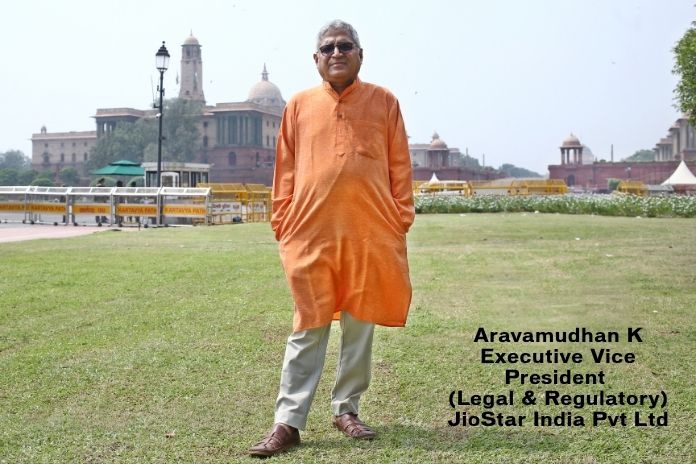
Behind Indian media’s glamour, Aru’s patient pursuit of policy reform shows how resilience, relationships and industry-minded leadership drive sector growth
K. Aravamudhan wanted to explore a different challenge beyond corporate communications. After several months at Star India, he asked to move into regulation. “I saw excitement in regulatory,” he recalls. In a business organised around attracting attention, he had chosen work that rarely received much of it.
Now JioStar’s executive vice-president, legal and regulatory, Aru has made that choice into a career. Central to that journey is his mentor, Uday Shankar, now JioStar’s vice-chairman. His story offers an alternative account of media leadership: not the celebrated programme, but the patient work that makes a business possible. For an executive navigating ministries and regulators, the achievement is often something that happens elsewhere: a launch, an investment, a programme and content commission.
It began far from television’s executive offices. After working as a clerk in a shipping company, he passed the Staff Selection Commission examination and arrived in Delhi in 1989 as a Central Service Secretariat (CCS) cadre in the Ministry of Industry. In 1993, he left to work with Karan Thapar on Eyewitness, the Hindustan Times video magazine.
News then travelled on VHS tapes. (which Aru recalled that in later part of his career carried to Hong Kong on his first foreign trip at Star). At the beginning of his career, he remembers an operation distributing thousands each month; his job was executive assistant, although the screen credit said public relations manager as he was also handled Karan Thapar’s famous press releases of his much-talked about interviews those days. Subsequent work across production houses, including SAB TV, UTV and Infotainment Television (ITV), gave him education in research, drafting questions, guests coordination and even adsales.
His decisive opportunity arrived indirectly. In 2006, he approached Uday Shankar seeking job for a colleague but Uday Shankar had a different idea and wanted Aru to join his team in MCCS which ran Star News then. He joined Star News, then moved to Star India in 2007, initially in corporate communications. In his telling, the switch to the regulatory team came in 2008, at his own request.
One early assignment illustrates why the work appealed. Star’s channels were being uplinked from Hong Kong, with the Indian operation acting as an agent collecting advertising and distribution revenues. It was a visionary decision of Uday Shankar who wanted to expand Star India’s operations in India decided to shift channels from downlinking to uplinking from India. Uday Shankar also saw an opportunity to have greater control over channels and content and its monetisation in India.
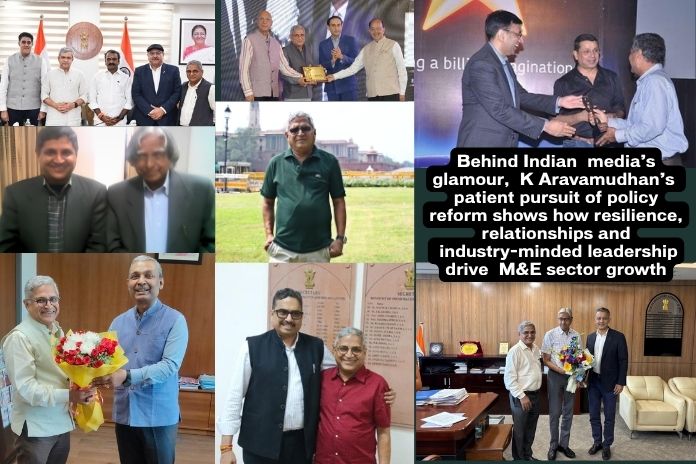
Aru recalls that Star India filed its uplinking applications in December 2009 and received MIB’s approvals in July 2010 for several Star channels. For him, this was the start of an exciting journey in the broadcasting sector which also gave him an opportunity to witness transformation of the Indian broadcasting sector from the government owned broadcasting to the opening up of news media to private production houses to opening up the broadcasting sector to the private companies.
He also recalls working closely with Uday Shankar to set up India’s first self-regulatory body for content on general entertainment channels, Broadcasting Content Complaints Council (BCCC), MIB’s decision to implement the path breaking decision to implement Digital Addressable System (DAS) and setting up the industry-led self-regulatory body for Original Curated Content Platforms (OCCPs or popularly known as OTTs) under IT Rules 2021. These were collective endeavours, not individual victories but Aru played his rule by acting as a bridge by aligning various stakeholders and helping in the transformation of the Indian broadcasting eco-system.
The principle behind that approach remains unusually clear in his memory. “Aru, if the sector does well, the companies in the sector will do well,” he recalls Uday Shankar telling him. The instruction was to avoid narrow, opportunistic positions and work for the overall industry’s betterment. Uday Shankar and Star India gave him both freedom and room, which Aru, believes would not have been possible under any other leader or company.
His gratitude is specific. Uday Shankar gave him freedom, opportunities through industry associations and room to acquire a reputation of his own. Aru admires the professionalism and confidence required of a leader who allows colleagues to grow using their skills to be on their own. The acknowledgement is less ceremonial than practical: autonomy allowed him to develop judgement. He works very closely with industry associations including IBDF, FICCI, CII, AVIA, IAMAI, BIF, USISPF, USIBC and PGI in driving industry’s agenda and shaping industry’s responses to various consultation papers by various ministries and regulators.
His daily newsletter – which he started way back in 2010 continues even today – reflect another form of persistence. He recently received the Lifetime Achievement Award at the 12th BCS Ratna Awards. A LinkedIn tribute celebrating the honour credits his newsletters, guidance and constant updates, describing him as an “industry resource”. His news daily newsletters keep the industry informed, engaged and empowered to act through timely knowledge-sharing and insights.
His speech at AVIA’s Policy Roundtable at APOS 2026 sets out three growth imperatives: regulatory stability to encourage investor confidence and long-term investment; sustainable monetisation to finance new, differentiated, high-quality content; and monetisation alongside content protection as the industry’s “twin pillars”.
For newcomers, the lesson is neither that relationships solve everything nor that persistence guarantees success. Working with the Ministry of Information and Broadcasting and TRAI needs patience with processes that do not follow commercial calendars. Resilience means returning with a better argument, not merely repeating a demand. A delayed permission can delay a business; an outdated rule of law can discourage its next investment.
Regulation and policy are unglamorous jobs, but central to the industry’s fortunes. Behind the curtains, people like Aru help make the glamour on screen possible. Nearly two decades after choosing regulation, his craft remains creating the conditions under which other people’s creative work can flourish.
Highlights

TIFF Reveals Plans for Industry Conference

Films by Shekhar Kapur and Shubham Yogi Selected for Toronto Gala

A Selection to Die for

Le Musk: A Brave New Frontier in Cinema

The Path finder: Jyoti Deshpande

Toonz to Honour Aabid Surti, Biren Ghose at Animation Masters Summit

India is the Country of Honour at Cannes

RAVINDRA VELHAL: DRIVING MEDIA TRANSFORMATION

THE PATH FINDER: JYOTI DESHPANDE

INTO THE WORLD OF RRR

Powerkids Appoints Manoj Mishra as CEO

Toonz Join Tunche Films to Co-Produce Spanish-Peruvian Animation Feature Kayara

National Museum of Indian Cinema Hosts Vintage Vehicles

I&B Secretary promises Govt’s Support to Film industry

Tom Cruise’s ‘Top Gun: Maverick’ to Blaze at Cannes

Illumination’s Minions: The Rise of Gru is the Annecy Festival Opener

Now, Shoot at Sight in India!

Lata Mangeshkar, India’s Singing Goddess

Quantum Image Making Has Arrived

Indian Films To Look Out For In 2022

2022: Centenary of Indian Cinema Legends

Singing Legend Lata Mangeshkar, Nightangale of India, Dies at 92

Bhushan Kumar’s T-Series Ventures Into OTT Content Creation Space

What’s India Looking for at European Film Market