A Voice That Will Never Die
By Pickle April 12, 2026
Share:


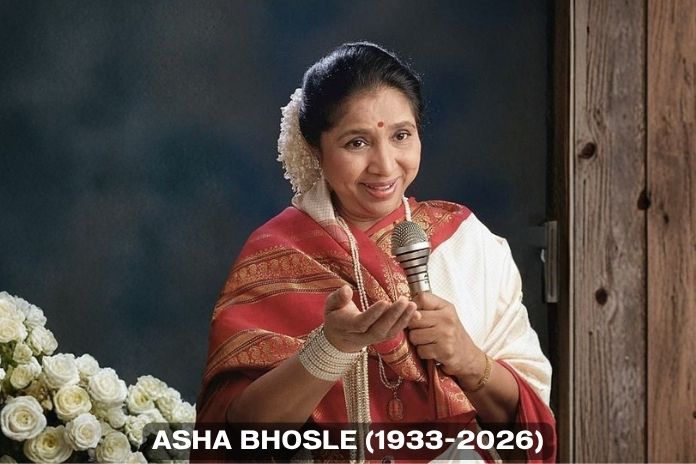
Asha Bhosle’s legacy, like her countless songs, will play on forever By Saibal Chatterjee
Unbelievable longevity was only one aspect of Asha Bhosle’s remarkably varied singing career. Her achievements as a vocalist who breathed life into songs in 20-plus languages over a period of eight decades are second to none, probably not even to her illustrious elder sister, Lata Mangeshkar.
Asha Bhosle, who passed away in a Mumbai hospital on Sunday (April 12) at the age 92, was a true trailblazer, a legend, an icon, a voice that enlivened Hindi cinema like nothing else ever did.
The enormous treasure trove of songs that Asha Bhosle has left behind is her shield against mortality. Music of the magical kind that she created in collaboration with some of India’s greatest music directors – S.D. Burman, Ilaiyaraaja, O.P. Nayyar, R.D. Burman, A.R. Rahman and Shankar-Jaikishan, to name only a few – never dies.
It plays on loop in the minds and hearts of those that have been touched by it. She sang a wide array of film and non-film songs and created a niche entirely her own.
A song that she sang in 1974 – Chain se humko kabhi aapne jeene na diya for Pran Jaaye Par Vachan Na Jaaye – never made it into the film. Yet it won a Filmfare award. Such was the beauty and power of her rendition that the song was set free to make its way through the world on its own terms. And that is exactly what Asha Bhosle did in her life and career.
Born in 1933 in the family of Pandit Deenanath Mangeshkar, Asha began singing professionally at the age of 10. Her first song was Chala chala nav bala, for the Marathi film Majha Bal (1943).
Her Hindi break came a few years later. The song was Saawan aaya in the 1948 film Chunaria, which also had numbers by Geeta Dutt, Lata Mangeshkar and Rafi.
In the early 1950s, the Hindi film playback singing scene was dominated by Lata, Geeta and Shamshad Begum but that did not deter the young Asha. In those years, she sang mainly for composers like Sardar Malik, Ghulam Mohammed and Sajjad Hussain for films that flew under the radar.
The influence of both Lata and Geeta Dutt was understandably difficult to shrug off and she had frequently face comparisons. But she evolved quickly and found her own voice. Once she did, there was no stopping her.
Asha Bhosle struck it rich with every music director she worked with, from Sardar Malik to Anu Malik, S.D. Burman to R.D. Burman and from Ilaiyaraaja to A.R. Rahman. These are only a handful of names. Bhosle was the go-to female playback voice for every composer who was in the business when she was churning out hit after hit
O.P. Nayyar employed Bhosle’s voice in 11 of the 12 songs in the 1952 film Chham Chhama Chham. The likes of Bimal Roy, who was then making Parineeta, and Raj Kapoor, who was producing Boot Polish, took notice. Bhosle sang half a dozen songs in Boot Polish.
B.R. Chopra’s Naya Daur, for which Nayyar scored the music, ushered in a new dawn for her. Both Chopra and Nayyar, along with the two Burmans, helped her along. Not that she needed much help.
Bhosle was always special. She could pack incredible range and vivacity into her voice, no matter what kind of song she was called upon to render. She imparted a distinct timbre to everything – sad songs, peppy numbers, soulful ghazals, lilting bhajans, coquettish love ditties and gentle lullabies.
She struck it rich with every music director she worked with, from Sardar Malik to Anu Malik, S.D. Burman to R.D. Burman and from Ilaiyaraaja to A.R. Rahman. These are only a handful of names. Bhosle was the go-to female playback voice for every composer who was in the business when she was churning out hit after hit.
She could be trusted as much to be Vyjayanthimala’s voice as Helen’s. Bhosle’s breezy cabaret numbers for the latter became an integral part of Hindi movies and foreshadowed today’s item numbers.
She sang O haseena zulfon waali jaane jahan in Teesri Manzil (1966) and opened the floodgates that allowed Piya tu ab toh aaja (Caravan, 1971), Aaj ki raat koi aane ko hai re baba (Anamika, 1973) and Yeh mera dil pyaar ka deewana (Don, 1978) to change the musical soundscape of Hindi cinema.
In 1981, when music director Khayyam roped her in for a slew of ghazals Umrao Jaan, the singer revealed her class. As she did when she sang for A.R. Rahman in Rangeela (1995). She was 62 but when she crooned Tanha tanha yahaan pe jeena, she did not sound a day younger than the film’s leading lady Urmila Matondkar.
One of the Umrao Jaan ghazals, Dil cheez kya hai aap meri jaan lijiye, fetched Bhosle a National Award. She won the National Award again for Mera kuch Saaman tumhare pass pada hai (Ijaazat, 1987), composed by R.D. Burman with lyrics by Gulzar.
The world was already accustomed to magic being created by the R.D. Burman-Asha Bhosle-Gulzar trio – be it in the form of Bechara dil kya kare (Khusboo, 1971) or Piya baawri (Khubsoorat, 1980). Ijaazat was only the apogee. There were many such highs strewn across her long, legendary career.
Highlights

TIFF Reveals Plans for Industry Conference

Films by Shekhar Kapur and Shubham Yogi Selected for Toronto Gala

A Selection to Die for

Le Musk: A Brave New Frontier in Cinema

The Path finder: Jyoti Deshpande

Toonz to Honour Aabid Surti, Biren Ghose at Animation Masters Summit

India is the Country of Honour at Cannes

RAVINDRA VELHAL: DRIVING MEDIA TRANSFORMATION

THE PATH FINDER: JYOTI DESHPANDE

INTO THE WORLD OF RRR

Powerkids Appoints Manoj Mishra as CEO

Toonz Join Tunche Films to Co-Produce Spanish-Peruvian Animation Feature Kayara

National Museum of Indian Cinema Hosts Vintage Vehicles

I&B Secretary promises Govt’s Support to Film industry

Tom Cruise’s ‘Top Gun: Maverick’ to Blaze at Cannes

Illumination’s Minions: The Rise of Gru is the Annecy Festival Opener

Now, Shoot at Sight in India!

Lata Mangeshkar, India’s Singing Goddess

Quantum Image Making Has Arrived

Indian Films To Look Out For In 2022

2022: Centenary of Indian Cinema Legends

Singing Legend Lata Mangeshkar, Nightangale of India, Dies at 92

Bhushan Kumar’s T-Series Ventures Into OTT Content Creation Space

What’s India Looking for at European Film Market


