AI: The New Co-Creator in the Room
By Pickle February 11, 2026
Share:


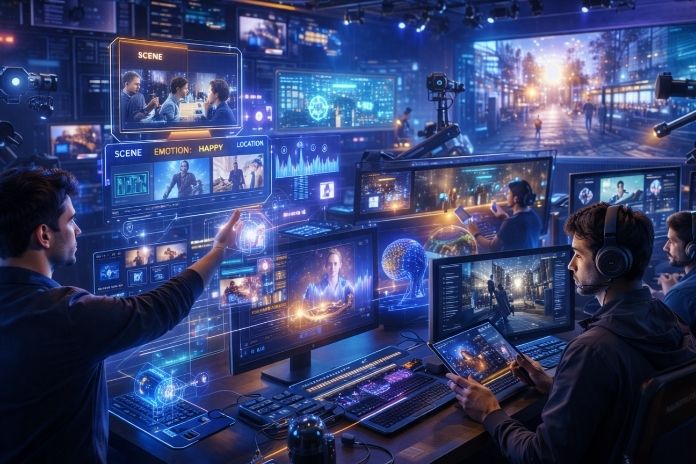
At the Big Picture Summit 2025, the conversation around artificial intelligence did not sound like a tech keynote. It sounded like a reckoning.
Across packed halls, panel rooms, and plenary stages at the Big Picture Summit 2025, the industry’s most influential voices returned to the same tension again and again: AI is transforming how stories are made, scaled, monetised, and distributed—but creativity, culture, and conscience cannot be outsourced to machines.
As Gaurav Banerjee, Chair, CII National Council on M&E and MD & CEO, Sony Pictures Networks India, set the tone in his opening remarks, the room was reminded that this is not just another tech cycle. This is an inflection point. “This summit is setting the tone for the AI decade, a decade full of promise and also full of uncertainty,” he said.
Banerjee acknowledged the transformative potential of AI—its ability to enhance efficiency, bring scale, and accelerate processes—but cautioned against letting machines define creativity itself. “AI should not define creativity,” he asserted. “Human imagination alone should do that. India’s natural strength lies in its people, not just in tools.”
It was a call echoed by many: that AI, for all its power, must remain a partner, not a master. The consensus was not about resisting technology but about shaping its trajectory with responsibility, ethics, and a clear-eyed embrace of India’s unique strengths.
Sanjay Jaju, Secretary, Ministry of Information and Broadcasting, Government of India, offered a stirring reflection. “If we are going to be the third largest economy, we have to have equal soft power across the world. Our stories have to be heard and seen.”
AI, he argued, is not just a tool for efficiency or profit, but a lever for cultural influence—a way for India to project its narratives, values, and ingenuity to the world. But seizing this opportunity requires more than technical prowess; it demands a commitment to creative excellence, ethical stewardship, and cultural authenticity.
AI as a Tireless Creative Partner
Few phrases captured the mood of the summit better than Co-Chair of CII National Council on M&E and MD & CEO of JetSynthesys Rajan Navani’s description of AI as a “tireless creative partner.” In a moment of clarity that cut through much of the noise around automation panic, he argued that AI is unlikely to replace creativity in any meaningful way in the near future. Instead, it will amplify what humans already do—helping creators work faster, access expertise more easily, and expand their imaginative reach.
“There is nothing that limits you when it comes to using AI,” Navani said. “Expertise that took years to build can now be accessed instantly.”
The real differentiator, Navani suggested, will be how effectively leaders and organisations learn to use AI as part of their daily creative and commercial workflows.
The future, Navani insisted, would belong to those who could fuse technology with human vision—“a very important point in history.”
The Technology Behind the Magic: India’s Unique Advantages
The summit’s technical deep-dive came courtesy of Ravi Rajmani, Managing Director, Global Head of AI Blackbelts, Google California, United States, who offered a glimpse behind the curtain of cutting-edge AI models. He introduced attendees to Gemini 3.0, Google’s latest, most advanced multimodal AI—capable of processing text, audio, video, and image inputs, and generating outputs across these formats.
Rajmani drew a compelling analogy: “Think about how a child learns. We see, we visualize, we talk, we hear, we touch. AI models are learning the same way.”
India, he argued, is uniquely placed to lead the AI revolution. Three ingredients are necessary: compute (the raw processing power to run large models), data (the fuel that trains them), and talent (the human capital to innovate).
With a $15 billion commitment to data centers in India, Google is betting big on the country’s role as a future AI powerhouse. “India has lots and lots of data—22 official languages and countless dialects. Diversity is our strength,” Rajmani emphasized.
But he was quick to point out that technological leaps bring new responsibilities. “Security and data privacy have to be numero uno,” he cautioned. “It is about what you are going to pick as your foundation model to invest on, and then you’re going to build the skill sets, then you’re going to build use cases on top.”
Democratizing Creativity: AI as the Great Equalizer
If there was a single thread running through the summit, it was the democratization of creativity. Gunjan Soni, Co-Chair, CII National Council on M&E and Country Managing Director, YouTube India, said, “With the power of AI, which makes creativity so much easier and accessible, this is going to quadruple and multiply as we go ahead.”
The possibilities are staggering. Feature-length films generated with AI tools, dubbed instantly into dozens of languages. Musicians composing soundtracks on the fly with AI collaborators. Writers experimenting with storylines and dialogue, using AI as a sounding board or an idea generator.
Yet, this new ease brings with it a new set of challenges—especially for an industry defined by its talent and craft. Soni reflected the ambivalence felt by many leaders: “As much as AI helps us unleash creativity, we know there are two sides to the coin. It will be up to this industry to act responsibly and make sure the benefits reach the general consumer and the creator, not just amplify the downsides.”
A New Workflow: Metadata and the Hidden Backbone of AI
One of the less glamorous, but most crucial, conversations at the summit revolved around metadata—the data about data that underpins AI’s power to organize, analyze, and retrieve content. As one speaker put it, “Metadata matters.”

In the era of AI, the value of India’s vast content archives—25,000 hours or more—lies not just in the films, shows, and songs themselves, but in the ability to search, tag, and analyze them at a granular level. LTI Mindtree showcased a project using AI to extract scene- and shot-level data from massive libraries, enabling everything from advanced search (“Which movie features three friends in college?”) to contextual recommendations and dynamic content generation.
This shift is not just technical but strategic. The ability to truly leverage AI begins with organizing and understanding one’s digital assets—a transformation journey that starts with tagging and structuring content for maximum reuse and creativity.
The Gaming Industry: AI as Accelerator, Not Replacement
While film and television dominated much of the summit, the gaming industry provided some of the most compelling examples of AI-driven reinvention. A plenary titled “AI – New Driver of Reinvention: Changing the Face of the Gaming Industry” highlighted the nuanced role AI is already playing.
Speakers emphasized that in gaming, as in other creative industries, AI is an accelerator—not a replacement. “If AI is the paintbrush, human emotion is the artist,” one panelist declared. Automation, they argued, doesn’t mean the end of creativity; rather, it can amplify it, handling routine tasks and freeing humans to focus on storytelling, world-building, and player engagement.
AI’s uses in gaming are already broad: procedural content generation, dynamic storytelling, intelligent NPCs, player-behavior analytics, and game balance. Indian studios, while still catching up to giants in China and Korea in terms of adoption, are beginning to experiment with AI for everything from QA testing to real-time personalization.
Yet, the risks are real. “If you use AI only to cut costs, you’re probably in a very bad place,” warned one speaker. “You’re not serving your company and you’re not serving your users.” Over-automation, panelists agreed, can lead to experiences that feel too perfect, too polished—losing the human quirks and serendipity that make games joyful and memorable.
Cultural Relevance: The Indian Way of AI
One of the most impassioned debates at the Big Picture Summit centered on cultural relevance. As Indian creators embrace global AI tools, how can they ensure that their stories and images remain rooted in local realities?
Geetanjali Sehgal, Co-Founder, GenVR Research AI, shared her experience building multilingual AI models trained specifically on Indian datasets. “Every idea comes in your native language first,” she said. “We created an image model completely built on Indian datasets, so it created culturally relevant images. The cultural and emotional relevance can be preserved if we build things according to our cultures.”
This was not just a matter of pride, but of creative survival. As National Award-Winning & Emmy-Nominated Filmmaker Ram Madhvani, warned, “The indoctrination of stories, the way stories should be told, is something that we have to rebel against. We have to embrace and use AI in a way that prevents us from being culturally eroded.” The danger, he argued, was not just technical colonization but a subtle loss of narrative agency.
There was broad agreement that India’s AI future must be built in its own image—drawing on the country’s languages, customs, histories, and emotional vocabularies.
AI in the Creative Process: Assistant, Not Author
Perhaps the most practical guidance came from those at the creative coalface. Sudhir Mishra and Anand Neelkantan, both acclaimed storytellers, described how they use AI as a tool, not a substitute.
Neelkantan recounted how he gives AI a scene and asks it to generate multiple versions—not to use them directly, but to break creative blocks and spark new ideas. “I ensure that I use none of them. It is giving the answers which 90-95% of the people would love. So how will I make my writing unique? I use my scenes, so I ensure that not a single thing is done [by AI]. But I am now producing much more, faster and better books.”
Responsibility, Transparency, and the Ethics of AI
The summit did not shy away from the ethical dilemmas that AI brings. Who owns content generated by machines? How should creators be compensated if their work is used to train AI models? How transparent should companies be with audiences about their use of AI?
Sunita Uchil, Founder & CEO, Karman Unlimited, summed up the prevailing mood: “The important part about AI is the transparency. If we are transparent about what we are using AI for, if all the stakeholders are aligned in the honesty of the subject that we are trying to produce, we can have a sweet spot where AI efficiencies marry into the best of creative risks.”
There was consensus that the industry must move together, establishing norms and principles for responsible AI use. Only by being proactive—rather than reactive—can Indian media and technology companies ensure that AI is a force for good, not exploitation.
Looking Ahead
In the AI era, India stands on the threshold of a new creative golden age. The tools are more powerful and accessible than ever. The risks are real, but so is the promise.
As Uday Shankar, Vice-Chairman, JioStar, rightly said, “I believe deeply in the power of disruption—not disruption for its own sake, but disruption driven by curiosity and courage. Progress comes from challenging status quo, not preserving it. The only real risk is standing still.
“The future of media will belong to those who choose to swim with change, not cling to familiar ground. And for me, that future has never looked more exciting,” he added.
As the Big Picture Summit 2025 made clear, the next decade will be defined not by the machines we build, but by the wisdom, imagination, and integrity with which we wield them.
Highlights

INDIA’S FLAGSHIP FILM FESTIVAL TURNS 50

TIFF Reveals Plans for Industry Conference

Films by Shekhar Kapur and Shubham Yogi Selected for Toronto Gala

A Selection to Die for

Le Musk: A Brave New Frontier in Cinema

The Path finder: Jyoti Deshpande

Toonz to Honour Aabid Surti, Biren Ghose at Animation Masters Summit

India is the Country of Honour at Cannes

RAVINDRA VELHAL: DRIVING MEDIA TRANSFORMATION

THE PATH FINDER: JYOTI DESHPANDE

INTO THE WORLD OF RRR

Powerkids Appoints Manoj Mishra as CEO

Toonz Join Tunche Films to Co-Produce Spanish-Peruvian Animation Feature Kayara

National Museum of Indian Cinema Hosts Vintage Vehicles

I&B Secretary promises Govt’s Support to Film industry

Tom Cruise’s ‘Top Gun: Maverick’ to Blaze at Cannes

Illumination’s Minions: The Rise of Gru is the Annecy Festival Opener

Now, Shoot at Sight in India!

Lata Mangeshkar, India’s Singing Goddess

Quantum Image Making Has Arrived

Indian Films To Look Out For In 2022

2022: Centenary of Indian Cinema Legends

Singing Legend Lata Mangeshkar, Nightangale of India, Dies at 92

Bhushan Kumar’s T-Series Ventures Into OTT Content Creation Space