Adoor: A long, steady walk to greatness
By Pickle September 10, 2026
Share:


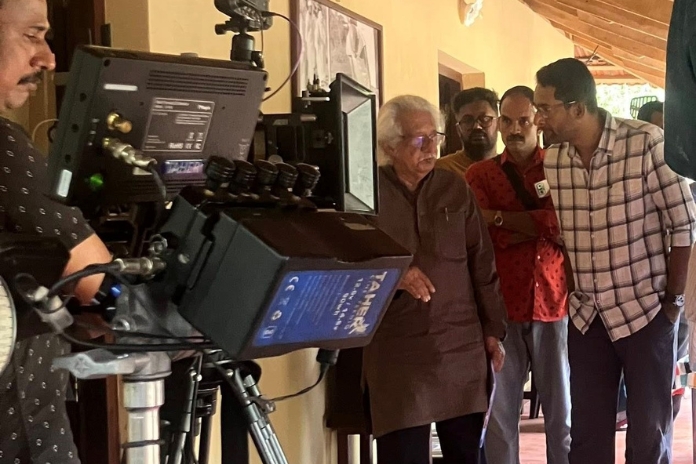
TIFF 2026 has shunned Adoor Gopalakrishnan’s Padayaatra, produced by and starring megastar Mammootty. The loss might not be the iconic director’s, not entirely at any rate
By Saibal Chatterjee
Adoor Gopalakrishnan has been making films and earning laurels for upwards of 60 years. He needs no endorsement from a film festival. So, this article is not so much about his first film in a decade not making it to the Toronto International Film Festival (TIFF) this year as about what the festival might be missing as a consequence.
TIFF 2026 has chosen to ignore his 13th narrative feature, Padayaatra. The festival no longer has the Masters strand where the Kerala auteur, one of Indian cinema’s all-time greats, was a regular since his sixth film, Mathilukal (The Walls), made the cut in 1990.
Produced by and starring Mammootty, Padayaatra, about a Gandhian doctor who opts to shift to a tribal area to work among the poor and disadvantaged, would have been a great fit for Gala Presentations especially since India has drawn a blank in TIFF’s splashiest section.
Given the huge following that Mammootty enjoys among the Malayali Diaspora, which has a sizeable representation in Toronto and beyond, selecting Adoor’s new film should have been a no-brainer.
The 86-year-old filmmaker’s achievements have been greater and more consistent than that of any living Indian director. A film that he has made after the longest creative lull of his 61-year-old career should, by all reckoning, have been a TIFF shoo-in even if, for the sake of argument, we were to accept that Padayaatra might not be in the league of his early films.
Padayaatra, which will now probably premiere at a European festival early next year, reunites Adoor with Mammootty for the first time since Vidheyan (The Servile, 1994).
Their previous collaborations were on Anantaram (Monologue, 1987) and Mathilukal (1990). Like the latter film, Vidheyan travelled to TIFF in the mid-1990s, cementing the reputation of both the director and the actor among film lovers in Toronto.
Had Padayaatra made it to Toronto, it would have been Mammootty’s third time at the festival – and a full-blown event for Indian and Malayalam cinema watchers.
Although Adoor has made only 13 fiction features, he has crafted more than 30 short films and documentaries, one of which, Kalamandalam Gopi, bowed at TIFF in 1995, the year in which he also made his eighth narrative feature, Kathapurushan (The Man of the Story).
Adoor, an unwavering perfectionist, takes his own time to develop a film. “I cannot make a film until an idea gets me really excited,” he has often told this writer over the years.
Adoor debuted with Swayamvaram (One’s Own Choice, 1972), seven years after earning a film school diploma. It took him three decades and a half to reach double figures as a director of feature-length fiction films.
Adoor’s tenth film, Naalu Pennungal (Four Women, 2007), an anthology that adapted four stories by Thakazhi Sivasankara Pillai about women from different strata of Kerala society, figured in the TIFF selection. So did his ninth, Nizhalkkuthu (Shadow Kill, 2002), the masterfully crafted moral allegory informed with pathos and restrained lyricism.
Considering that he passed out of the Film and Television Institute of India (FTII) in 1965, 13 feature films may seem like meagre returns. But assess the intrinsic, sustained quality of his body of work and it becomes abundantly clear that each of his superbly crafted Malayalam-language cinematic essays is, in terms of impact and longevity, worth five films by a lesser mortal.
The strength of Adoor’s films lies primarily in the fact that they are deeply personal yet unfailingly universal. They are illuminating chronicles of a complex, constantly evolving society.
His ability to spot and interpret the subtle nuances of societal upheavals and human foibles is nothing short of phenomenal, a fact that invests his films with the sort of emotional and intellectual depth that are completely out of bounds for lesser filmmakers.
From Swayamvaram all the way up to Pinneyum (2016), which, too, went to TIFF, in every single film that Adoor has authored has been an artistic triumph.
How many filmmakers in the world can boast an oeuvre as unwavering as Adoor’s: Swayamvaram, Kodiyettam (Ascent, 1977), Elippathayam (Rat Trap, 1981), Mukhamukham (Face to Face, 1984), Anantaram (Monologue, 1987), Mathilukal, Vidheyan, Kathapurushan (Man of the Story, 1996), Nizhalkkuthu, Naalu Pennungal, Oru Pennum Randaanum (A Climate for Crime, 2008) and Pinneyum?
The creative, social and political concerns in these films appear to be the same on the surface, but the treatment and ambience are invariably entirely new and fresh each time Adoor writes a script.
Adoor was born in 1941. Having lived through the many tectonic shifts Kerala has experienced, he deciphers every little tremor of humanity, or the lack of it, with amazing acuity.
His idiom is his very own, his images clinical and deeply resonant, the emotions controlled. A deep understanding of the human mind in general and the recent history of Kerala in particular govern his approach to narrative situations and character traits.
In most of his films – from Swayamvaram, in which a man and a woman break away from their families to begin a new life together without the sanction of marriage, to Nizhalkkutthu, where an old, infirm hangman grapples with pangs of guilt in pre-Independence Travancore to Pinneyum, which explores the repercussions of greed and criminality – socio-political realities inescapably impinge upon life and determine the nature of human striving.
His body of work is a stunning demonstration of artistic consistency. Whether it is the linear Kodiyettam (The Ascent), the poetic Elippathayam (The Rat Trap), the trenchant Mukhamukham (Face to Face), the elliptical Anantaram (Monologue) or the emotionally layered Mathilukal (The Walls), his control over the medium never wavers.
Adoor writes his own scripts, handpicks his actors and possesses a keen eye for detail both within the cinematic frame and the ideational framework of a film. He never ever plunges into a film like a quick-fix artist; he always ambles into it with the gentility and focus of a consummate craftsman, chiselling away with utmost patience.
The translucence of Adoor’s magnificent films stem from their pure core, a core that embraces and internalizes without compromise the nuances of life, the workings of the human mind and heart, and the dynamics of society.
Padayaatra might have been shunned by TIFF, a festival that hosted him six times in the past. But Adoor and a film of his have never failed to find their place in the world.
Highlights

Shahid’s Kabir Singh Becomes Top-Grossing Film of 2019

TIFF Reveals Plans for Industry Conference

Films by Shekhar Kapur and Shubham Yogi Selected for Toronto Gala

A Selection to Die for

Le Musk: A Brave New Frontier in Cinema

The Path finder: Jyoti Deshpande

Toonz to Honour Aabid Surti, Biren Ghose at Animation Masters Summit

India is the Country of Honour at Cannes

RAVINDRA VELHAL: DRIVING MEDIA TRANSFORMATION

THE PATH FINDER: JYOTI DESHPANDE

INTO THE WORLD OF RRR

Powerkids Appoints Manoj Mishra as CEO

Toonz Join Tunche Films to Co-Produce Spanish-Peruvian Animation Feature Kayara

National Museum of Indian Cinema Hosts Vintage Vehicles

I&B Secretary promises Govt’s Support to Film industry

Tom Cruise’s ‘Top Gun: Maverick’ to Blaze at Cannes

Illumination’s Minions: The Rise of Gru is the Annecy Festival Opener

Now, Shoot at Sight in India!

Lata Mangeshkar, India’s Singing Goddess

Quantum Image Making Has Arrived

Indian Films To Look Out For In 2022

2022: Centenary of Indian Cinema Legends

Singing Legend Lata Mangeshkar, Nightangale of India, Dies at 92

Bhushan Kumar’s T-Series Ventures Into OTT Content Creation Space