The AI Layer Has Entered the Budget Sheet
By Pickle September 7, 2026
Share:


By Pickle News Network
Brad Pitt did not defend artificial intelligence. He defended the mid-budget movie.
“There’s a lot of pushback against AI, but AI is going to be the very thing that, if used as a tool, is going to help these mid-budget films, $40 to $90 million-budgeted films, get made,” Brad Pitt told Esquire. He was more guarded about synthetic performance, noting that a machine could imitate his choices but that “the final product might not be my choices.”
That distinction — AI as production infrastructure rather than AI as talent — is now the industry’s real fault line. And it is where the money is moving.
The cost curve, not the culture war
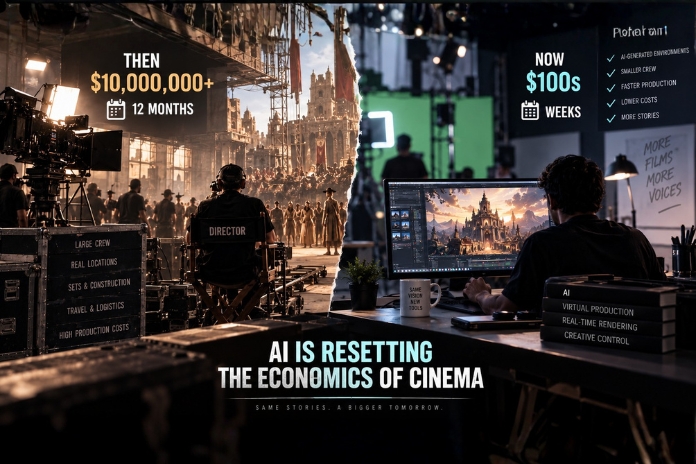
The numbers arriving from working productions are unusually consistent. George Strompolos, chief executive of the Google- and Disney-backed AI studio Promise, estimates that hybrid films combining live actors with AI-generated environments run 20% to 50% cheaper than conventional shoots, while Obsidian executive producer D Ryan Reeb puts his own savings at 30% to 40%, according to The Guardian. Netflix has said AI was used on 300 of its 1,000 titles in 2026. Ron Howard is preparing an AI-enabled animated documentary. Promise shot its horror feature Touch Grass with one actor, a handheld camera and white sheets hung around an office, with Chinese model Seedance 2.5 generating a swaying meadow live on the director’s monitor.
The resistance is equally organised. Christopher Nolan has called the technology “so completely rejected by the public.” Guillermo del Toro insists there is “absolutely no goddamn AI” in his Pan’s Labyrinth re-release. Emily Blunt’s response to AI performers was blunter: “Please stop taking away our human connection.”
India skipped the debate
While US guild contracts constrain digital replicas and creative decision-making, India has gone straight to deployment — “at a scale unseen elsewhere,” Reuters reported after visiting two AI studios and interviewing 25 executives.
The pressure is structural. Indian admissions fell from 1.03 billion in 2019 to 832 million in 2025 even as box office hit a record $1.4 billion, and streaming has squeezed budgets across the middle of the market. EY estimates AI could lift Indian media and entertainment revenue 10% and cut costs 15% over the medium term.
So the tools went where the margins are thinnest. Rahul Regulapati, who runs Collective Artists Network’s Galleri5 AI studio in Bengaluru, says mythology and fantasy production now costs a fifth of traditional filmmaking and takes a quarter of the time. JioStar, the Reliance–Disney venture, ran a 100-episode AI-generated Mahabharat that drew 6.5 million views on launch day, 2.1 times its platform average, per CNBC. Abundantia Entertainment has put $11 million into an AI studio and expects AI-assisted work to be a third of revenue within three years. Eros Media World re-released Raanjhanaa with an AI-altered ending — and got a public rebuke from its star Dhanush, who said the recut “stripped the film of its very soul.”
The startups underneath
The layer beneath the studios is where Indian firms are building. Bengaluru’s NeuralGarage rebuilds mouth and jaw movement so dubbed performances stop looking dubbed, work now used on Yash Raj Films titles including the Telugu War 2. Koovis is selling screenplay-to-rough-cut previsualisation with Telugu text-to-speech. Stoira is pitching script-to-storyboard in minutes. Working creators cycle through Seedance, MiniMax, Kling, Midjourney, Adobe Firefly, Google’s Flow and Higgsfield, which is popular precisely because it aggregates the rest.
The results scale down as well as up. FirstAI Consultancy shot human actors, then generated animated characters from their expressions — a job that would have cost millions and taken a year, delivered for a few hundred dollars in weeks. AI artist Prasad Gori, who three years ago chased production houses for work, now fields 10 to 15 offers a week.
That is the changing phase of cinema. Not machines replacing directors, but a compression layer wedged between the script and the shoot — and, for the first time, a route to market for filmmakers who never had one.
Highlights

Sai Pallavi: Natural Beauty is a Natural Actor Too

TIFF Reveals Plans for Industry Conference

Films by Shekhar Kapur and Shubham Yogi Selected for Toronto Gala

A Selection to Die for

Le Musk: A Brave New Frontier in Cinema

The Path finder: Jyoti Deshpande

Toonz to Honour Aabid Surti, Biren Ghose at Animation Masters Summit

India is the Country of Honour at Cannes

RAVINDRA VELHAL: DRIVING MEDIA TRANSFORMATION

THE PATH FINDER: JYOTI DESHPANDE

INTO THE WORLD OF RRR

Powerkids Appoints Manoj Mishra as CEO

Toonz Join Tunche Films to Co-Produce Spanish-Peruvian Animation Feature Kayara

National Museum of Indian Cinema Hosts Vintage Vehicles

I&B Secretary promises Govt’s Support to Film industry

Tom Cruise’s ‘Top Gun: Maverick’ to Blaze at Cannes

Illumination’s Minions: The Rise of Gru is the Annecy Festival Opener

Now, Shoot at Sight in India!

Lata Mangeshkar, India’s Singing Goddess

Quantum Image Making Has Arrived

Indian Films To Look Out For In 2022

2022: Centenary of Indian Cinema Legends

Singing Legend Lata Mangeshkar, Nightangale of India, Dies at 92

Bhushan Kumar’s T-Series Ventures Into OTT Content Creation Space