40 years on, John Abraham endures
By Pickle May 10, 2026
Share:


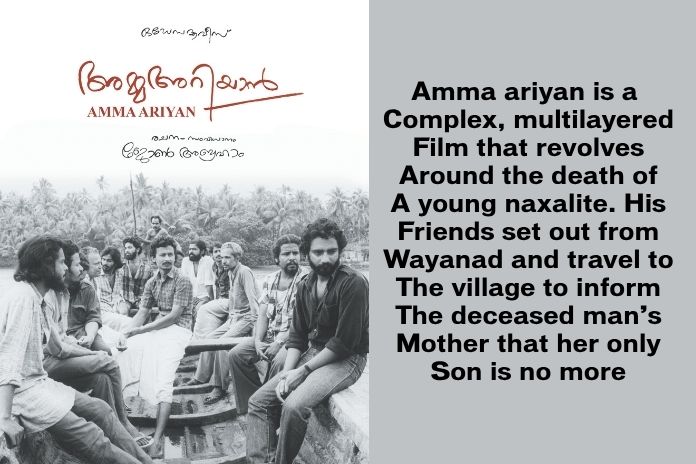
Nearly four decades after his untimely death, John Abraham, the creative force behind India’s first crowd-funded film, Amma Ariyan, continues to be the patron saint of all lone rangers of cinema on the subcontinent. The seminal film resurfaces at the 79th Cannes Film Festival in in a restored 4K avatar
John Abraham passed away less than six months after the release of his fourth and final film Amma Ariyan (Report to Mother). He fell from a rooftop after a party in Kozhikode. Taken to a hospital, he went unrecognized, due medical attention was inordinately delayed, and he died a day later due to a rapid aggravation of his condition.
Abraham was just shy of 50 on the day of his demise – May 31, 1987. Thirty-nine years on, the rebel-filmmaker continues to be a lodestar that shines bright and lights the path of every independent filmmaker in India. recalls with awe and reverence.
The awe and reverence that he evokes is second to none. He was the prime mover behind the Odessa Collective, a people’s cinema movement that came into existence in the mid-1980s and birthed Amma Ariyan, India’s first crowd-funded film.
Cannes Classics was introduced in 2004. India was represented that year by Mother India. Since then, ten other Indian masterworks have been screened as part of the section. Amma Ariyan is the twelfth. It has been restored under the aegis of Film Heritage Foundation (FHF) at L’Immagine Ritrovata laboratory in Bologna, Digital Film Restore Pvt. Ltd India and Pixel Film Restore India in association with Odessa Collective.
The film’s editor Bina Paul and cinematographer Venu pitched in with their expertise in the course of the restoration process. The 4K restoration was done with one of the film’s two surviving prints: a first generation 35 print preserved at the National Film Archives of India.
Amma Ariyan will be screened in Salle Bunuel in Cannes on May 16 in the presence of lead actor Joy Mathew, Bina Paul and Venu, besides Shivendra Singh Dungarpur, Director, FHF.
Says Dungarpur: “This is our fifth consecutive year at Cannes with a restored film. This year, we’ve brought back a rare gem that was in danger of being lost. With no original camera negative and only a single surviving un-subtitled print, the restoration was particularly challenging.”
Madhav Reddy, CEO, Digital Film Restore and Pixel Film Restore India Ltd., a division of Rotomaker LLC Hollywood states, “Having carried out restoration work on over 5,000 films for all major Hollywood studios, we bring the same rigour, precision and commitment to every project we undertake, regardless of its scale or origin. Working on ‘Amma Ariyan’ has been a deeply meaningful experience”
There can be no denying that the impact that John Abraham had on a whole generation of young Indian film students is beyond measure. How Abraham went about raising money for Amma Ariyan has been part of Indian cinema folklore ever since he pulled off the then seemingly impossible feat.
He travelled from village to village, beating a drum to draw the attention and people, and sought donations from the general public. Besides, he organized screenings of Charlie Chaplin’s The Kid and Anand Patwardhan’s documentary Hamara Shahar (Bombay Our City, 1985) as part of his fund-raising drive. His friends, too, contributed their mite in getting Amma Ariyan off the ground.
Amma Ariyan is a complex, multilayered film that revolves around the death of a young Naxalite. His friends set out from Wayanad and travel to the village to inform the deceased man’s mother that her only son is no more.

It was screened all across Kerala on a completely non-commercial basis, in pursuance of Abraham’s philosophy that cinema should be for people and not for profit.
Although this unprecedented experiment aimed at freeing film production and distribution from market forces proved to be an inspiration for many, it did not have a lasting impact on the way Indian films are made and exhibited.
Yet, Abraham remains a beacon for all those who believe that the medium needs to be liberated from industrial norms and that there is more to this medium than just entertainment.
Abraham learnt the ropes at the Film and Television Institute of India (FTII), Pune. Among his teaches was the legendary Ritwik Ghatak, from whom he imbibed a rebellious spirit. He was guided by the firm belief that rules, especially those set by others, did not matter one bit.
After serving as an assistant to another Ghatak acolyte, Mani Kaul, during the making of Uski Roti (1969), he branched out on his and debuted as a director with Vidhyaarthikale Ithile Ithile (This Way, Students, 1972).
But it wasn’t until five years later, when he made the Tamil-language, Agraharathil Kazhuthai (A Donkey in a Brahmin Village,1977), that he achieved fame and acclaim. The film is regarded as a peerless classic.
Ghatak, the filmmaker and mentor that he looked up to, died ten years before Amma Ariyan saw light of day. Abraham’s tribute to Ghatak was characteristically robust: “I know that you are no more/But I am alive for you/Believe me, when the seventh seal is opened/I will use my camera as my gun/and I am sure the echo of the sound will reverberate in your bones/and feed back to me for my inspiration”.
Agraharathil Kazhuthai ruffled feathers in a way that Ghatak would have loved. The hard-hitting satire on Brahminical conservatism feteched Abraham a National Award, but the Tamil film was denied a scheduled telecast on Doordarshan. An influential lobby in Tamil Nadu advocated a ban on the film. The film has stayed in their crosshairs ever since.
It is easy to see why. A donkey strays into a village dominated by Brahmins. A professor decides to keep the animal. He appoints a mute girl to look after the donkey. The entire village turns against the donkey and its caretaker. When the girl’s stillborn baby is deposited outside a temple, the donkey is blamed and is killed. Miracles begin to occur in the village.
The villagers, believing that the donkey is responsible for the miracles, begin worshipping the carcass. They then organize the donkey’s funeral and burn it. The fire spreads and engulfs the entire village. Only the professor and the mute girl survive.
Abraham’s third venture, Cheriyachante Kroorakruthyangal (Cruelties of Cheriyachan, 1979, Malayalam), added another chapter to the legend of John Abraham.
John was not a proponent of neo-realism. His style was very individualistic and his shots were unpredictable. At many times, he used fantasy and non-linear narration. He believed that cinema is language with its own logic and rhythm and, therefore, in terms of form and structure it should be far removed from literature.
That, however, did not mean that his cinema was solely for cinema’s sake. Far from it. For John Abraham, film was a tool of resistance, a weapon to be used to shake up the world. In Cannes this year, the celebration of his cinema could serve the purpose of reminding those who still care to pay heed that the medium is not living up to its true potential in his country and elsewhere.
Highlights

TIFF Reveals Plans for Industry Conference

Films by Shekhar Kapur and Shubham Yogi Selected for Toronto Gala

A Selection to Die for

Le Musk: A Brave New Frontier in Cinema

The Path finder: Jyoti Deshpande

Toonz to Honour Aabid Surti, Biren Ghose at Animation Masters Summit

India is the Country of Honour at Cannes

RAVINDRA VELHAL: DRIVING MEDIA TRANSFORMATION

THE PATH FINDER: JYOTI DESHPANDE

INTO THE WORLD OF RRR

Powerkids Appoints Manoj Mishra as CEO

Toonz Join Tunche Films to Co-Produce Spanish-Peruvian Animation Feature Kayara

National Museum of Indian Cinema Hosts Vintage Vehicles

I&B Secretary promises Govt’s Support to Film industry

Tom Cruise’s ‘Top Gun: Maverick’ to Blaze at Cannes

Illumination’s Minions: The Rise of Gru is the Annecy Festival Opener

Now, Shoot at Sight in India!

Lata Mangeshkar, India’s Singing Goddess

Quantum Image Making Has Arrived

Indian Films To Look Out For In 2022

2022: Centenary of Indian Cinema Legends

Singing Legend Lata Mangeshkar, Nightangale of India, Dies at 92

Bhushan Kumar’s T-Series Ventures Into OTT Content Creation Space

What’s India Looking for at European Film Market