The Power of Policy Dialogue
By Pickle September 27, 2026
Share:


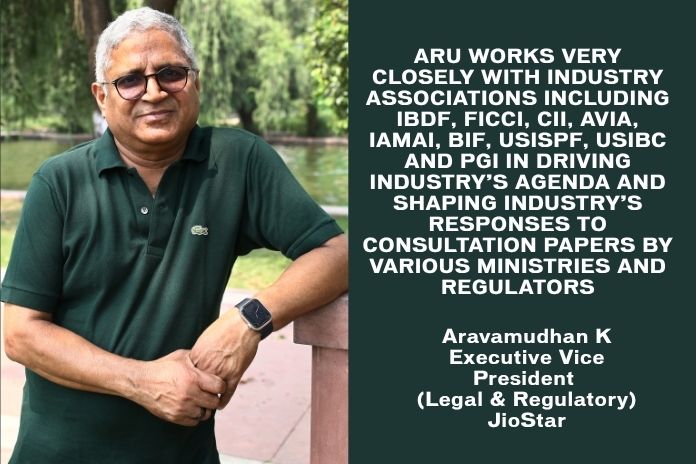
Drawing on two decades in media policy, K Aravamudhan, Executive Vice President (Legal & Regulatory) JioStar India Pvt Ltd makes the case for regulatory reform that enables investment and innovation
Take us through your first few years’ in media policy and regulation to where we are now. How has this profession shaped (you) in the media and entertainment industry?
I started my journey at a time when the uplinking and downlinking was first introduced in 2005, so my early years were very much about understanding television, regulation and the relationship between broadcasters and government.
As the industry evolved, my role evolved with it—from dealing primarily with broadcasting policy to navigating the much wider and more complex world of digital, OTT and emerging media.
What the profession has really taught me is the value of listening, building relationships and trust and finding common ground amongst stakeholders. In media policy, you may not always agree, but keeping the dialogue open and constructive is what ultimately makes a difference.
You have witnessed the Indian media industry evolve from predominantly television to a multi-platform ecosystem. How has that changed public policy thought leadership?
When I started, my main focus was largely on linear television. However as Star India grew into a significant player in the Indian M&E landscape, my role in the Regulatory team also expanded to handle sports, movies, OTT and technology.
For me, that has meant moving from simply understanding regulation to anticipating where the industry is headed.
It has made my role more about learning, listening, connecting the dots and helping build a policy environment that keeps pace with change by facilitating engagement at all levels using available tools like media and industry associations.
From your work on television and OTT self-regulation, what makes an industry-led system credible to government and viewers? Where should it be strengthened?
I believe self-regulation works best when it is credible, transparent and accountable. For government, it should demonstrate that the industry can set clear standards and address genuine concerns effectively; for viewers, there must be an accessible and responsive mechanism for grievance redressal.
The focus now should be on strengthening these processes, improving transparency and consistency, and ensuring that self-regulation keeps pace with the rapidly evolving television and OTT ecosystem.
What has been the single biggest transformation you have witnessed in the M&E sector in 20+ years?
For me, the biggest transformation has been seeing broadcasting become a much more structured and professional ecosystem. The Ministry of Information & Broadcasting (MIB) believes in ease of doing business at all levels. I have personally witnessed the evolution of BCCC (the self-regulatory body for general entertainment content on television), the establishment of the industry-led self-regulatory mechanism for OTT under the IT Rules 2021, the emergence of BARC as an audience measurement system – although there is a temporary setback at the moment, and the implementation of Digital Addressable System (DAS) transformed the Indian linear broadcasting sector.
You have worked through several major regulatory debates—from tariff regulation and television ratings to the Broadcast Services Regulation Bill and digital regulation. What have these taught you about policymaking in India?
These debates have taught me that regulation must evolve with the industry. I believe the current tariff and price-regulation framework has run its course, and it is time to explore a forbearance-based model that gives broadcasters and DPOs greater flexibility and reduces regulatory burden.
Which regulatory reform do you believe had the greatest impact on broadcasting?
Given the challenges facing linear broadcasting and its dependence on advertising, while competing with digital platforms, I believe the Government’s decision to relax the 10+2 advertising cap is an important timely relief which allows advertisers to come back to the linear broadcasting space. It provides much-needed flexibility and relief to broadcasters. The steps taken by MIB on this front are certainly welcome.

You have had the best of deliberations with various Ministries, regulators and industry associations. How has the government’s approach to the media industry and regulations changed over these two decades?
I think the Government today recognises M&E as an important economic and soft-power sector, with a clear ambition to position India as a global hub for content creation. Given our rich storytelling heritage and vast talent pool, the focus should now be on enabling policies, simpler regulation and greater ease of doing business to unlock the potential of the Indian M&E sector.
Which policy intervention are you most proud of?
Having worked closely with Mr Uday Shankar on policy and regulatory matters for nearly two decades, I feel happy looking back at how the sector has evolved. The progressive uplinking and downlinking guidelines, ease of doing business, BCCC as a model for self-regulatory body for the broadcasting industry, BARC’s industry-led audience measurement, DAS, the decision not to auction satellite spectrum, the authorisation regime for foreign satellites and removal of the bit-rate cap on transponders have all been important, path-breaking steps for the broadcasting sector.
How will AI change media policy, regulation and government affairs? How do we navigate AI in regulation and policy outlook?
I would look at AI primarily as an opportunity for India’s M&E sector. As Mr Uday Shankar often emphasises, AI can help make Indian media more competitive globally and unlock new possibilities in content creation and distribution. From a policy perspective, the challenge is to enable innovation while addressing legitimate concerns around copyright, creators and responsible use. The regulatory approach should ideally remain enabling and flexible for different technologies.
When television, streaming and social video compete for the same viewer, should a level playing field mean extending broadcast rules to digital or remove outdated restrictions on television?
I don’t think a “level playing field” is the right lens, because broadcasting is essentially push content, while digital and social media are largely pull content. They operate on fundamentally different models, so identical regulation is neither practical nor necessarily appropriate. The focus should be on proportionate, fit-for-purpose regulation.
What according to you are the three media-policy reforms over the next two years, which would you prioritise, and what measurable difference should those reforms make to M&E growth?
I would prioritise three things: simplifying the regulatory framework, moving towards greater tariff forbearance, and creating a more enabling framework for emerging technologies such as AI and satellite services. The objective should be simple—less regulatory friction, greater investment and innovation, and stronger competitiveness for Indian M&E globally. The measurable outcome should be faster approvals, lower compliance costs, increased investment and sustained growth in the sector.
Lastly, What are the skills that the next generation of media policy professionals will need? What advice would you give a young professional entering government affairs today?
Government affairs is not a profession you learn through degrees or doctorates alone. It is built through patience, engagement and trust. My advice to young professionals is to keep learning, stay ahead of developments in the M&E sector, understand policy and regulation deeply, and build genuine relationships with policymakers, regulators and stakeholders. Ultimately, the engagement should be based on mutual respect and mutual benefit—not simply advocacy.
Highlights

Embracing Cinema Through Screens of all Sizes

TIFF Reveals Plans for Industry Conference

Films by Shekhar Kapur and Shubham Yogi Selected for Toronto Gala

A Selection to Die for

Le Musk: A Brave New Frontier in Cinema

The Path finder: Jyoti Deshpande

Toonz to Honour Aabid Surti, Biren Ghose at Animation Masters Summit

India is the Country of Honour at Cannes

RAVINDRA VELHAL: DRIVING MEDIA TRANSFORMATION

THE PATH FINDER: JYOTI DESHPANDE

INTO THE WORLD OF RRR

Powerkids Appoints Manoj Mishra as CEO

Toonz Join Tunche Films to Co-Produce Spanish-Peruvian Animation Feature Kayara

National Museum of Indian Cinema Hosts Vintage Vehicles

I&B Secretary promises Govt’s Support to Film industry

Tom Cruise’s ‘Top Gun: Maverick’ to Blaze at Cannes

Illumination’s Minions: The Rise of Gru is the Annecy Festival Opener

Now, Shoot at Sight in India!

Lata Mangeshkar, India’s Singing Goddess

Quantum Image Making Has Arrived

Indian Films To Look Out For In 2022

2022: Centenary of Indian Cinema Legends

Singing Legend Lata Mangeshkar, Nightangale of India, Dies at 92

Bhushan Kumar’s T-Series Ventures Into OTT Content Creation Space